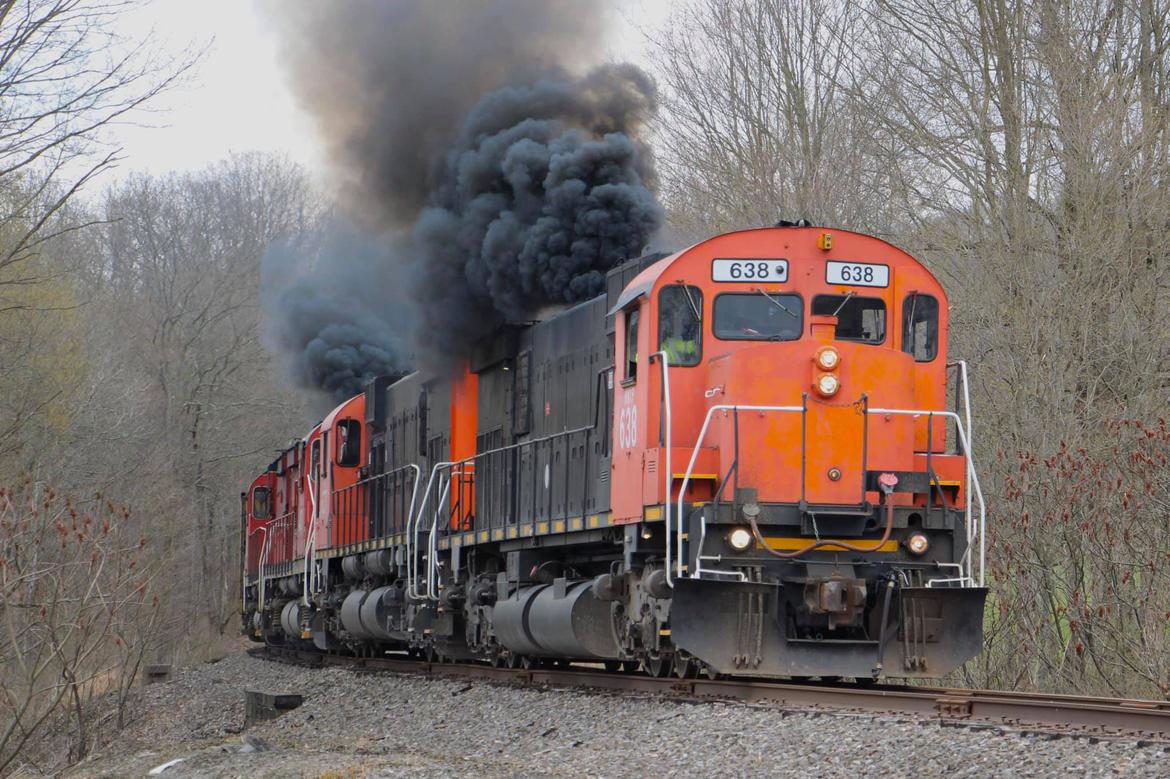
Maybe this is a stupid question, but why do old ALCOs have the leaky oil seals, which causes the oil to get into the exhaust and combust, creating that smoke, if I remember correctly. If this is indeed correct, why is this? As far as I am aware, EMD and GE do not have this problem, although maybe this shoddy build construction is why EMD and GE are still in business and ALCO isn’t but I don’t know.
The story I have heard is the excess oil collects in the turbocharger at idle - when the engine leaves the idle condition and starts ‘working’ and things heat up and the oil turns to smoke.
Alco smoke is not related to things like EMD startup smoke, where oil and fuel accumulate in the manifolds and blow out as exhaust mass flow and temperature increase, or to GE smoke where bad injectors or turbo seals put excessive fuel or lube oil in hot exhaust.
The problem is that their excitation is set up to load the engine before its turbocharger catches up with commanded/governed fueling. You will see in your reading almost every expedient to spool the turbo up except the right ones.
No. The point about the 251 is that it is efficient and smokeless once the turbo boost catches up with the engine load. Towbiats soend almost all their time at relatively constant load and rpm.
You may see considerable smoke if the boat is maneuvering or making up a tow – comparable to the fun smoke show you might get if trying to flat-switch quickly. But I have yet to see any boat on the Mississippi with that characteristic Alco sound produce any visible smoke at all.
As a kid we took a family vacation to New Orleans. We too the tour boat to see the sights along the New Orleans waterfront. We are out in the middle of Big Muddy and damn! there has to be a train coming up the river. Tow boat powered by EMD 567’s.
You were not in the right place. The EL U34CHs (greatest of all honorary steam locomotives) ran at 725 governed rpm when furnishing HEP to one of their lightweight trains. Watch at South Hackensack, at the McDonald’s just south of River Edge Road, where the power came to a stop. At notchup most of the work ‘accelerating’ the rotating mass was already done, so what you heard was fast exhaust getting far deeper and throatier while a long laminar orange-red glow stretched up out of the stack. By the time the end of the train reached you it was already doing 40 or so mph and still accelerating hard, while the exhaust beat was that of a poppet-valve engine like Duke of Gloucester, not a typical diesel roar. And even after the cab front had flirted off to the side, a couple of miles down, you could still hear the reverberation of that exhaust beat as the engine went through cuts or past buildings.
And we were treated to this show multiple times a night from the early '70s for over two decades!
Ah, ok. For some reason I in error assumed the P42 (whole Genesis line? P42, P40, P32ACDM, and I think that’s all but I may have forgotten one) had some other engine but I was wrong, woops. (Side note, when I googled how many locomotive models had some variation of the FDL, it didn’t give me a number of models but it said " Universal Series (1959–1977):
U25B: 478 built, all with 7FDL‑16 variants
U28B: 148 built, all with 7FDL‑16 variants
U30: 1,000+ built, with multiple 7FDL‑16 subseries (C, D, E, F, G, H)
U33: 1,000+ built, with multiple 7FDL‑16 subseries.
U34: 1,000+ built, with 7FDL‑16F variants
U36: 1,000+ built, with 7FDL‑16F and 7FDL‑16H variants
Dash 8A, Dash 8B, Dash 8C, Dash 8D, Dash 8E, Dash 8F, Dash 8G — all with 7FDL‑16 variants.
Dash 9 Series (1993–2004):
Dash 9A, Dash 9B, Dash 9C, Dash 9D, Dash 9E, Dash 9F — all with 7FDL‑16 variants.
AC Series (1994–2004):
AC4400CW, AC4400CWi, AC4400CWii — all with 7FDL‑16 variants."
Although, I’ve never heard of a “Dash 8D” or anything like an “A” or beyond the “C”; Didn’t this nomenclature start and end with the Dash 7? And I say anything beyond the “C” because of the B-B trucked Dash 8s and the C-C trucked Dash 8s, so I don’t know. Same exact thing I though with the Dash 9 or is it AI screwing things up again? Anyways, it estimates that 20,000+ individual locomotives total were built with the FDL or some variation of it. Really didn’t realize it was that much…
U34CH…keeping the engine speed ahead of the load is the trick for minimizing smoke. GE had some others… 1-5-8 speed schedule. “Skip 3, double 6” speed schedule.
Having the engine do some HEP work also helps get you up the loading curve.
But, you simply can’t beat an EMD getting off the line…
I’m pretty sure that a number of U28C locomotives were built. In the early 70’s, some form of UxxC would be hauling the BN coal trains from Colstrip. I remember the distinct chugging sounds of the GE’s when accelerating east of Miles City, along with feeling the ground shake as the locomotives passed by on the then jointed rail.
So were they not actually used as passenger locomotives because they didn’t work well for their intended purpose or were there other outside influences on them not really being used this way?
I have never read an account of the contemporary GE cowls that had anything good to say about them in passenger service. I’m sure that Santa Fe worked them reasonably hard.
The ‘correct’ thing would have been a GE equivalent of a C636P or the FP45s – a cowl U36C with better trucks. Probably not too much better in the end, though…