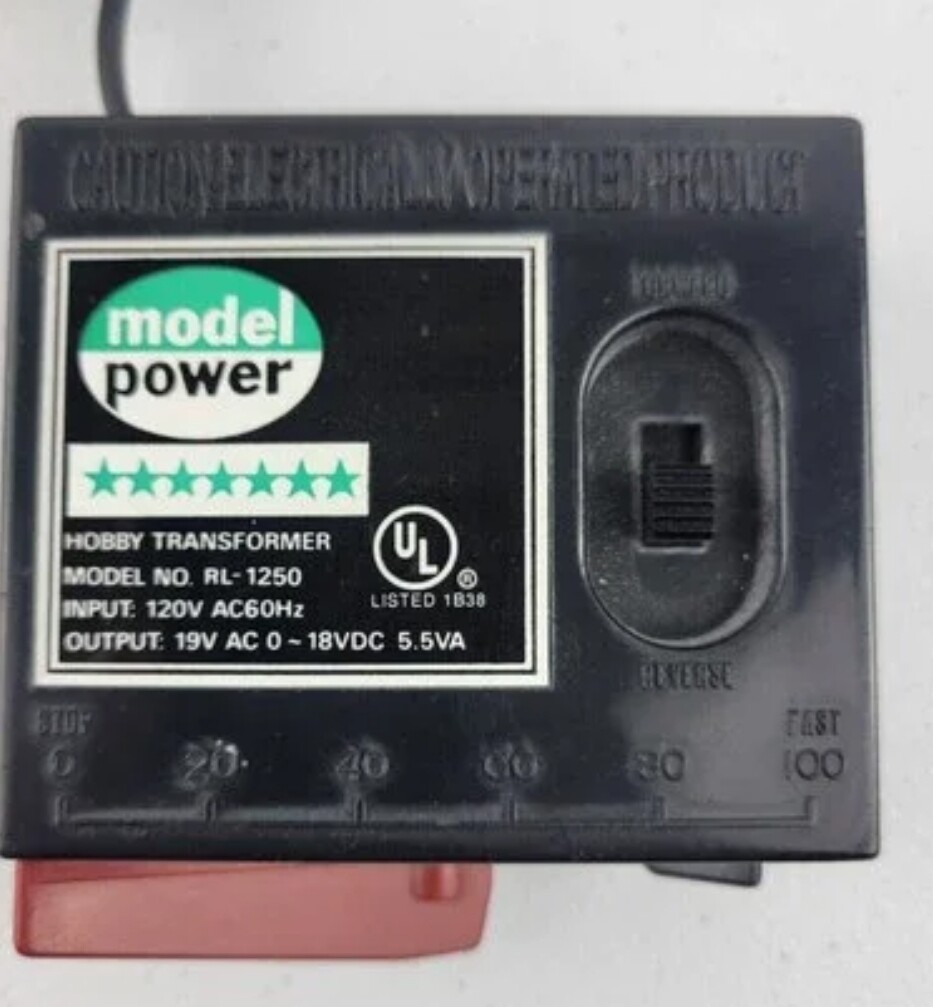
I have one HO model train controller “modelpower RL1250”. I do not know the year of make. It made in Hong Kong. Output is 18 Volt and 5.5 Watts. It has a red colored lever on one side. The lever can be moved in the increments of 20s i.e., 20, 40, 60, 80 and 100 full. If I check voltage with multimeter by selecting DC it shows 16V on all positions. If I select AC or frequency Hz it does not show anything. If I connect a load then it measures different Voltage and frequency at different positions. My questions are:-
Is the controller PWM?
Why does it not measure voltage when load is not connected?
I have three HO Locos.
The first one is an old analogue HO F9 Santa fee. I got it about 38 years ago alongwith the three freight cars one tanker and a caboos. I kept it packed till recently. I do not know which model company manufactured. Nothing is written on it and no packing box. On the feul tank, it is written “Made in Macao”. The two axle rrear truck four rubber traction wheels with tires (may be some European manufacturer). The two axle front truck has pickups. The rear truck has, before backwards and horizontally disposed, Mabuchi three pole carbon brushed rounded 24x27 mm motor (likely to be R370) with a worm gear on the multiple spur gears of the trucks. I polished commutator of the motor and the pickup wheels, oiled and greased the motor, and gears.
The second is a new analogue Atlas (Rocco Austria) HO GP 38 from eBay. There are no electronics in it.
The third is also a new analogue HO BR 218 Diesellok Epoch VI made by Piko. It has some resistors, capacitors, and inductors attached to the motor without a printed circuit board.
I connected all the locos separately one by one with the controller mentioned above. The following were the results:-
1). The F9 Santa Fe started at 20 mark (3-4) volts from the modelpower RL1250.
2). Piko BR 218 Diesellok noiseless smoothly at 2-3 volts.
3). Atlas GP38 makes small humming noise then started at the mark 50-60 (9-10 volts).
In short, where is the problemt? Do I need to change the motor in the Atlas GP 38 loco, Do I need a new controller, simple 12 volt PWM with 12 volt adapter?
Okay. I can’t help on everything here, but…
I wouldn’t expect the meter to show frequency or anything (correct) for AC with DC, which is supposed to be the output for the power pack. The load/voltage thing is probably caused by the rheostat, but it shouldn’t be a problem. I’m not certain by what you mean by “PWM”, but I’m guessing Pulse-Width Modulation which, to my knowledge, shouldn’t be needed for the Atlas loco, and I doubt that the power pack would have Pulse-Width Modulation. Its speed range may simply be different than the others, though it could be having some other issues. Have you made sure that it’s cleaned and lubricated? A dirty drive train can require a lot of power to the motor (think of trying to turn a rusty valve) to get going and is hard on the motor and all the mechanical components.
Is the power pack like this one: MODEL POWER HO AND N SCALE RL 1250 TRANSFORMER SPEED & DIRECTION CONTROLLER | eBay?
The controller is same as you shared the link. The piece of the track is brand new. The Atlas and piko locos are well lubricated brand new. Here is the controller.
Hi, I have three different DC controllers, they should have an DC output for sure. This will able you to go forward or reverse. I think the humming comes because of the AC voltage , so the motor cannot go forward or backwards. Also good to open your controller and check al four diodes. Hope it might put you on track to a solution.
I think you need a better powerpack if you want to run the Atlas as it is, but I also think the Atlas needs to be worked on.
If the engine is ‘humming’ you may have a bad diode in the rectifier bridge or lame filtering of the rectified DC, either of which is not uncommon. You may note that the pack is only rated 5.5 voltamperes at 18V, which does not suggest to me that it is sourcing very much current at low speed even if rectification were perfect and ripple-free… so if the Atlas is drawing excessive current for any of the prospective reasons, you’d get the symptoms you’re describing. It is my opinion that an ‘analog DC’ engine with a voltage-controlled motor that only moves at ~10V likely has mechanical problems that should be systematically identified and addressed. That the Piko engine on the same power pack starts smoothly at a quarter of that voltage makes me further think it is the Atlas that has the real issue.
I have an Atlas GP38 that I bought for $5 at a train show because it didn’t have a motor in it. I put in a $10 motor from Micro-Mark and connected the shafts with silicon tubing. It runs smooth. At that point, I added a NCE decoder and converted it to DCC.
Thanks to all my friends in the forum. I am not sure to assume if the problem was in the controller then this old F9 Santa Fe and BR 218 Piko would also not be running. Ken-Vandevoort can you give me more information about the motor regarding size, RPM, voltage, etc.
The motor is Micro-Mark’s 86529 Flat Can Motor 2430 DS 12V. I stuck it to the chassis with double sided tape. The silicon tubing is .5mm and I found it on eBay. I covered most of the shafts with the silicon tubing so it would have plenty to hold on to. Once I confirmed it was working on a length of flex track with a DC power pack, I went ahead and installed a NCE D13W decoder and programmed it on my programming track. I still need to install the headlights, but I do have the LEDs and resistors to do that.
UPDATE
I bought a 60 watt 24 V PWM (22 to 300 kHz by my multimeter) and 16 V60 Watt laptop power supply and tested. All the locos performed excellently both at slow speed and high speed. The Atlas GP38 started at 3 V and drew 200 at start to 300 mA at16 V. I think the problem was in the Model Power HOBBY TRANSFORMER 500mA only