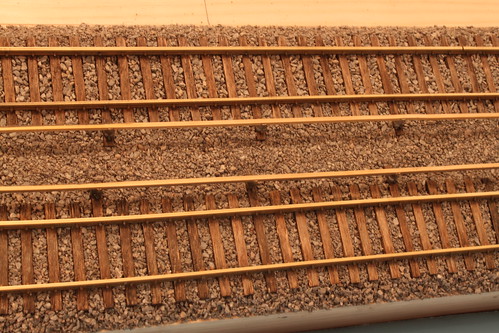
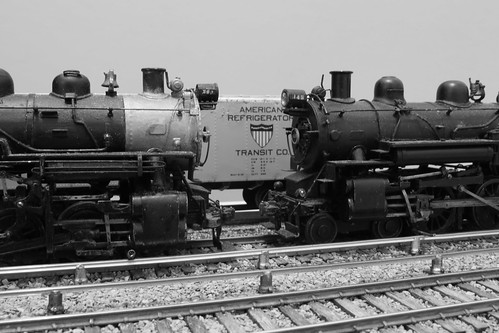
That wacko is me. Growing up in New York City during the war years, I had the opportunity to see some layouts using OUTSIDE 3rd rail. There was a lot of 3rd rail lines around NYC at the time. Model 3rd rail layouts were reliable. The pickup was a piece of coil spring sticking out from the side of the model, running on an outside rail. It eliminated reverse loops that plagued 2 rail systems.I used to visit the huge O scale layout that was in the old Hoboken terminal in new Jersey.
I haven’t been able to find any 3rd rail layouts in operation recently. Do they still exist? or have they completely disappeared. Please note: I’m not talking 3 rail tinplate, but outside 3rd rail. It was common in O scale but not used on the smaller scales. I like the idea of 3rd rail because of it’s authenticity with electric prototypes. Overhead pantograph operation also interests me. To see a GG1 running on 2 rail operation with a dummy pantograph and no catenary puts me off.
At any rate, I’ve committed myself to 3rd rail and overhead catenary on my next layout. It will be 1:8 scale with a 7-1/2" track gauge. This large a scale will make it easy to develop 3rd rail fixtures. The layout will not be a riding layout. Control will be by radio. The engines I have built so far are constructed from wood, metals and plastics. A typical model weight around 100# and is presently powered by internal storage batteries. I have plenty of room (8 acres)
Ever since the model railroad bug bit me 70 years ago, I have been mostly a scratch builder. I laid my own track with individual ties and used interlocking tower methods to control turnouts. I built my own turnouts. I guess I have a lot of patience to build rather than use snap track. My first HO layout was powered by car st
Except perhaps for those modeling the NYNH&H, or interurban/rapid transit lines, I doubt anybody is till modeling O scale with outside third rail.
I remember the late Bob Hegge used it on a part of his Crooked Mountain Lines, but that layout disappeared when Hegge died, ca. 1983. The late John Armstrong also used outside third rail for his Canandaigua Southern, which was a steam road, but I thought he converted to two rail before he passed away.
Have heard of it in both prototype and O scale, never have seen it that I know of.
Since it was mostly used for O scale, you might go over to the O scale folks at the Classic Toy Trains forums and see if any one there know of any layouts still existing.
Forgive my ignorance but I wasn’t aware that electric locomotives such as the GG1 ran on three rail track in real life. Instead, I thought they relied on overhead catenary alone.
The reason that so many of the old O scale layouts used third rail was the general unavailability of insulated driver sets in the old days. Some of the old timers just stayed with third rail because the were familiar with it, had a large investment in it, or lacked the means to convert their old locos. Bob Hegge’s third rail adventure was different. He modeled interurbans. There were a number of them that used third rail on all or part of their systems, even out in the country. The Sacramento Northern, for example, used pantographs, trolley poles, and third rail concurrently. The third rail section was eventually legislated out of existence due to safety concerns.
I have some photos I took of my models, but they are not the best quality. I’m currently involved in a carpentry job with my son, so things are a mess right now. As soon as that’s done, I wil try to get my camera to work and take some better pictures. I make my own wheels and trucks from aluminum and wood. The wheels are made from Baltic Birch plywood with a thin steel strip bonded to the tread. When painted, they don’t look like wood. They work well and will not see any heavy loads.
The practitioners of 3rd rail O scale are dying off. While there may be a few others not so well known, I think the passing of John Armstrong in 2004 marked the final end to an era long gone.
A few years back (sevend or eight!), my brother-in-law and nephew from California visited me in the Atlanta area. He asked me if there were any club layouts to visit. I checked out the internet, and we were invited to visit the Atlanta O Gauge club, which still used outside 3rd rail at the time. They allowed us to operate trains from their raised control tower, and it was quite a thrill, especially since the operator had to power up the next block as the train entered it, and de-power the block he was leaving. Quite a feat for some rookies, but it was still a thrill. As we left, I kept thinking that a more modern control system would enhance the enjoyment of the layout, and since then DCC has come of age. I even acquired a few outside 3rd rail locomotives, but have since sold them on eBay.
Ok. Sorry I missed that I was really tired last night when I read your post and was left scratching my head. Guess thats what lack of sleep does to you.
Plenty of prototype electric railroads used outside 3rd rail, either over-running or under-running, and many subway and separated-grade electric lines still do. California banned the use of exposed third-rail in 1946 after a child in Rio Linda, CA was electrocuted on the tracks of Sacramento Northern Railway’s right-of-way. SN used a mixture of third rail and wire overhead, with wire in towns and third rail in the countryside. If the train didn’t have to stop in a town, sometimes motormen would just coast from the edge of third rail through town to the beginning of the next third-rail segment in order to avoid having to stop to raise a pantograph or trolley pole, then drop it at the end of the wire.
I plan on having some non-functional exposed third rail on my HO scale model of the SN–as well as some overhead wire.