Let me start this out that I have no experience railfanning anywhere but on the East Coast, and most of that is in PA, but it seems to me that the railroads have been slow to embrace LED’s both in signals and engines. The only train engines I’ve seen with LED’s are the new Amtrak ACS 64’s. I did see a few LED’s along the NEC in CT a few months back too. However, I have yet to see a NS engine (other than step lights) or even a single grade crossing signal with LED’s.
What are you talking about? I just installed an LED bulb over the entry door to our shop.
Dost thou have been living in a cave?
Union Pacific has embraced LED’s bigtime with their signals!
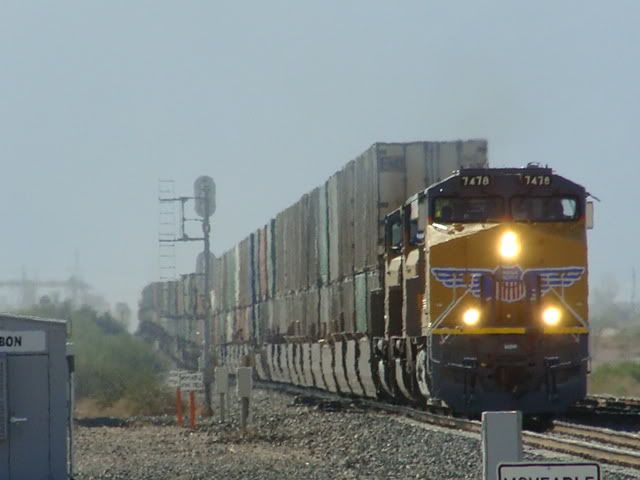
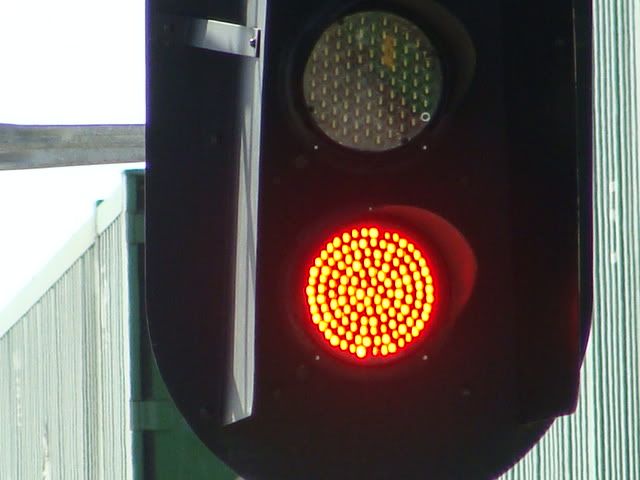
Above views from Arizona, shot July 12, 2011.
LED signals are popping up all over my neck of the woods.
I’ve seen them turning up in grade crossing signals and in several wayside signals.
You may not see many LEDs because railroad equipment (including lamps) are fairly robust and do not need frequent change-outs. Why do you expect the railroads to spend money on shiney new before they need to?
Just looking at headlights - you can’t just go out and buy an LED “bulb” for your car’s current headlights - you have to replace the entire fixture. That said, many new vehicles are coming out with LED headlights.
You may see new locomotives with LED headlights, but I doubt the far-less-expensive incadescents will be replaced wholesale unless someone can demonstrate significant savings.
Those places where LEDs can easily replace incandescents, most of which have been mentioned already, they are being replaced. Solar power may start making inroads even in locations where commercial power is available.
When we replaced the incandescent lamps in our “FREDs”, we went from hardly getting a full day out of a charged battery to being able to cut back the time they spent charging to several days a week. We can get several day’s operation out of them now.
Here is one replacement for numberboard or walkway lights.
http://www.evansgroup.net/locomotive-led-step--walkway--number-board-lights.html
There was a story recently (on Trains, 3 months or so…) about the NTSB findings that mixing LED style track side signals with conventional incandescent type caused an accident; the farther (LED) signal was showing a more permissive aspect than the nearer (non-LED) signal & caused the engineer to run through the closer signal…
Storey was from Jan. 2015
Was a NTSB Safety alert
That type of accident has happened with totally incandescent signals in the past - there are many elements involved in how individual signals are viewed from approaching trains.
For a while, green LEDs weren’t as green as one might desire - more yellowish, instead.
Nowadays, they can “dope” them pretty precisely, so green is really green, etc.
In Australia, Pacific National has replaced the headlights on their Cv40-9i units as they go through major overhaul. The fitting seems to be a standard twin unit with the sealed beams replaced by a hexagonal array slightly smaller than the old bulb and reflector.
Those LED lights are very bright and are visible from further away than the standard headlight. The ditch lights on those units are LED too, but a different pattern with fewer larger LED elements, possibly because they now flash (alternately) when the horn is sounded, a feature added along with new cab electronics and a new 7FDL-16…
EMD said that the SD70ACe-T4 uses LEDs for evereything EXCEPT the head and ditch lights. Since these are available, there might be a USA standard requiring conventional sealed beams…?
M636C
The Class 1 railroads have replaced or are replacing all the signals with LEDs.
The regional railroads would not be able to change all their signals as quickly.
There’s at least one NS engine running around with LED headlights installed. Most of the other lights on the engines (numberboard and running) are being replaced as the engines get shopped. Many of the newer RCO engines are getting amber LED beacons instead of the normal strobes.
Lanterns are LED now. Signals are still mostly incandesent yet, but LEDs are slowly being worked in. Amtrak has been more proactive in using them. Neat to see an old PRR dwarf signal with LED upgrades.
Did a Chicago Detroit trip last week, most of the signals I noted were LED. Most of the grade crossing flashers around where I live are LED. The industry, FRA, and the University of Illinois conducted a visibility/ conspicuous study of conventional vs LED grade crossing flasher study in the late 9Os. The goal was to preempt FRA from fighting LEDs in that application. Needless to say the LEDs were as good as or better than conventional.
One down fall to LED’s is the lack of heat allows snow to cover the lens. I see this problem every winter on our traffic lights.
It’s a problem for vehicle lights as well.
While the visible range may be reduced, at night it shouldn’t be a problem short of a serious blizzard of sticky snow. On a sunny day, however, it could be an issue.
Perhaps that’s one reason for the length/depth of the hoods on the “Darth Vader” signals.
I hope LED replacements are better for railroads than they have been locally for highway traffic lights. Cities in this area switched pretty quickly as soon as LEDs became available and they seemed to start failing within a couple of months. The failure was that as many as 40% of the LEDs in any one array would be dark. I suspect the whole array was replaced when it got any worse than that. I haven’t heard whether the failures have been caused by faulty LEDs or the circuitry behind them.
I have noticed, however, that newer installations seem to be much more reliable. They’re still only marginally better than incandescent when driving into the Texas sun. Even good-sized black sun shields behind the lights don’t help all that much; wise drivers approach any signal with extreme caution when driving into the sun and, with the sun at your back, assume the other fellow is not so wise.
Our local traffic department tells us that it is manufcturing defects by a certain company ( unknown ). LEDs use DC and it may be that the rectifiers do not work well. As well some company in parts pipeline may have gone bankrupt ?