Can someone please include some guides on wiring Tortoise switch machines for use on turnouts? I currently use shirt pins to prevent cars from derailing as that go along my Atlas turnouts.
I know that DPDT switches are needed anything else (besides a lot of money for the machines!). I figure to soon start switching the turnouts now that scenery, weathering and the mainline is solid. Do I need one switch per turnout? If not, how to have one machine control multiple turnouts?
For detailed info, I suggest you go to Circuitron.com. Normally, you will need one Tortoise switch machine for each turnout. However, it could be possible to control more than one if they are close together and physically linked.
A tortoise can probably control several switches. It is a motor that moves an arm. the creative part is coming up with the mechanics required to connect the moving arm to multiple switches. since every layout is different, that will have to be up to the person hooking it up and their ability to solve the mechanical issue.
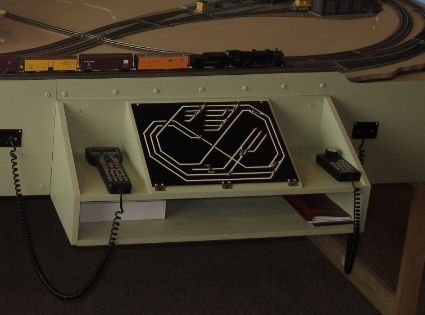
For my 20+ code 83 turnouts I used Tortoises. I built a control panel with a track diagram and a miniature DPDT at a typical turnout “Y”. All the turnouts are powered by a single walwart type 12v power supply, split to the DPDTs at barrier strips for each connection. My supply is from Circuitron and can handle 30 Tortoises. I added the nifty and cheap feature of a bi-color LED for each, which simply wires in series with the DPDT wiring to the Tortoise. I used 22awg auto stranded red/black rip cord for the wiring. Near the Tortoise, I used 5-8 pole barrier strips for easy connections, 2 for the wires from the DPDT, three needed for powering my frog from rail feeders, and three more when I added an on layout bicolor switch indicator light (I added these at mainline turnouts). Of course, you can get by with as few as two DPDT wires.
Where I have two crossovers, I used a separate Tortoise for each turnout but the two (crossover pair) are simply wired in parallel to the same DPDT so they work in unison as needed.
As an extra, you can put a red green LED in series with one lead to see where the point are. The Tortoise requires about 15 to 18 ma at 12vdc. Our club did that and used 9 vdc for a little more prototypical point speed.
Br Elias i seemed to have forgotten more than I knew about electricity in my years away from the hobby. Can you explain how the single pole reverses the polarity at the tortise? Thanks
A couple ways, 1. Two DC power supplies. Reverse polarity from one another with a common between them. SPDT selects one or the other to send to the stall motor. 2. Use AC power with a diode in opposite direction on each side of the toggle.
These are both covered in the Tortoise installation manual.
Thanks all for the digestable explanation on using the Tortoise switch machines. I forgot to ask how they would work with Atlas selector switches? Wouldn’t I need a switch to move the Tortoise arm and then use the Atlas selector to power the isolated track(s)?