At long last I have built a spray booth and equipped it with an air filter and exhaust fan to vent the fumes. So, now I am ready to paint a series of 12 Walthers Mainline passenger cars. These are brand new painted and unlettered cars.
My original intent was to paint these cars with Scalecoat II, but since it has been discontinued, I decided to choose a high quality acrylic paint. I have narrowed my search down to Tamiya and Vallejo. I am interested in your opinions and experience with each brand.
My plan is to wash the cars, then prime them, and then spray paint them with an airbrush. I do have questions about primers, thinners, and flow improvers.
I mentioned this to you before. Although neither airbrushing nor acrylic, I’ve been very happy with the Tamiya “TS” (lacquer) spray paints. It goes on thin and I’ve had zero issues with covering up fine detailing. I would expect the same with their acrylics and with using an airbrush.
Rich,
I mentioned this to you before. Although neither airbrushing nor acrylic, I’ve been very happy with the Tamiya “TS” (lacquer) spray paints. It goes on thin and I’ve had zero issues with covering up fine detailing. I would expect the same with their acrylics and with using an airbrush. I’ve only brushpainted with Vallejo.
Since the bare plastic already has a coat of aluminum paint I would skip the primer step. One process I’ve used for the ‘stainless-steel’ look is the Alclad II product and that does require a base coat ofgray but in the case of your already painted cars I would try the Alclad II directly over the Walthers paint.
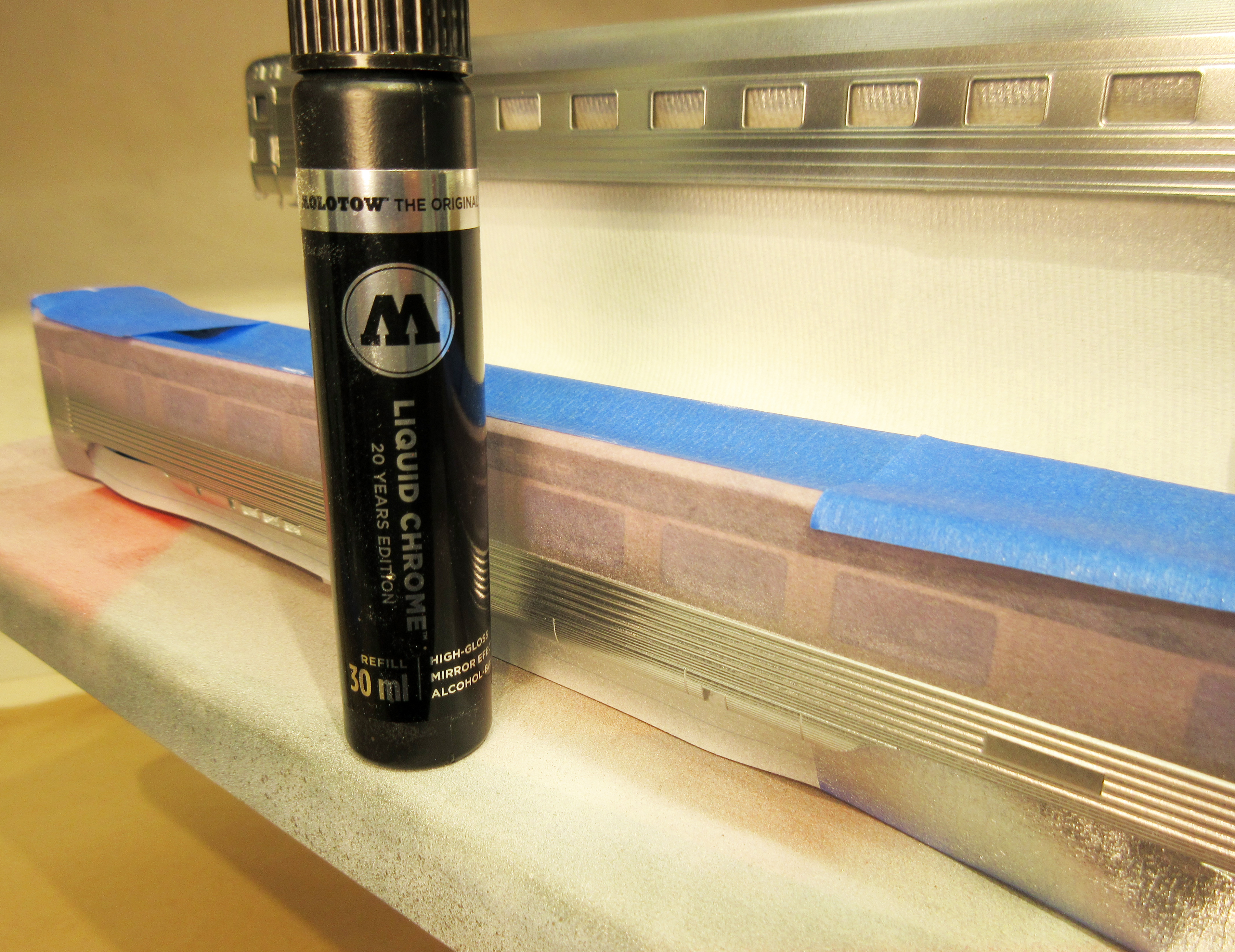
I don’t use Alclad any more since I’ve found what I consider a superior product and that’s the Molotow chrome paint. It is a little tricky to shoot just right. You have to keep the leading edge wet and the stuff dries almost instantaneously.
In the case of this brass 21 roomette car I DID use primer since I was going over bare metal. I used Tamiya rattle-can primer and the Molotow chrome over that:
My experience with Vallejo is that the paint, while it looks great, does not have very good adhesion and would not hold up well to even moderate handling of the rolling stock.
Therefore, between the two brands you mention, I’d experiment with the Tam
Kevin, thanks for that heads up on possible Scalecoat II availability. There was a point where I thought that Scalecoat II was the way to go, but once it was discontinued, I started to research acrylic spray paints and decided to go that route.
That is one of the questions that I have not resolved in my mind - - whether or not to use primer since the cars are already painted.
I should mention that I do not intend to maintain the stainless steel look. I will be repainting the cars in red/gray and black/gold.
Ed, when you say that Vallejo does not have very good adhesion and will not hold up well to even moderate handling of the rolling stock, what will happen? Will the paint flake off? Smear or smudge? Wouldn’t priming prevent those kinds of problems? Or some type of clear coat?
In researching this issue, using a primer is often recommended. Is priming only necessary if the original paint is stripped off?
Before starting this thread, I had established a preference for Vallejo, specifically Model Air, since it is formulated for airbrush use and does not require thinner. Tamiya requires thinner for airbrush use. Any thoughts on this?
Rich) Im sorry I cant give you the answer you asked for, just offering this as FYI info. You can skip this post if you want.
I dont spray primer coats because i use an underlying color sometimes to enhance the top color. So the underlying color i suppose could be construed as a primer.
Im one step behind you, no paint booth yet. I do have the air brush, compressor, and a few parts. So congrats on getting yours done - hope you get many hours out of it. Im still using rattle cans (UGH!).
To that end, I have found Tamiya to be a good substitute for the yesteryear paints. Havent tried Vallejo yet. Their availability doesnt seem to be that of Tamiya. And I can still find Testors in the same size rattle can. But Testors in a bottle for air brushing… ???. I find them, but question their newness.
Now, RustOleum owns Testors now, and I think for now they are still producing Testors. However, the spray patterns I get from the rattle cans are just aweful. Spatter, splotches, spitting, and spitooey! They make a nice paint but it goes on like oatmeal. Hard to judge this for air brushing but i think it would be a good paint.
I know youve past rattle can territory now, so im just saying I give a thumbs up to Tamiya. Vallejo, um maybe. Testors - if you can find it Id try it, atleast one.
Lastly, I wouldnt primer yet let the factory paint be your primer. Every layer of paint/primer is one layer less of detail that shows because your covering it up. I know thats super fine thinking but layers add up.
Douglas, thanks for that post. I found it interesting and thought provoking.
I already have two sets of the Walthers Santa Fe cars and two sets of F7ABBA Warbonnet consists. I bough these painted unlettered Walthers Mainline cars to simulate Monon passenger coaches. I am glad that you like them.
A Monon fan! I agree that the Red and Gray of Indiana University was the passenger scheme, but thought the Black and Gold of Purdue was the freight scheme. BTW, you need some company service cars to haul beer, whiskey and shot glasses so the online saloons can make Boilermakers.
For years I used PollyScale for structure and some rolling stock painting. For me that stuff dried like true baked enamel, it was very durable. I still have some that has adhered to some of my painting equipment (mixing stirrers and such) that the only way to remove it is with a sharp scraper.
As my supply of PollyScale began to dwindle I stocked up on my next best choice (after experimenting unsuccessfully with Badger ModelFlex) which was Vallejo.
Vallejo is excellent for brush painting. It is good for airbrushing, too (I use both Model-Air and regular line thinned using their thinner). On structures I was used to the PollyScale going right over the bare plastic after a wash to remove the mold release. It made a very durable coating that would stand up to normal handling and, indeed, if you needed to remove any paint say for a gluing surface you would have to sand it or scrape it off.
After some of my first attempts with Vallejo in the airbrush on bare plastic structures I found I could certainly achieve the look I wanted and a great choice of colors, or even mixed to my liking but the paint could easily be scraped off with my finger nail even after three days of curing.
Using Tamiya primer over the bare plastic was a big improvement but the Vallejo could still be scraped off with just a little more effort.
This is my experience anyway. Others might have some trick to make the finish bond better or perhaps using an overcoat of Dullcote or other clear finish might help.
I have very little experience shooting Tamiya, Rich. I’ve used it maybe half-dozen times and had great results with it but for whatever reason I never kept a large stock of it. Now the rattle-can Tamiya primers are handy and top quality so when it comes to primer that is my first choice. I still have a pretty good ‘stash’ of Scalecoat and that is my #1 go-to for locomotives and rolling stock.
There are dozens of ‘trial’ videos on YouTube comparing modeler’s chrome paints. The aircraft modelers especially need lots of shades and finishes of ‘bare metal’ look.
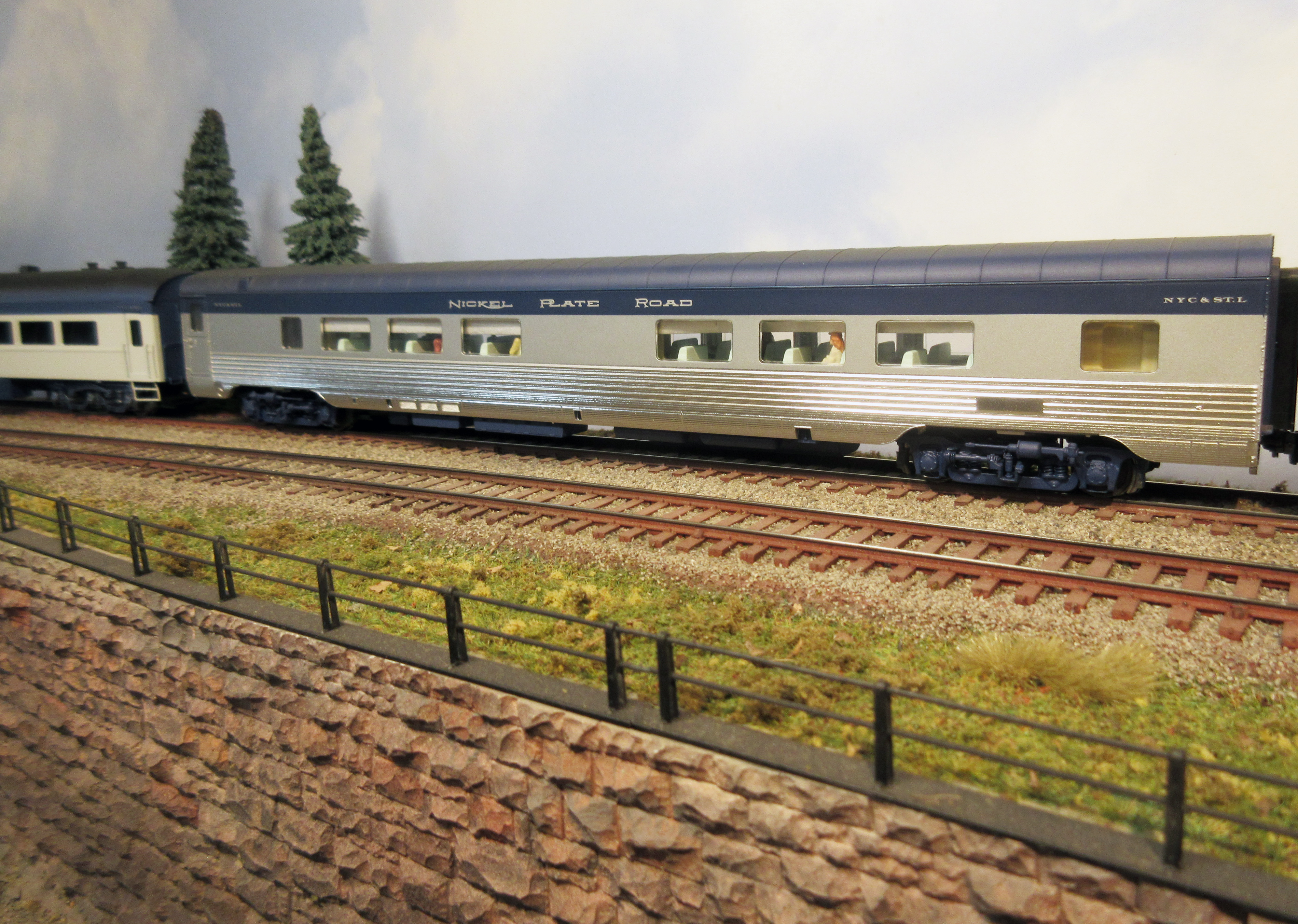
Like you, I have some passenger cars that were older Protos before Walthers offered the plated finish so my goal was to find something that replicated the stainless steel used by Budd, P-S and ACF for their fluted and sometimes, not so fluted, stainless sheathing. The example of the Nickel Plate coach is one such car. I simply masked the areas surrounding the fluted siding and shot it with either Alclad-2 or, more recently, the Molotow. Any other ‘chrome’ paint simply looked like the same stuff Walthers was using. It had no reflectivity like their later plated finish offered.
This Walthers Proto, Pennsy twin-unit diner was stripped and given the Alclad 2 process. I had great results:
I dislike the word “experiment” in this context. I want to get it right on the first try.
My initial objection to Tamiya is that it requires thinning, lots of it, for airbrushing, whereas Vallejo Model Air comes ready for airbrushing, no thinner required. But, maybe that is why Vallejo is easily scratched. Dunno.
In any event, I am now leaning strongly to Tamiya. I guess what I could do is “experiment” with both brands on some scrap plastic sheet and then test how much abuse each brand can take.