I would like the advice of creating a helix in my Man Cave layout to allow the rails of the Mountain run to lower scene of the city/farm land display area to facilitate the routes from the elevation of the Mountain routes to lower level for maximum viewing the city/farm land area. The city are will cover a 56" wide by 68" long area, the farm land will ad a section of 30" wide by 45" long. The Mountain run will enter and exit through the farm land. The track will leave the farm land 27" higher that the farm land, and arrive 17" higher… this is at least the best of my measurements to allow the rails to runt he entire route around the Man Cave and through the walls if this is the lay out I plan on taking.
As inspiration for the CR&T’s helix – I’ve purchased both “Guide to helix and staging design” PDF-downloads found at the Information Station.
You can start with volume #1 before purchasing volume #2. Upon closer examination of the two helix/PDF cover pictures – You don’t have to enter & leave the helix at just one location.
See the prototype Gallitzin Tunnels for some helix entry/exit ideas. Note how the east side portals has “sparse scenery” without a town compared to the railfanning at the west side portals. The “real estate” of the helix summit-top can be “doubled-up” for scenery, a town, or more yard-trackage – Which can be approached separately from the helix portals.
In HO, most people have found that a helix of 30" radius or larger works best with a variety of equipment. With the typical outside supports and clearances, this would result in nearly a 6 foot by 6 foot area devoted to the helix. Do you have that much space to spare?
From your description, this would probably be larger than any of your visible layout areas.
Helixes are an OK idea when you have enough space. Doesn’t seem at first glance as if you do.
Construction of a reliable helix is somewhat exacting – not a typical project for a newcomer to layout building. The way forum posters (most of whom have not built one) toss around the idea of a helix in the forum, it sounds like they just fall together. Sadly, this is not the case.
Byron
well this was smug to say the least. I guess he started building train layouts in his mothers belly.
As a fairly well-known custom layotu designer I would say he knows where he is coming from. If it were so easy to build reliable trackwork, there wouldn’t be a zillion articles on it - compound that with being on a curve and a continuous grade - no, a helix is NOT a simple project. That doesn;t mean the person contemplating it is an idiot for thinking they can do it - why is it assumed everything said about potential pitfalls of a particular endeavor is somehow some sort of personal attack ont he person contemplating it? Benchwork, wiring, trackwork - those are things I am good at. I stink at scenery. If I posted that I was goign to build a gret towering waterfall on my layout, and someone said “hey, did you think of a, b, and c” I’m not going to think they were accusing me of being a moron who couldn’t possibly pull this off, instead I’d have to think about it and probably practice before I ruined my layout.
–Randy
I’m used to thinking in terms of N Scale (not HO Scale) – Which the is only way a helix can fit into CR&T’s available space. Taking your time in planning for that more exacting element has proven invaluable – Thanks to room-prep time taken for a joint usage library/layout room.
I fact, since CR&T is traction, a way has been devised for live-powered overhead construction inside the helix! Only pain-staking planning, and N Scale, is making this doable in the available layout space.
Back to the above-mentioned helix-PDFs: Volume #1 has the “Silvergate Gate Northern” with a helix under one end of a 2-level dogbone-design layout, and: Volume #2 has the 2-level HO Scale “Union Terminal Railway” and underlying helix in a 4’x8’ space.
“cuyama’s” thoughts above are well-taken – What you end up with many times is much different than what you start with in layout planning. And, you really do have to plan ahead.
P.S.: My first exposure to Byron’s articles was in How to Build Realistic Freight Yards and his most-excellent 6-page “A baker’s dozen yard ideas for design and operation.”
Well Byron, if you don’t think I have enough space for a helix to elevate the entrance and exit of my city/farmland routes to mountain routes, then how would you bring the entrance route through the farmland at height of 69.5" down to 48"-60" city scenes and the exit up to the 74.5" through the farmland? This is the height that would allow sufficient mountain (suspended) routes to allow the track to circle the 2 car garage converted Man Cave, allowing the tracks to run over head and run through the planned walls.
What you wish to do may simply not be possible in your space within the practical limits of reliable model train construction and operation. I’m not telling you what to do or not to do, merely pointing out the realities of helixes based on experience. Best of luck.
I don’t really have a good sense of the space you are working in, as far as figuring out what is possible. But you might have heard of the “no-lix” approach which essentially treats the entire layout as one big scenicked helix. This would be an around-the-walls or shelf style layout, which seems different from the broad rectangular regions you’re describing. Still, there might be a way to build to the nolix concept; let the track loop through a scene such that part of it is hidden, like behind a backdrop. Longer runs, like a long straight mainline right behind the backdrop (maybe make the backdrop panel removable for access), might be able to gain significant elevation.
But all of this is highly speculative, without a decent plan of your man cave! Any chance you can get something drawn up?
Possibly because Robert is making the same mistake as many other people not used to communicating in a forum - they assume that just because they are only working on one project at a time, everybody else also will remember the background and context from their earlier posts.
Here is a drawing from an earlier post of his:
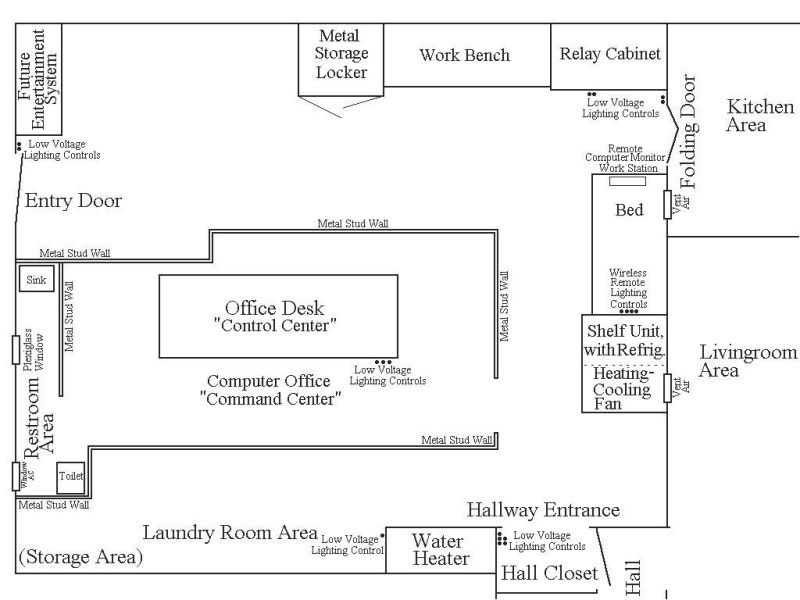
No size indications on the drawing, and Robert’s verbal descriptions of his space are rather confusing as well - he keeps refering to his scenes rather than to “top wall”, “left wall” etc.
But we know it is a former two car garage - so probably about outside dimensions o the main square is about 20 x 20 feet.
Stein
Tony Koester wrote a good book: Designing & Building Multi-desck Model Railroads (How to get more out of your space) Tony’s book covers continous grades as well as Helix designs.
If you don’t/can’t use a helix, try a continous grade upward as Tony did.
Your heights also concern me. If you don’t have a mushroom design with a elevated floor 60" 69.5" and 74.5" is a heck of a reach. Ideal layout height for an average 5’10" man is between 42"->53" from his feet.
The problems with helix are space and grade. Track head to track head between levels you need about 3.5". This is 3" for the height of a double stack + 1/2" for track + wood support structure.
1/2" for track + support = .1" (code 100 track). N cork roadbed is about .12". You’re now down the ~3/8" plywood.
I don’t advocate tacking track stright to plywood when possible. It creates too much noise. A thin layer of sound absorbing n track roadbed is recommended. Woodland scenics make some good stuff that’s sold in sheets.

This is the drawing of my present Man Cave Layout. The area to the left of the metal storage locker, is where I plan on on building my city/farmland so the city area will be right on top of the “Future Entertainment System” so it will be chest level. This is the area I had measures to indicate the city/farmland and the Mountain scene will run along the wall and start out behind the metal storage locker.
“Well Byron, if you don’t think I have enough space for a helix to elevate the entrance and exit of my city/farmland routes to mountain routes, then how would you bring the entrance route through the farmland at height of 69.5” down to 48"-60" city scenes and the exit up to the 74.5" through the farmland? This is the height that would allow sufficient mountain (suspended) routes to allow the track to circle the 2 car garage converted Man Cave, allowing the tracks to run over head and run through the planned walls."
What I was asking here is that with my intended tracks that I plan on passing over the walk way to clear the doorway by my office (near the laundry area) needs to be 72" (6’) high, and with the information I gathered on the percentage grades, the track at the wall over the “Future Entertainment Center” will measure 74.5" (6’-2.5") for the outbound track, 69.5" (5’-9.5") on the inbound track. The “Future Entertainment Center” measures 4’-3" high. What I was asking if a helix wouldn’t work, how could I bring the inbound track down to the height of 4’-3" (51"). The area I plan on using for the city section will measure 56" deep, 72" wide (from the wall next to the exit door towards the metal storage locker) and there would be a section that will butt against the metal storage locker 32" deep, 40" wide for the farmland scene.
This is what I was looking for to go from a 4’3" city land scene to the outbound track or from the inbound track.