I’m new to the hobby. Like to do things on my own, however I have no artistic ability. Is there someone who could draw me a logging layout on an 8.5 x 4.5 foot layout that has a 7 x 4 foot L extension that is 90 degrees from the base layout?
Hello All,
The first question is how much is in your planning budget, or how much can you pay for this planning?
Next, what scale and gage?
Let us know and we can help.
Hope this helps.
[#welcome] to the forum. Your intial posts are moderated so there will be delay before they appear.
Drawing and designing are two different things. There is a profession designer in the forum.
You don’t need a lot of artistic ability or money to use one of the free track planning software packages like Scarm https://www.scarm.info/index.php
You can search the Model Railroader database for logging railroads here;
http://mrr.trains.com/how-to/track-plan-database?size=&scale=&type=&q=logging
Yeah I can draw somerging for you. send me a private message with your email.
Modern logging or steam era?
To the OP…
Welcome to the Forum, and to the Hobby.
I urge you to pick up some Kalmbach books on the basics - including track planning - and spend a few weeks with them. New is great, but used (Ebay) are always available.
We are here on the forum to help you with your efforts, but the key is YOUR efforts. And you won’t go far until you do some reading and reading and more reading. And if you can visit a train show or a club’s open house, so much the better.
ENJOY,
The first thing you should do is pick up some books on track planning and layout design. The first thing you will find in thiese books is not how to draw your layout, but how to chose a scale, gauge (not the same thing), era, local, etc. And finding the space (which is about th eonly thing you have defined so far - though once you consider access, that space may not be the true space you have). Only once you have figured out what it is you actually want to model can you even begin to actually design something - or have someone else design it for you.
Artistic ability is not needed at all for layout design. I have zero art avility. Stick figures is about the best I cna do. But drawing a layout is more mechanical drawing, regardless if you use pencil and paper or a CAD program. Forget those artistically rendered images you see in the magazines, you don’t really build from those. You need to locate the track so it doesn’t go off the edge, use appropriate radius curves, and not make the turnouts too sharp - those are absolute measurements, not artistic interpretations.
Somethign to consider, if you are just getting started in the hobby, is that instead of building your absolute dream layout, you build something smaller first. Some people luck out, they build one awesome layout that manages to meet all their needs and desires the first time out. But that is the exception rather than the rule. The term “chainsaw layout” is used to describe a first attempt, which you use as a learnign experience for the various aspects of the hobby - tracklaying, wiring, scenery, operations, etc. You likely will end up not using this layout in your final grand scheme and will instead tear it apart to make room once you are more comfortable and ready to start “the big one”. Many things can be salvaged, so it’s not a complete waste, and at any rate, there is no real price to be placed on the experience and knowledge gained - though the closest I suppose would be to look
Surely your artistic ability exceeds your spelling ability.[:)]
No, but it may exceed my typing ability. I am quite a good speller, if you ask me to spell a word out loud. Typing, not so much. Less so on a laptop keyboard.
–Randy
LION NEVER drew or designed a layout except in the head of him.
You start with the central feature of your layout, in the case of the LION, that was Penn Station in New York City. And from there you just keep adding track (as you can afford it). If something does not look right, pick it up and try again.
A logging layout can tollerate tighter curves then the New York Central System.
As for my layout, I siwitched from a “Commuter Railroad” to a “Subway System” half way throught the construction thereof. I ripped out Penn Station and replaced it with the 34th Street Subway station a four track mane lion.
I have pulled out curves and replaced them with a helix. I pulled out the helix and replaced it with a bigger helix.
You are just starting : Have Fun, try things. Even real railroads pull out tracks and or sidings and rebuild them to suit their gnu needs.
Here is LION and the helix of him:

The track used to go from the lower level in the fron to the upper level in the back. My locomotives could make the grade but the subway train sould not. Besides the helix allows fro a longer run time between the two stations.
Since tunnels are part of a subway layout, I decorated ith inside of the helix as a subway tunnel (Note the hand rail along the bench wall.)

ROAR
DennisS:
You have a layout size in mind. Do read track planning books before building anything. As mentioned, artistic ability is not needed for track planning.
A ruler and a compass if using a pencil and paper, or a track planning piece of softwear if you like computers. Paper is cheap, plywood is not.
Dave
Hello All,
John Allen on planning:
“A model railroad should probably start with a concept. Why? Because much knowledge about railraoding, experience in model railroading, and thought are required before a proper concept for a model railroad can be formed. These requirements are seldom possible on a first pike. Mine was no exception.”
- -John Allen; Gorre & Daphetid Railroad.
So you have a concept: A Logging Railroad. Great first step!
You have the space planned: By my calculations just over 66-sq. ft., by your dimensions.
Are you planning a walk-around layout?
Will it be set in a corner?
If not in a corner which side will be against a wall?
This information is needed because you can only reach so far over a layout before you need some form of alternate access to track, rolling stock and/or scenery.
What Scale? Z, N, HO, HOn3, O, On3, European TT, etc…?
Steam, diesel or transition?
Are you modeling a specific region or era or is this a freelance pike?
DC or DCC?
What is your modeling interest?
A logging railroad is typically set in the mountains. Point-to-point operations; loading and unloading at the ends with or without turnarounds?
Circular running with loading/unloading sidings?
Bridges, tunnels?
As you can see, there are many factors in just “drawing a layout”.
There are many professionals (some on these forums) that will assist you in achieving your ideal layout or they will hand you a “turn-key” operation- -all at a price (everyone has to make a living, these are professionals that will give you museum quality results).
I began my layout planning with a sheet of graph paper, a mechanical pencil and a LARGE eraser. Actually the first itineration was on a bar napkin and a pen; but that’s another story.
For planning layouts some prefer CAD or other planning software. Some programs
No sign of the OP…maybe he is off absorbing Kalmbachs “HO Primer” or “101 Track Plans”…
Dennis or anyone else for that matter could also get a version of Trainz and “build” and “operate” a virtual layout in the proportions, shape or schemes that he (or you) envisage(s).
Even though it will not exactly translate, it is a good way to work out if the layout would work in the way you intend or has any inherent problems and save bit of time in the design phase ultimately. The drawing from that point is fairly easy but maybe that is because as an older person, I understand the geometry a little better and it is easy for me to say!
Cheers from Australia
Trevor
Hello, Dennis,
And welcome to the world’s GREATEST hobby.
Logging operations were usually simple and primative. For starters, you might wish to read one or more of the many books written about them to get some ideas. Mostly they were point-to-point operations, from several cutting sites to the mill site. Many were narrow-gauged (cheaper to build and operate), using exotic locos like Shays, Climax and Heislers.
For operational enjoyment, you might also wish to include a bit of a loop, for provide for continual operations.
Since you like to do things yourself, may I recommend the open source, FREE track planning XTrackCAD software, useful for most scales.
http://www.xtrkcad.org/Wikka/HomePage
XTrackCAD is extremely versatile, and easy to learn how to use. Many demos are provided. I’ve tried many model railroad design software packages; I’ve found that this one is the very BEST! It includes parameter files for most commercially-available track and accessory components (including buildings, etc.) It even has parameter files for most standard North American locos and rolling stock, which enable you to operate cyber-trains on your layout before you build it, so you can work out any kinks and problems.
So go ahead and download the most recent production version – Version 5.1.2a – open a tutorial, and start having fun designing your own railroad. Don’t get discouraged. If you start getting frustrated, step away for an hour or
OK, Dennis I’m game. I can’t do much on my layout until my Arthritis flare up subsides but I can still dink around on my computer.
Here is a one foot grid.
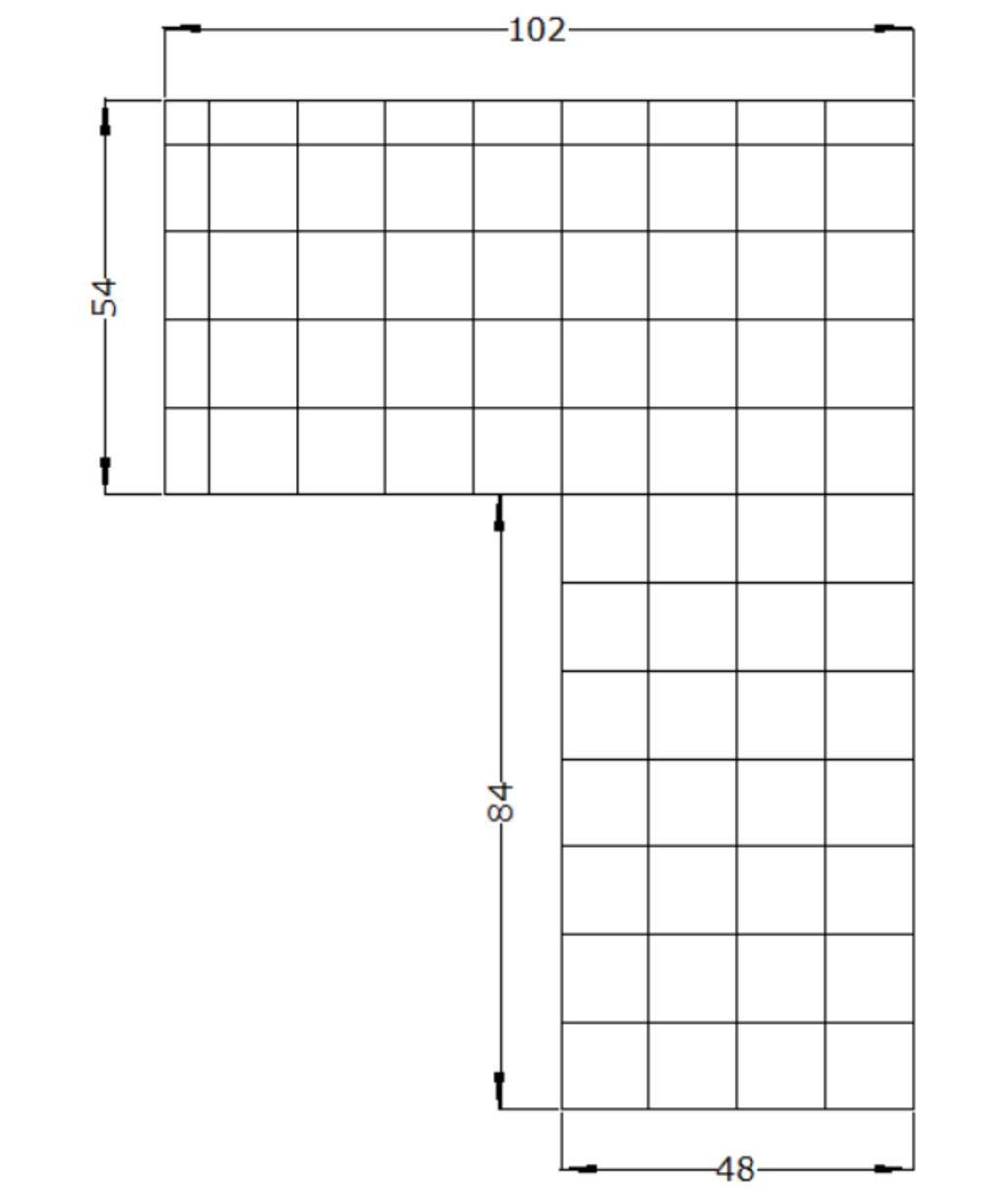
Click on the drawing to expand.
Now what?
Mel
My Model Railroad
Hello All,
RR_Mel, got your PM!
Thank you for your kind words.
For some reason I can read the PMs, but not respond. (I cannot even log off the forums.)
The reference is not Leadville, CO, it is Alma, CO, which is located across the Mosquito Range from Leadville.
The name for my freelance pike is derived from the confluence of The Middle Fork of the South Platte river and Buckskin Creek, here in town.
If you want to continue the conversation PM me an email address and I will respond.
Back to the subject at hand…
I too got to doodling- -on paper- -the combinations of the L configuration.
My additional question is: How will these areas be connected?
•In an L-shape- -Then the question is which dimension? In your diagram you put the 84" and the 54" edges together (as we ass-u-me-ed). On one of my iterations I put the 102" and the 48" together.
This results in the same square footage area but a very different configuration.
•Just to throw the proverbial “spanner in the works” the OP could also (given the floor space) put the long edges together either butting one edge flush or…Centering both.
•With centering both on their longitudinal sides a triangle could be cut from the longer section and fitted into the gap of the smaller section thus creating a trapezoid. This would still not address the reach issue.
•A third configuration would be a “T” rather than an “L”. Again, depending on which edges you mate could result in a vastly different configuration with the same area.
Not hearing from the OP makes me wonder if he has ghosted.
Hope this helps.
Check your PM
Is this Single Post Syndrome?
Been a week. Here is a simple loop showing max radius of 22”. A logging layout could easily use 18” radius.
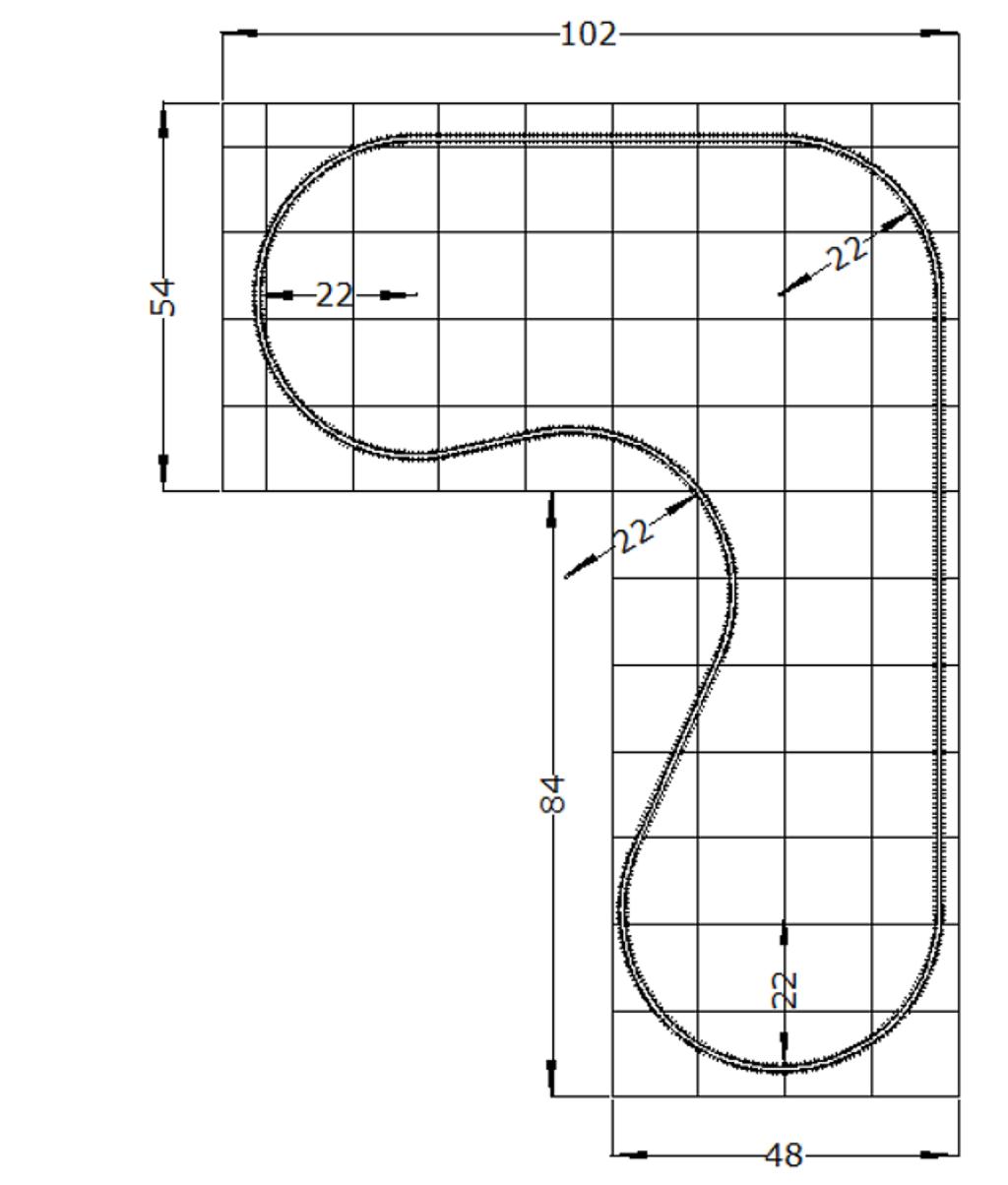
Mel
My Model Railroad
http://melvineperry.blogspot.com/<
Yep, looks like it has struck again.
Rich