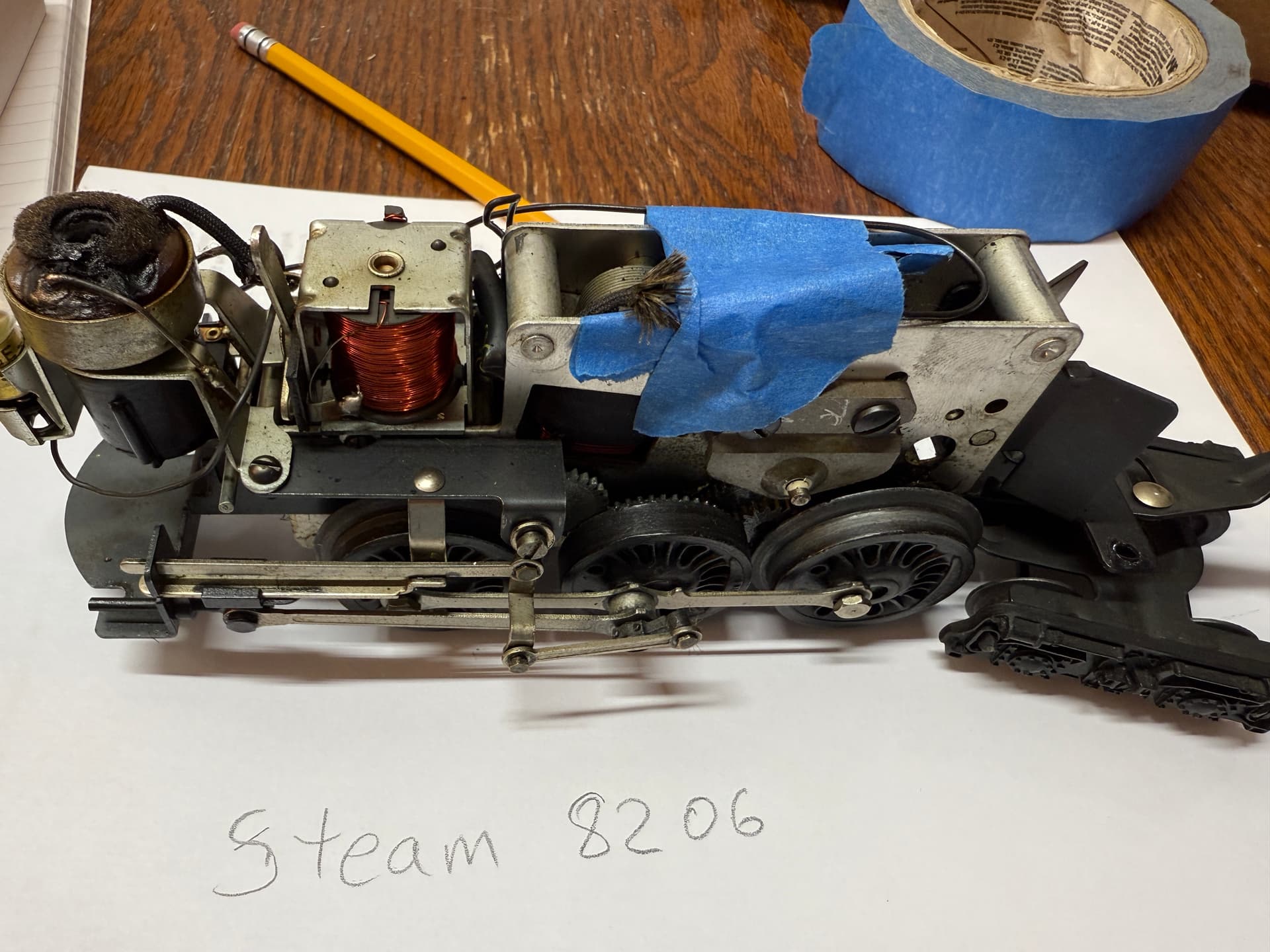
I purchased engine 8206 a few years ago. Don’t recall how well it ran then. Yesterday it would not run, then it ran, E unit was erratic, then nothing and the overload light on the transformer would come on.
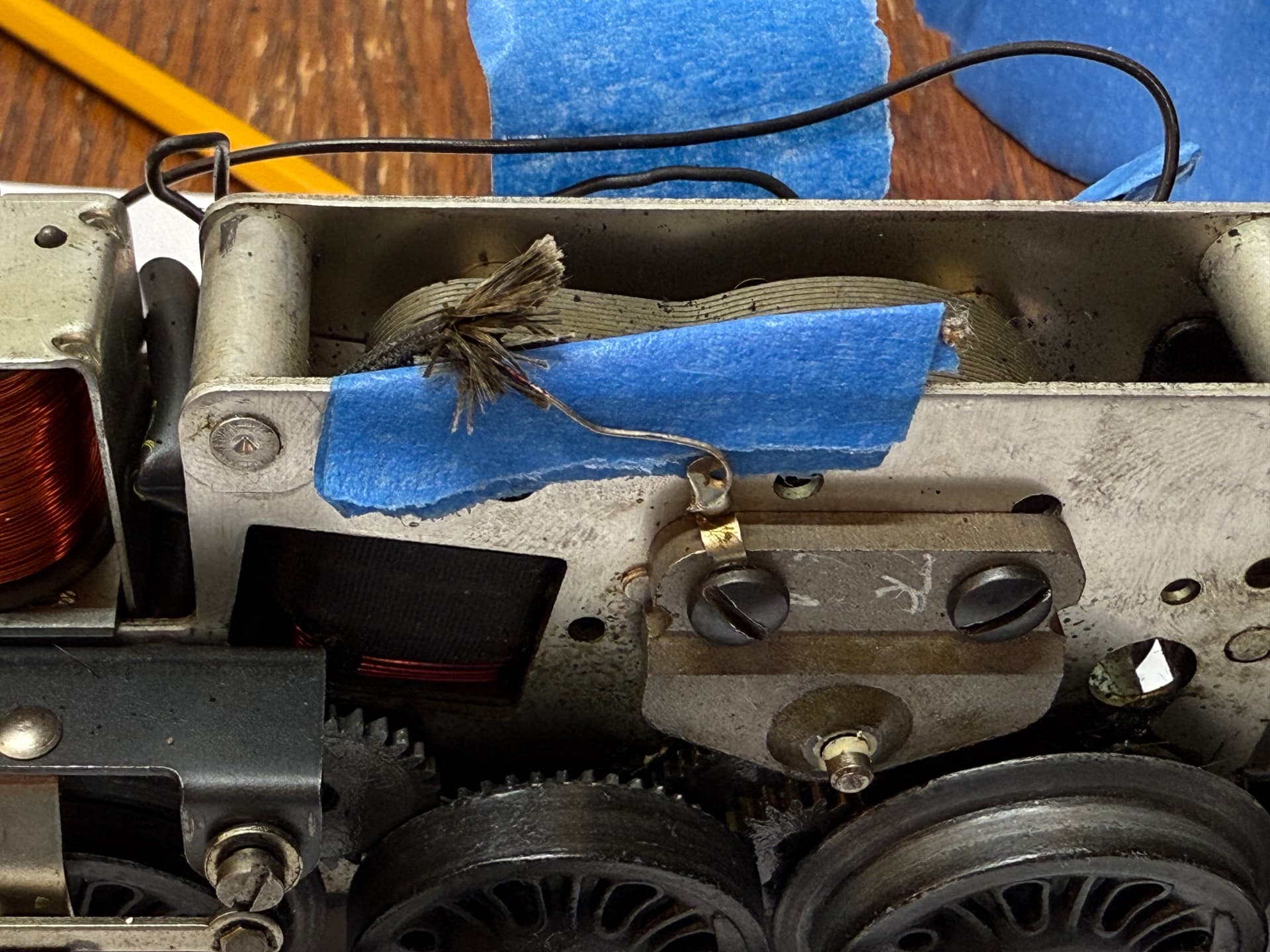
I opened it and found two things that did not look right. I used some plain tape for temporary insulation. With the tape in place and the body off, the engine ran fine. The E unit is working F-N-R.
Does the wire with the black frayed insulation need to be isolated from the frame, which I put the blue tape on?
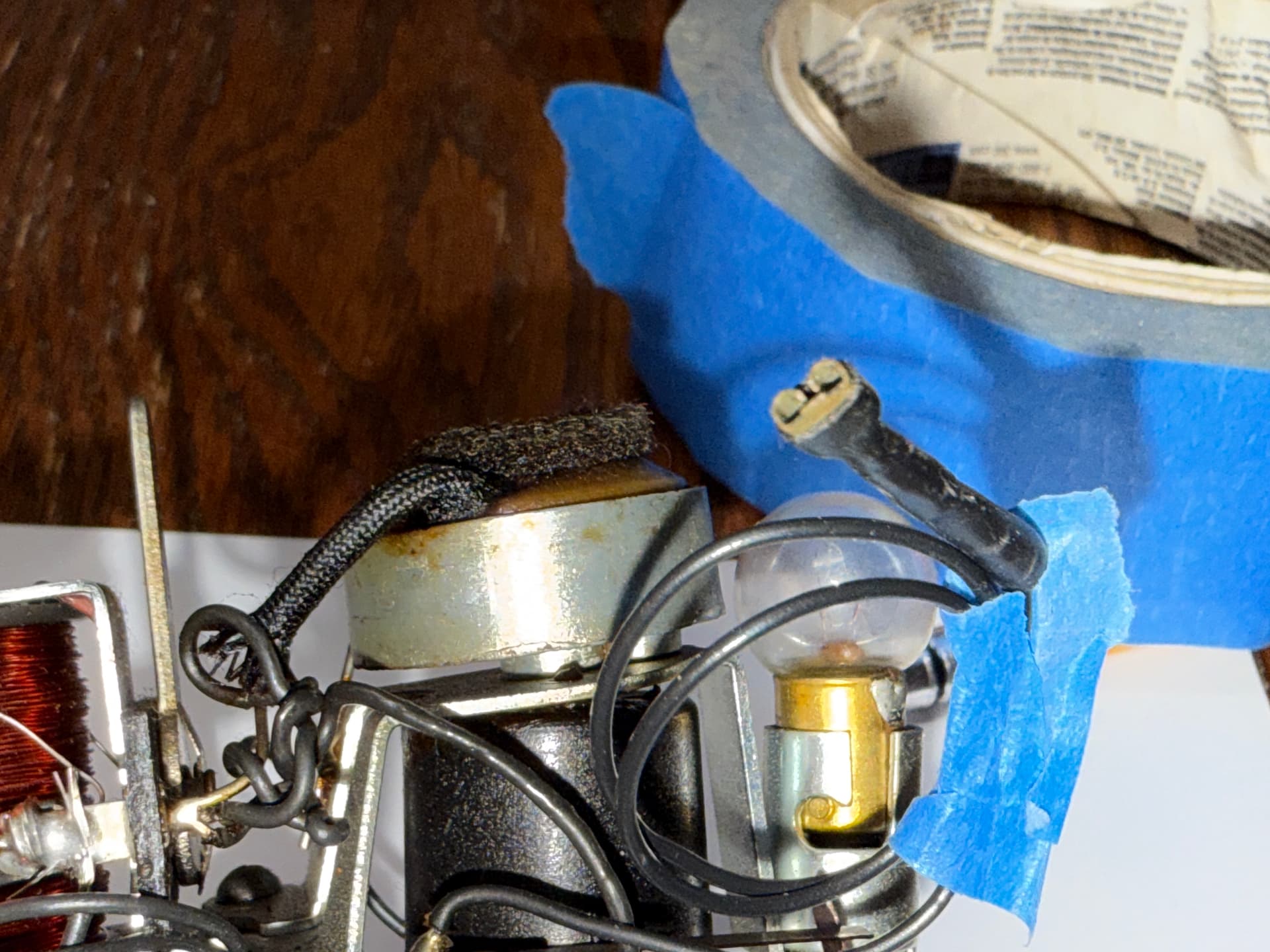
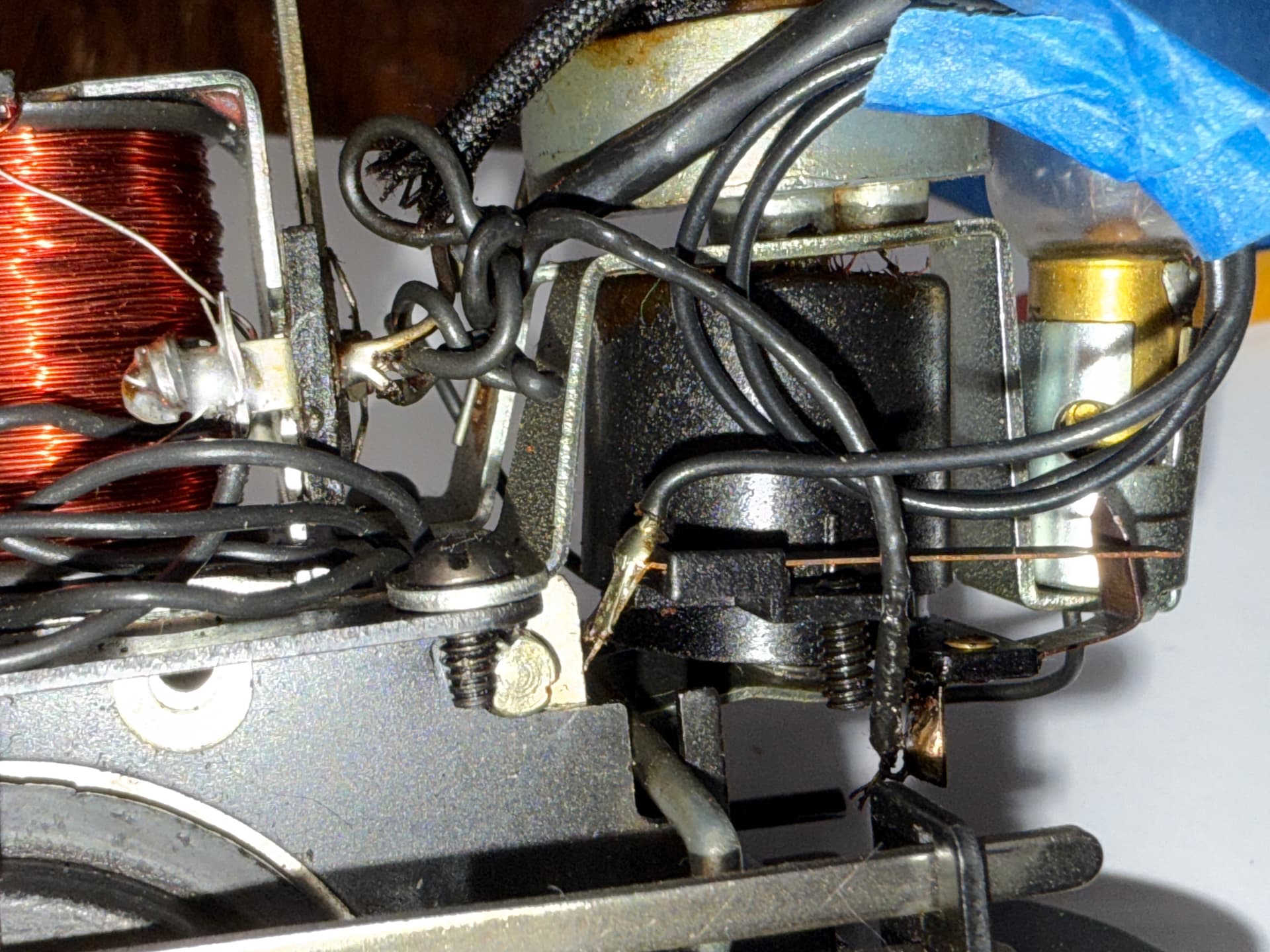
Second, there is a long loose wire that is soldered near the smoker unit. See photo with small piece of blue tape. The other end has a female connector end. I coiled up the wire for the photo and added tape.
Does this wire with the connector look original? I don’t see where the loose end connects.
I am using Greenberg’s Repair.. 1945-1969, 7th ed. Engine 8206 is not listed. I assume it is post 1969. Is it a reissue of an engine from 1945-1969?
Whoever wired that was clueless. Looks like solid strand wire, too much “poke through”, too much heat (Weller gun?) with melted insulation.
Fuzzy wire is ground. Lug screws to chassis. No idea what the blob hanging out the right side of the blue tape is.
24 gauge, stranded and tinned at the ends, replace one wire at a time ONLY with a small iron.
I’ve seen bad, that’s right up there with the worst.
TOC
Thank you for pointing out the flaws. I have noticed more in the photos than looking at the engine. Ok, I see how it is grounded. The insulation must be need down lower. I will tape up the fray. But, is that wire soldered to/near the smoker with a female connector needed? The connector end was just flopping around. Thanks
I located the answer to the vintage question I posted for the 8206
The Lionel engine 8206, known as the “Hudson,” was released during the MPC era, which began in the early 1970s. It is often associated with the postwar Lionel models, particularly the 2065.
The 8206 shares the same wheel configuration as the 2065 but features a different boiler front design. Both engines utilize a similar E-unit layout, making them compatible in some respects.
The 8206 is essentially a modern interpretation of earlier designs, reflecting Lionel’s practice of reusing successful concepts with slight modifications.