Here´s an example of german model railroading in perfection:
http://www.bronneim.de/Bahnhof/bahnhof.php Slide show on the lower left side.
And yes, its HO scale!
Here´s an example of german model railroading in perfection:
http://www.bronneim.de/Bahnhof/bahnhof.php Slide show on the lower left side.
And yes, its HO scale!
This is a fascinating discussion. I think I am well qualified to comment since I started out as a Marklin modeler but have switched to American models in recent years. I have been trying to collect my thoughts on the various approaches to model railroading and have posted some articles on my blog:
This one in particular may be relevant: An article about capturing real-world complexity
Overall, I prefer American outline models: In terms of detailing and running quality, Kato, Atlas, Proto 2k and Athern are light years ahead of the Europeans.
On the other hand, I really like the European approach to operations. I want to be a railfan on my layout. I don’t want to mess around with waybills and paper work!
The new layout I have under construction will there fore combine American models with European operations. Best of both worlds 
Really?
Check this:
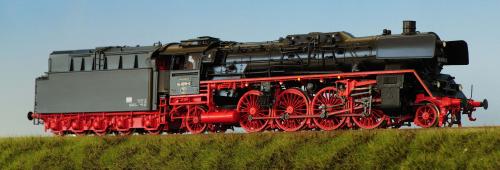
or this:

or this:

and a last one:

You may be right when looking at older Marklin/Fleischmann locos, but Brawa, Roco and others are by far superior to what I have ever seen in the US market, other than hand made brass locos. And we talk mass produced locos only…
Dear Ulrich,
I never said that line; but
My LHS told me the very same, even he said " When I sell my customers those trainsets or tracksets they’ll come back, when I sell them flex track and peco switches they’ll never return".
I still have my Marklin trainset, got it when I was 10, so it must be 54 years old. My youngest (8 yrs) puts the track on the floor, dad connects the “trafo” and it still runs and runs and runs. Never did some maintenance.
I always loved the John Armstrong approach. If you can’t buy it make it. So I was very pleased to hear about someone on this forum who tinkered for a month to get a switch working properly. Going beyond the ready to run or shake the box mentality, attracted me to American model railroading. And a bit of Californian Dreaming (tnx the Mamma’s and the Pappa’s) came in. Why dreaming of a rainy England, Holland or Germany if can dream about the Sunny State. Why dream about the DB or the NS or GW with their drab colours if you can dream about the Santa Fe.
In Europe the DB has merely interchanges with the DB; drab colours are interchanged with the very same drab colours. I imagine my Port of Amsterdam layout in the Bay Area, so interchanges with the SF, UP, SP and WP can be made. Untill the European Common Market was founded in the 50’s international traffic was scarce. Germans bought German cars, Italians bought Fiat, the French their Peugeots; it took almost 50 years to get us buying from abroad. Inters
I am impressed. What is this big Atlantic? Brawa? Prototype? Cost in USD? Is it two-rail DC? I love Atlantics, and that loco looks great to me. I could turn down the flanges to RP25 depth, no problem there.
I do not believe in the separation of American and European model railways.
For years, cross-pollination has been in progress, cultures have exchanged ideas and concepts, only the subject matter has differed. Neither is better than t’other, just different. I am building a room sized layout based on ‘less is more’ principles whilst the subject matter is German and the s
Robert - that Atlantic is a class S9 passenger steamer of the former Royal Prussian Railway Administration (Koenigl. Preussische Eisenbahnverwaltung - KPEV), built around 1910. Despite of its sleek look, the design was not really successful and only a small number were built. Their service life ended about 15 years later.
The model is by BRAWA ( http://www.brawa.de/en/products/h0/locomotives/steam-locomotives/40270-s9-preussen.html ), superbly made, but out of reach in terms of price. In Germany it sells for about 550 Euros, that´s $ 730.00! Off course, it´s DCC and sound and you should not have a problem to run it on code 100 rail, even code 83 is fine.
Paulus - sorry for misquoting you - it was Stein, who wrote something like it!
I fell in love with US outline model railroading after I opened my first copy of MR 40 years ago. Since then, I am especially fond of those big articulated steamers and the F- and E-type diesels, best in a A-B-A consist! I do not care much about those GP´s and SD´s with their box-like utility design, but that´s my personal choice.
Buying US locos was out of reach in those days - brass locos were about $100 - the weekly spending income of my father. US model railroading was very much advanced in those days, but; IMHO, the Europeans have covered a lot of ground, since.
This has been a really interesting discussion. We do see quite a bit of cross-pollination between here and Europe, particularly in scenery techniques, but there’s no doubt that the styles are different. Here are a few observations:
1 The “one town with staging” approach is a great way to have realistic scenery and realistic operation in a small space. My current layout and the one before both used that approach and I’ve really enjoyed it.
The level of detail and the number of features on model locomotives probably depend as much on what price a manufacturer wants to sell the locomotive for as on any other factors. We (and the Europeans) have far more brands than train factories, and even firms that have their own factories often outsource production to others.
I’m pretty sure that the East German railways ran quite a bit of steam into the late 1980s, though they may have announced an official end to steam operation before that.
Ulrich is absolutely right about couplers being a challenge for modelers of European railroads. They’re not all compatible and most are pretty large. Add to that the split between the 2-rail DC and 3-rail Marklin systems and things can get pretty complicated for Euro modelers.
Thanks for reading MR,
Terry
Ulrich
a question and a remark
The layouts build by Bernd Schmid aus Munchen, Rolf Ertmer (Repa Bahn) or from Herr Wientgen had outstanding scenery. Trackplanning was not state of the art. The development of the layouts of Bernd and Rolf however were amazing. Rolf Ertmer developped his own line of track because he didn’t like the offerings of Marklin and Fleishmann. Still all these layouts were wide.
So the questions;
are reach in problems typical American? or do we accept akward derailments as a fact of life? As a teen I once ran a train in a tunnel, on my uncle’s layout, though it was forbidden to do because of track problems. On birthday party’s, the story is still be told.
is, even in the 500 euro prize range, still equipment being offered that can’t be run on code 70 track?
BTW a very nice Atlantic indeed.
Paul
Ulrich, My apologies, I did not express myself properly. The photos you have shown are indeed beautiful models with spectacular detailing - some of them looked like Micro Metakit? What I meant to say was that the American companies produce excellent models at very reasonable prices. In contrast, most European outline models are very expensive here in the US. For example, Micro Metakit models are well over $2000. I find it hard to see European models before buying them and dealer support is very limited. Buying directly from Germany has its own problems. I can recall shipments from ETS getting delayed for months in US customs. In terms of “value for money”, I find the American manufacturers to be superior. I have a limited budget for my hobby and I like to stretch it out as much as possible. I just find I get more for my money here. However, I can well understand the situation may be inverted for you in Germany!
— mainly BRAWA!
There are a number of small makers of highly detailed, custom models, like Micro Metakit, Modellbahnmanufaktur Crottendorf, Weinert (for white metal kits, but way above the old Bowser kits) - fantastic models, but even in Germany, you need that “rich uncle in America” to be able to buy one of those $ 2000 + models.
I consider Roco, Brawa, Hag, Fleischmann as “premium” brands with prices commonly in the range of $ 300 - $ 500. Much more than your BLI $119 + decoder SD40-2 w/sound!Compared to German prices, US is the paradise! And your are right, in terms of value for money, the likes of Atlas, Athearn, Kato are superior, even with the still prevailing quality issues.
Buying directly in the US does not really give us an advantage - we have few, but very active importers who carry US outline mrr stuff at reasonable prices.
Looking at the price level of European mrr equipment in the US, it seems to me, that they do not only charge the manufacturer’s MSRP, but also generously add an allowance for the exchange rate… [:(]
Paul - buy a Euro 800 Big Boy from Marklin and put the loco on code 100 track, push it gently over the track and you can feel each tie plate and nail!
Unless you put new fine scale wheels to your locos and cars, code 70 is out of question, code 83 is ok with NEM flanges.
Why use a Maerklin Big Boy, surely the correct model would be a Trix with optional RP25 wheels? The introduction of the NEM 362 close coupling interface also means that coupling compatibility is no longer an issue as the coupling head can be swapped for any type, including Kadee.
Only Maerklinists have issues with compatibility as their system is unique to Maerklin* and Hag, real model railway modellers use 2-rail despite Maerklin’s dominance of the German market.
TH
*It should be remembered that Maerklin is first and foremost a toy manufacturer and it caters predominately for that market.
Hello,
this is a great discussion. I too started with a Marklin set. When the bug bit again it was time to go North American. Yes some of our mainlines might as busy as a German branch line, but there is something great about North American Railroading. Maybe it is the roar of two big AC’s going along at a mere 15 mph pulling where each locomotive pulls more then the heaviest German double headed ore train?
As for price, there is no comparison between the European and American model Manufacturers. We have it good over here, but here is the catch. BRAWA uses the same Chinese manufacturer for its locomotives as P2K!!! If you want to know what crazy prices BRAWA charges just look at the Walthers catalog. Just make sure you sit down first. Also I just purchased a latest production of a Roco six axle electric locomotive. It runs as smooth as my Kato and Atlas and P2K locomotives but I would say not noticeable better. The same in the running noise department. As for detail, the Roco is not that much better then the North American counterparts. As for the price, well it was twice the price and then some of anything six axle from Kato, Atlas or P2K.
As for layout design, settings and operations. It all has its pros and cons, it just depends on what you like to do. In my case, that darn VIA is nothing but a hindrance to to them slow heavy freights.[:)]
Frank
Frank - I just checked the Walther´s web page for pricing - incredible! Now BRAWA is certainly a premium brand, although their locos are manufactured in China. They do spend a lot on quality control, which makes the product nearly as dear as if it were manufactured in Europe or the states. As for Roco, I never encountered a serious noise issue with their locos - does it come from the gears or the motor? If you are on DCC, maybe you can change the pulse frequency a little to get rid of that “gnarring” sound? In terms of detail, Roco is enjoying a good reputation, but with those sleek modern electrics, don´t look for detail where the prototype has none. If you tell me which one you mean, I can check on that… [:)]
TH - don´t let any of the serious Marklinistas know what you think of their precious “toys”. I know that there is a type of “religious” war between those 2-rail DC or DCC aficionados and the 3-rail AC or MM gang. But there a number of layouts I know of using Marklin, which are certainly in the ivy league of model railroading - like Miniatur Wunderland!
For those, who can read German, the following link may be interesting. It is from a friend of mine in Switzerland, who is currently building a new layout, based on the BLS railroad and some of the typical landmarks of this road, like Blausee-Mitholz Station, both Felsenburg tunnels, the famous Bietschtal viaduct (btw, a Faller product). Just click on “Bauberichte” and enjoy reading them!
http://users.quickline.com/marolf/
For those of you who have been bearing with me so far on my little excursion into European style model railroading - my next layout will be of US outline! As I am “specializing in arctic railroading”, it´ll be based on the ARR - I just love Bowser´s F-7A in ARR guise!
You consider Minatur Wunderland to be a anything but a toy albeit on a monstrous scale? Surely it is a commercial tourist attraction designed to make money for its owners, it is honest about its purpose and has no pretensions to be a serious representation.
Those ‘serious’ modellers who use Maerklin use often the excuse that they started with the product and are too committed to change but nothing can disguise the obtrusive row of puckos which are not part of any prototype railway.
Roco is not enjoying any reputation at the moment, their quality control has been in decline since the takeover, it is certainly not the company that I first knew.
However this discussion seems to have taken the usual course of mistaking Germany for Europe and ignoring the influence of the British market and to a lesser extent the French on model railways. Both, unlike the German manufacturers, are enjoying strong sales, despite the recession, thanks to the enterprise of Hornby and Bachmann who offer products are prices at a level of quality that would be more recognisable to US modeller.
Hi Ulrich from Belgium,
Nice to see a so involded discussion about ours home trains.
I did’nt have a lot to say about all this discussion.
But I think we have two main times modeling in Europe, the Marklin time and now ,the after time Marklin.
What I mean by this conclusion is the fact that by the 60’s nearly everybody who run a model train in Europe was running a Marklin train.
That means, they were confined to the Marklin system, which is reliable but a little bit toy like, especially whit the track and accesoiries.
So many of these people didn’t join, what we call the modelist world, because they buy only ready to run models and easybuild models like Faller or the other big plastic European manufacturer.
That was I call the Marklin time, whit the spaghetti layouts and poor modelistics qualities.
This situation had, I beleive, killed for a long time the flavor of fine modelism. Only a few good looking layouts could be seen in these times and especialy in UK.
Since 15 years, It seems that the things have changed; there is a lot of choice of equipment on the market, other manufacturer like Fleischmann, Brawa, Roco made very fine plastic models.
We see more fine layouts, more fine modules at train show; operations have appeared here and there and DCC is everywhere, even some wood kits are on the market. A few brass European factory are also on the market.
The magazines have more fine modeling articles, they don’t show like in the past, so many Marklin layouts. So I beleive we are on the good way.
Marklin had lost is place of major furnisher of model train in Europe, but if you are speaking in a conversation " I am modeling trains" they often ask you “Marklin trains?” because the impact of Marklin was so great.
It’s only my point of view, but because Marklin was so powerful on the market and some other manufacturer have follow them (Fleischmann and Trix AC models)
As Ulrich has suggested that Minatur Wunderland is amongst the ‘Ivy League’ of modelling, where does that leave other public pay-to-see layouts?
http://www.pendonmuseum.com/index.jsp
https://www.miniatur-wunderland.com/onlineshop/
Therefore a simple question, which one is the commercial enterprise and which one is the model railway layout? I think that the answer is both have the same need for public funding but their ethos radically differs.
And finally, another German layout that breaks the mould.
Hi Marc,
I looked at the pictures in this link - chapeau! What a beautiful work of art!!! You´ll never make that with the stuff sold by the big “M” - [swg]
Marklin still seems to be the market leader, mainly for reasons of nostalgia, as our fathers and a lot of us have started out with that brand. I remember looking down at my classmates who had a Fleischmann, or even worse, a Trix train set! They certainly dominated the scene and despite all recent troubles, I guess they still do.
Their new generation of steam locos are certainly a step-up improvement in terms of detail when compared to what Marklin used to be:


At the prices Marklin is asking for them - they´d better be! [}:)]
But as we are discussing not only German mrr practice here, let us also take a look at other European countries. Big M started very early to make locos of European prototype - the early 1950´s saw already locos of Dutch, Belgium, Danish, Swiss, French, Swedish prototype and I don´t mean just those steam locos of German origin renumbered or the famous Swiss “crocodile”. Marklin certainly spread the hobby, at least on the Continent, thus giving the few local manufacturers a hard time - remember Jouef, Lima, Liliput, Rivarossi, Kleinbahn all struggling along? A couple of times Big “M” ventured into the US market - but I am not sure about their success with US outline equipment. The 1960´s saw some F-type loco, which looked bad to me, having seen “real” F´s in MR ! It was what I saw in MR that made me pack up my Marklin stuff and sell it!
There is no reason to condemn Marklin, though, as s
OK, now we can see where Ulrich’s thread is heading.
Just a couple of points to consider:
Germany is not actually Europe, although it would like to be regarded as the greatest influence, it is merely one state albeit one who has issues. By the same token Maerklin does not represent European railway modelling any more than Athearn is the only US manufacturer.
If we are taking the lead from Ulrich, it should be noted that German model railways are in trouble. Not just the bankruptcy of Maerklin but Faller, Kibri, Klein Modell Bahn, Fleischmann and Roco are all having problem, more worrying is the decline in numbers of model railway stores. In my own region, we have lost almost every retail store and even some cities have none.
Much of the blame has been put on the race to exploit the ‘complexity’ goal of ever more complicated and expensive models (a valid point raised by several on this thread) whilst losing touch with the core markets. At the moment Piko are attempting to reverse this trend with realistic models manufactured to an affordable price and they are succeeding.
Where does that leave Maerklin?
As mentioned before Maerklin’s roots lie in the toy sector, their embrace of the model market has been an expensive mistake as they produced models that were in many cases unrealistic and massively over-priced. Consequently, they were not purchased by their core toy market neither did they appeal to the modeller whose interest was realism.
I sincerely hope that Maerklin will survive if it can re-discover its r