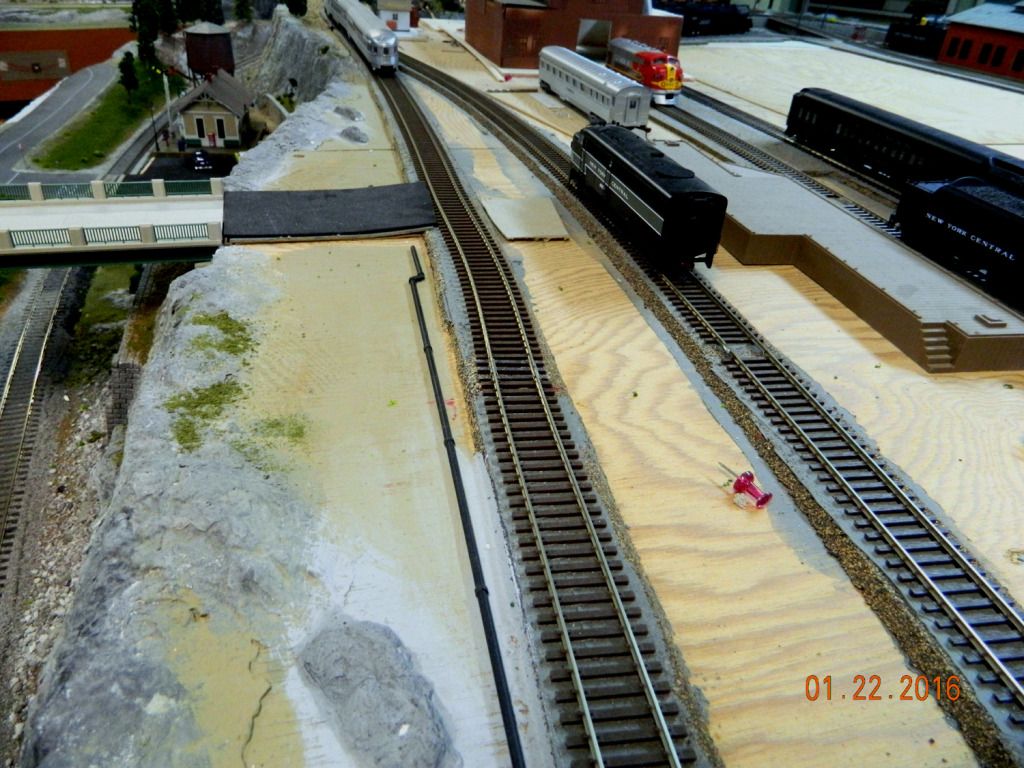
I just noticed this today while running some trains and it actually happened in two places but this is the worst one. I did notice that in both places the latex caulk was very thin and may have contributed to it’s movement. The train room has a small electric heater in it to keep the temps up during the winter as the house heat vents don’t seem to be adequate in this room. I don’t know when this expansion occured so I’'m not sure what caused it, the heater or the summer temps.
Your track didn’t expand - the wood contracted, mostly from the low humidity drying it out. The added heat only makes it worse - warmer air can hold more moisture for the same relative humidity.
During cooler temps I agree with Randy but when it warms up the rails grow with temperature. Here in Bakersfield before I doubled the attic insulation my garage would hit 108° in July and August and 30° in winter. The 75° plus change will ding track! I lost 9 full sections of flex track. The rails expanded and broke the plastic spikes.
I left a 1/32” gap between sections during the track replacement. The increased insulation now holds the summer temps well under 90° and the lows don’t go under 55°. The rails still move with the 30° to 35° temp change but not enough to do damage.
A lesson learned the hard way, do not solder the joiners if you experience a large temperature variation in your train room.
Mel
Modeling the early to mid 1950s SP in HO scale since 1951
That is not a bad kink, we have has worse ones on the Boothbay layout. Always on track that has been laid down with caulk in the spring to fall, and not ballasted. Low humidity during the winter in a heated building bring them out.
A solid length of Code 100 N/S track 100’ long will expand its length by only 0.25" (1/4") with a rise of 30 degrees F. Three smallish gaps spaced out will take care of that over 100’.
It could be that heat has caused some of the problem, but my bet, as Randy has suggested, is that at least 70% of the problem can be attributed to shrinking grains in the wood substrata under the ties. With a decent grip by adhesives or track nails preventing slippage, the shrinking wood forces the ties together, with their webbing connecting them, and eventually they have to slip sideways. Had it happen to me.
So- if you have already fixed cork roadbed to a plywood surface, and that wood surface has been otherwise undisturbed in a garage environment for at least a year of moderate temperature changes (florida), can you start fixing track - flex, sectional, and switches without worrying about subsequent track kinking, or are further precautionary procedures needed to avoid this problem?
Before I controlled the humidity in my layout environment, I had the occasional track kink pop up. Since getting control of that issue, no problems have occured. The temperature swings have remained unchanged with no ill effects. Sub-roadbed is unpainted 1/2 plywood on a 1x4 frame. Track is code 100 flex with all joints soldered. Temp swing is 60 degrees to 90 deg. Humidity level is maintained between approx 30% and 50%.
What this tells me is that humidity is the main, if not, only factor that really matters since the temperature never did vary more than 30 deg. Before getting control of the moisture, I had expansion and contraction problems regardless of the temp.
I had that happen once, but only once, in my 12 years into the hobby. No idea what caused it, but I had to remove the section of flex track, trim the ends of the two rails, and reconnect the section of flex track.
My track is mounted on Woodland Scenics foam road bed laid on top of 1/2" plywood. I am not sure that I buy the plywood contraction issue. My guess is that I, and you, connected the sections of flex track too closely and too tightly.
Thanks guys, I think Randy (and others) is probably right about the humidity. I have a connected basement below the train room with open passage ways (no doors) and there is a dehumidifier in the basement. When I first built this addition I had a terrible moisture problem in the basement, up to 1" of water on the floor, so I installed the dehumidifer and no problem down there since.
Thinking about temperature variations in the trainroom: I don’t think it ever varies more than 20-30 degrees from winter to summer, so that probably isn’t the problem as you all pointed out.
I will put a gap in the rails where this occured and leave the rail jointers unsoldered. I actually push the track back into place and it looks like it would go back without cutting a gap; but I won’t do that. This did happen at another location last year and I just pushed the rail/track back into place and anchored it with new caulk; so far it hasn’t happened there again. It just never occured to me that lack of moisture could cause this! You learn something new every day. Thanks again for the help.
The trouble is the plywood, period. Even when you install it on a building or floor you need gaps. The rail dosn’t expand enough by itself to be a problem for most railroads. Remember it at like an 1/8" over 100’, not 1/4" but could be wrong and niether is very long considering most don’t have a straight 100’ run, not even clubs!
We used to have that issue at our club layout. Once we took control of the humidity and ballasted our track, we haven’t had a reoccurance of the problem.
I have had a functioning dehumidifier in all my train rooms ever since the one incident in the late spring of 2005. It was my first layout, one comprising three full sheets of 5/8 plywood G1S laid flush side-by-side over a framework. I came down to the train room/unfinished basement-with-bare-cinderblock walls and open joists above me to find a wide wow in the unglued Code 100 I had laid across a plastic bridge. On both sides of that maybe 24" of flex was EZ-Track with its plastic base, and it was held in place via DAP acrylic latex caulking. I elected to pull out the flex, shorten it by maybe 1/8", and reinsert it into the bridge deck. Never had a recurrence, but I also went and bought a dehumifier, my first for a train room, and have never looked back.
Another tip, for those still reading: if you go with milled lumber for your benchwork, purchase what you need (using a careful plan as a guide so you don’t get too much or too little, or even the wrong stuff) about five days prior to first cuts. Lay it out on a flat floor, with some weights on it to help keep it both flat and from twisting, and let air get at it. Get that dehumidifier going and let it run for at least four days. You’ll have to empty the reservoire at least twice, maybe three times. By the sixth day, you will have nice dry wood to measure and to cut. It will keep its measured length, but more importantly its width, and it shouldn’t change lengths or widths if you continue to keep the moisture in your train room between 40-66%. Above 65%, you can expect to see some problems developing on tracks that are not well ballasted.
I remain skeptical. I have looked at some web sites devoted to plywood by trade organizations. The indication is that plywood is subject to very little, if any, expansion and contraction.
When I once had the same experience as the OP, I had to trim the ends of the rails to fit them back together. MY contention is that the original fitting was too tight and the track gave under pressure, probably from heating, cooling, and humidity fluctuations in the train room.
Its not the plywood by itself. Its the part that doesnt have scenery yet. A fellow club member has a large layout in his basement that had been in progress for 3 years with no issues. Then 2 winters ago there was a BIG issue. We had started installing scenery on the layout and had painted some sections. We noticed when we came back to the layout in January after taking Christmas off that there were kinks in the tracks (many of them). We noted that these kinks only occured in the areas that scenery had not been started (bare plywood). It turns out that laytex paint does not seal wood, rather it actually allows moisture to travel through wood. This caused painted the plywood to expand and contract with air moisture content variations. Since then we have finished painting all benchwork and there have been no further issues with this layout of this nature.
Edit: I think I may have posted here in the forums about this Jan 2014 or so.
My layout is in the basement, bitter cold days, it’s about 60 degrees, hot humid days it’s about 75. My track is on roadbed material, glued to 2" styrofoam, glued to 1/2" plywood. All the glue was actually latex caulk. No problems in 8 years.
I think having everything securly fastened down, evenly with the caulk, and all ballast in place helps maintain the alignment. Every track joint is soldered, with a small jumper wire attached.
In all of my 40 years in the construction trades, the CDX type of plywood was the worst for expansion and contraction. I don’t think anyone uses it as a base for a layout.
I’ve had it happen a couple of times, both in my main classification yard. It was a nuisance but not a difficult fix. I work on the railroad almost exclusively in the cooler months so when I lay plywood and track, the temperatures and humidity are at the low end of the cycle. I’ll discover expansion problems usually at the end of the warmer months when I get back to model railroading. I’ve had plywood buckle so now I leave a small gap betweeAdd Quote to your Post n sections when I lay it and cover the gap with duct tape. No problems since. Likewise I leave a small gap between rail sections to allow for expansion. I’ll use a scrap piece of thin styrene or something similar to measure the gap.
We had a MASSIVE problem at the club I used to belong to. In our original quarters, there was no AC< but we did have plenty of heat. One turnback corner was built during the summer, and because it was so hot and humid, we probbaly made it worse by keeping the doors open, this was pretty much the only airflow we had. The framing was built to house standards, all 2x4 studd wall construction. We had plywood, and then homasote. On this curve, we had a loadsin in/empties out arrangement with a power plant and coal mine, so in addition to the 2 mainline tracks goign around the outside edge, there were 4 more tracks connecting the mine and power plant that wouldbe hidden under scenery. It all worked great. Unthi the weather turned cold and we turned on the heat in the building. Warm, dry air - and EVERY ONE of those 6 tracks buckled, much worse that the OP’s photo.
It is NOT the track expanding, never is, unless you have temperature swings so severe that you really couldn’t be in the room at either extreme. The wood dried out and shrank, and I still suspect the homasote as well. It’s not temperature - wood is quite stable across a range of temperature. It’s the humidity, or lack thereof. Ideally you should let any lumber sit and acclimate to the location it will be used, but if your humidity varies greatly through the year, that can be difficult to accomplish. It’s not easy to truly seal wood - latex paint does not ‘seal’ anything, you need shellac or varnish, and you have to remember to get the cut ends as well. ANd even this just slows down the process.
A precentative measure, sonsider the wood age and dryness as well as the current climate when putting down the track. The problem at the club was the track was laid when the wood was at maximum expansion, and not enough gaps were left. If laying track in the dry winter (at least, that’s how the humidy works around here), you can leae fewer gaps because the wood will only expand when the humid
As I said in a previous reply, I had the identical problem to the one shown in the OP’s photo. One time, one spot, one piece of track. It was much more likely an overly tight fit of two connecting pieces of flex track than a one inch stretch of plywood suddenly expanding and contracting.
My layout was living happily ever after until we got a new high efficiency furnace. The furnace guy told us that the new H.E. furnaces really tend to dry out the air and that some people actually get a humidifier installed after the fact. Anyway a few months after the install I ended up with two spoings in the track. They were an easy quick fix so no harm done.
We did get a very good electronic air cleaner with the new furnace and the dust level went to practically zilch on the layout. It was a good trade off.