I am in the planning stages of an HO layout and plan on using Code 83 track. I recently purchased samples of three leading brands of flex track: MicroEngineering (which I found quite hard to flex, but looked the most realistic), Atlas (which easily flexed and looked quite good) and Peco (which was also nice). I was wondering if anyone else had a preference and why.
I used Atlas, at the time I was laying track on my layout, I bought my Atlas Flex Track for between 50 cents and 75 cents each (Code 100). My guess is it is much more expensive now. Still, it is probably cheaper than the other two. However, you may have different needs than simply going with the cheapest, I would tell you that the three you tried are all good choices.
LION uses ModelPower from Trainworld. It is the cheapest I can get, albeit you have to buy the whole box (100 sticks). Not a bad thing, LION has 900’ of track.
ROARING
I have always used Atlas Code 83 flex track, and I like it a lot.
But then came the 3 year shortage (aka as absence), and I started using Peco Code 83 flex track. Peco is a bit difficult to straighten out once it has been curved.
Rich
I’ve always used Atlas, but for my new layout I will be using Peco, mainly because they have a wider range of turnouts, plus the Electrofrogs are easier to power than Atlas.
–Randy
When I got back into the hobby, the train shop I went into had a strip of every brand (at least many of them) on display next to each other. I chose by the look I liked best. Whether it was the spring back to straight or stayed where you put it flex didn’t matter to me.
I am wondering what Rapidos new bendy track is like as think all their other products are excellent.
Some people can’t tell the difference between a $100.00 stereo speaker and a $2000.00 stereo speaker so they will be happy with the $100.00 dollar one. My eyes catch detail so the look was important to me. When I am going from layout to layout at a train show, I notice that the track is different from layout to layout and do think it makes a difference.
I’ve used Atlas and ME. For me Atlas is the better track. I find the quality and appearance of the Atlas better and easier to handle. All I know of Peco is what others say about it and it’s usually positive.
Joe C
I use Peco,have used their track for over 40 years,never had problems with it-I do live in the UK where it’s easy to get!
Steve
No right answer here. If you’re going to paint & ballast your track, that may reduce the differences you actually notice, unless you stop to scrutinize, or see more apparently in a photo. Maybe try paint & ballast some of your trial pieces (on roadbed and then decide.
UPDATE: I did decide on code 83 Atlas flex, but Walthers-Shinohara turnouts as I liked the broad selection of the latter. There is a 0.017" tie thickness difference that some ignore and some address by shimming under the turnouts with cardboard or sheet styrene. On crossings, I hate the Atlas 90-degree ones I installed in series, would recommend another brand.
I began construction of my present layout in 1995. At that time Atlas code 100 was the prevalent brand, at least around here. My previous layouts were all Atlas.
Right around then Walthers began importing the code 83 line from Shinohara and I liked the appearance (smaller spike heads, spike holes located at the rail base, more ties per meter) and at that time they had a large selection of turnouts including #8s which I wanted for mainline crossovers. They since have included #10 turnouts. The line also included several curved turnouts and double-slip switches. The first few years these turnouts were power-routing type. They have since re-tooled and made them all-live which I have switched over to for the most part.
Well, the layout is celebrating 20 years this month and I’m still using the code 83 Shinohara (Walthers) with no regrets. The only occasional QC problem I’ve encountered was a little plastic around the frog that needs to be filed and an occasional jumper that was not securely tacked to the underside of the rail, requiring an extra feeder wire here and there.

That’s my experience, anyway. YMMV
Ed
My layout has examples of MicroEngineering, Shinohara (Walthers), and Atlas.

Above is Micro Engineering. It’s the most difficult to curve (and straight for that matter) but does deliver a fine appearance. The ties have a somewhat irregular look due to the small variations in spacing and are offset from the center line so the ends don’t all line up perfectly. It’s as realistic as you can expect from flex track.
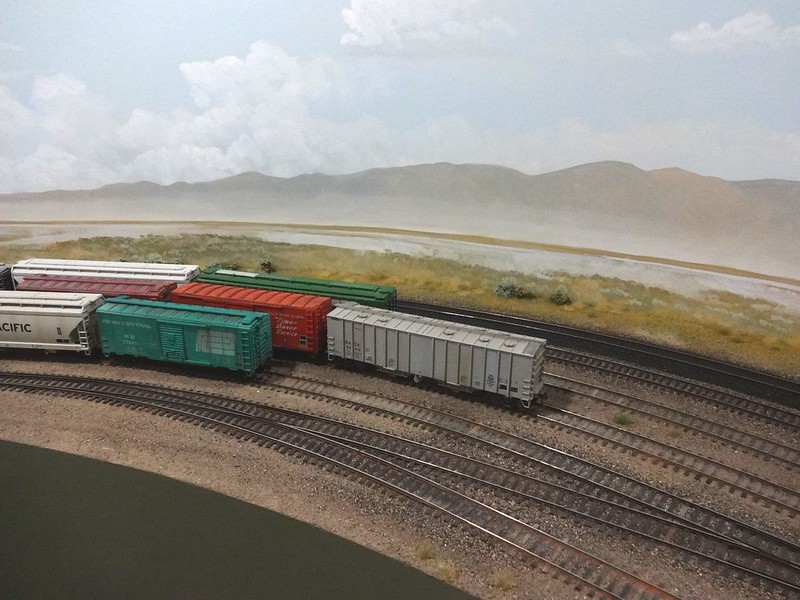
THis yard uses a lot of Shinohara code 70, which is similar in appearance to their code 83. Compared to the Micro Engineering on the back two tracks, note how the tie spacing is wider, and the ties are also somewhat wider themselves. Their code 83 is sold under the Walthers brand. It’s about the same to use as ME, the spikes are a bit bigger, and it costs more.

This yard is Atlas 83. The spikes are larger than the above brands, and the ties are very rigid and regular in placement. Careful weathering can mitigate both issues to some extent. It’s also the easiest to use.
Atlas ties are thicker than ME or Shinohara (which essentially match one another), something to consider if you plan on mixing brands of track and turnouts. I don’t have any Peco, but note that its ties are thicker still. Also note that each brand has a different rail cross section, requiring attention to achieve smooth joints, and brands of rail joiners aren’t necessarily readily interchangeable. While careful installation can allow the different brands to be used together, more skill may be required to really do it right - something else to consider when choosing.
One thing to consider, these three manufacturers and probably others will all work with each other. Here is the prices I found at M.B. Klein’s (Model Trains Stuff) all are Code 83: Atlas, Price for qty. of 5 $4.35 each, Micro Engineering, Price for qty. of 6: $4.83 each, Pico Price for qty. of 25 $5.39 each.
Shinohara track has been available from Walthers, I believe, since before I started my layout in 1988. At this time I did not find Shinohara Code 83 flex track with wood ties available at Model Train Stuff; or, I would have included it in the price list.
I’m into making things look real, also. I painted all my Code 100 Atlas track roof brown and repainted random ties various shades of gray. The painting is all important to making track look real, to me, far more than the size of the simulated spikes. Yes, the spikes are too big. However the money I saved by buying Atlas track allowed me to spend money on better locos and rolling stock, the real players in the realism game we play. Where I to start over, I would probably go with either Atlas or Micro Engineering.
I am with Ed, having used Walthers/Shinohara Code 83. I chose it primarily because I use many of their wide selection of curved turnouts. Other factors are good looks, thin ties, small spikes, the ability to spike the track (you can glue it if you prefer-I don’t), and small, tight rail joiners that look good and mitigate against loss of electrical conductivity. It is easy to flex but not too floppy. Admittedly, the product is more expensive but worth it, I believe.
Dante
I just bought a box last week…
http://www.modeltrainstuff.com/Walthers-HO-815-39-Code-83-Flex-Track-10pac-p/948-815.htm
$9 bucks a stick. Granted, not cheap. I also like the M-E stuff but I wanted to try to stay with one manufacturer. I did use Atlas 100 in a staging yard and in another storage yard I used Atlas code 83 along with Atlas #6 switches.
Instead of clipping off any ties on the ends of the flex track I carefully squeeze them closer together rather than lose a tie or two.
Shinohara has to be handled a little more carefully as you can unzip the rail if you mishandle it but I have only encountered rare instances of that.
Another item I liked was the bridge track which, I guess, you can now get separate ends and make it as long as you want. Back when I needed some it was only one length but easy to cut and join. Looks great with the guard rail and bridge timber guard. Like Dante I had used the Shinohara joiners but I also used Atlas N scale and M-E and in places out of sight the Atlas universal 83/100 joiners which are large.
For those tiny joiners I modified a #11 blade and slip the joiner on to the blade then it is much easier to push the joiner on to the end of the rail. Careful filing is a must!
Happy Tracklaying… Ed
I used one scissors cross over that was a Shinohara Code 100 product and I have a Micro Engineering bridge track on a scratch trestle I built, the rest of my track and turnouts are all Atlas, with some Snap Switches and the majority Custom Line Turnouts. I would not use Snap Switches again as there is no way to power their plastic frogs.
In actuality, if I were to start over again, I would model the Rio Grande Southern in Sn3 scale and would hand lay all my track and use “Fast Track” jigs to build my turnouts with.
We all build to “What looks good enough” in our own eyes.
My new N Scale build is all Peco C55 flex and Electrofrog turnouts. Real quality product with hugh choice of turnout types which I needed for the new design. Doug
Before starting my layout during the beginning of the “Great Atlas track shortage” I purchased a stick of code 83 flex from the same manufacturers as you. I preferred the look of the Micro Engineering after test ballasting and painting several inches of each.
The fact that the M.E. rail profile and tie height matched the Fastrack turnouts I chose clinched it, went with the M.E. There was some research and experimentation involved in my learning to finesse the M.E., but Ribbonrail gauges help and I do like how the M.E. holds it’s shape after forming.
Having started track laying in 2012 can’t comment on longevity, and only running 4 axle diesel models some with stoutness, but so far so good.
Regards, Peter

I have some ME code 70 and 55 flex that has been recycled through three layouts over the last 25 years. It still holds up.
The good thing is you don’t have to stick with only one type/brand of flex track. You can connect any to another and the most you might have to do is shim one side to get an even transition.
I’ve always like the ease of flexing good ol Atlas flex, but I have some Walthers code 70 which is stiff and takes a good deal of bending to get it set to the curve or straight as desired. I’ll be using the code 70 in my yard and since I already had a bunch of Atlas code 100 and 83, I won’t need to buy much, if any, for my current layout.
Yes, if you are not rough with flex track, it can be re-used, which saves money - and these days track has gone up significantly in price.
I’ve been using Atlas flex track. It works well and looks good. The only drawback was the Great Atlas Track Shortage, but I had stocked up and managed to weather the storm.
Note that the cross section of each brand of rail is different. In particular, when you try to join Peco and Atlas, you’ll find that there is no such thing as a rail joiner that will fit easily but snugly on both. I’ve been using the Atlas joiners which they claim will work on both Code 100 and Code 83, but I’m only using Code 83 track. These joiners, unfortunately, are still unavailable at my usually well-stocked LHS. Right now, I’m using Walthers joiners, after trying Peco and finding them too tight for easy use. Both Atlas and Walthers joiners work well on both brands of track.