Hi all! I’m quite new in this forum space so I do hope I’m posting in the right place!
I’ve recently acquired both of these beautiful kits for a good price, and I’m wondering if any experienced builders here have some tips to share with me? My prior experience with kit building has been with Tyco locomotives so I was wondering if there was anything different I should keep in mind when building these or particular quirks.
I’ve gotten away with not buying drill bits but from the looks of it I’ll have to buy some for these two kits.
Some other miscellaneous questions:
Would any of you recommend clear coating locomotives only rather than painting? I’ve personally loved the raw metal look of them when I’m finished building them and have debated choosing one to do it with. Perhaps the Challenger?
Does spray paint work well with adhering to the metal for these kits? I’ve used spray paint mostly for my Tyco locomotives.
These two kits are both from the late 70s to early 80s. I shouldn’t be worried about lead dust correct? I’m quite attentive to things like lead and prefer not to work with any heavy metal alloys.
Gidday MTL, welcome to the Forum. As far as I’m concerned, not that that’s worth a lot, you’ve come to the right place.
I too recently picked up a Bowser “Northern” kit which I’m looking forward to building when I have the time.
If you like the “raw metal look” then go for it. A clear coat applied with care shouldn’t do any harm; it can be amazing how much moisture from “dry” fingers can tarnish/rust bare metal.
Personally, I would not be concerned about any lead dust, BUT for your own personal preference and safety, wear a dust mask.
I would advise that you take your time, remove any flashing or burrs, and most importantly, Have Fun.
I’ve built a couple of the Bowser kits. You will need drill bits - a drop of oil helps with the drilling, let the drill do the work! The trickiest part of the Bowser kits is the valve gear - you might want to order an extra set of rivets from Bowser, to be ready as you will probably botch a few. Make sure the mechanism is absolutely free from any hitches (in forward and reverse) before proceeding. You might want to look into a Helix Humper or similar repower kit if you are thinking of going with DCC, though the Bowser motors are plenty powerful.
I am building a Challenger right now and it’s quite… A challenge. The parts have become brittle - the eccentrics and side rods, in particular, are very fragile. Luckily, the eccentrics can still be bought separately. Many parts from the Hudson kit are compatible… There is a lot of filing involved and a lot of things to figure out. Mantuas are similar but the axles bearings are different.
Follow the instructions to the letter. I thought I could assemble everything without applying any lube, but that is practically impossible. I plan on installing a decoder, so that complicated things. A Helix Jumper would have been nice, but I believe they folded a while back.
PS: Mine is assembled and works in DC but still draws too many amps. Took it appart several times… The mechanisms roll freely separately, but there are of lot of components in there for a single motor… At this point, I am hoping it will break in, but I’m not sure that will work. I installed rare earth magnets, there is still a lot of overall resistance/friction.
Thanks for the help everyone! I think I’ll start them when I have plenty of time and the correct tools at hand!
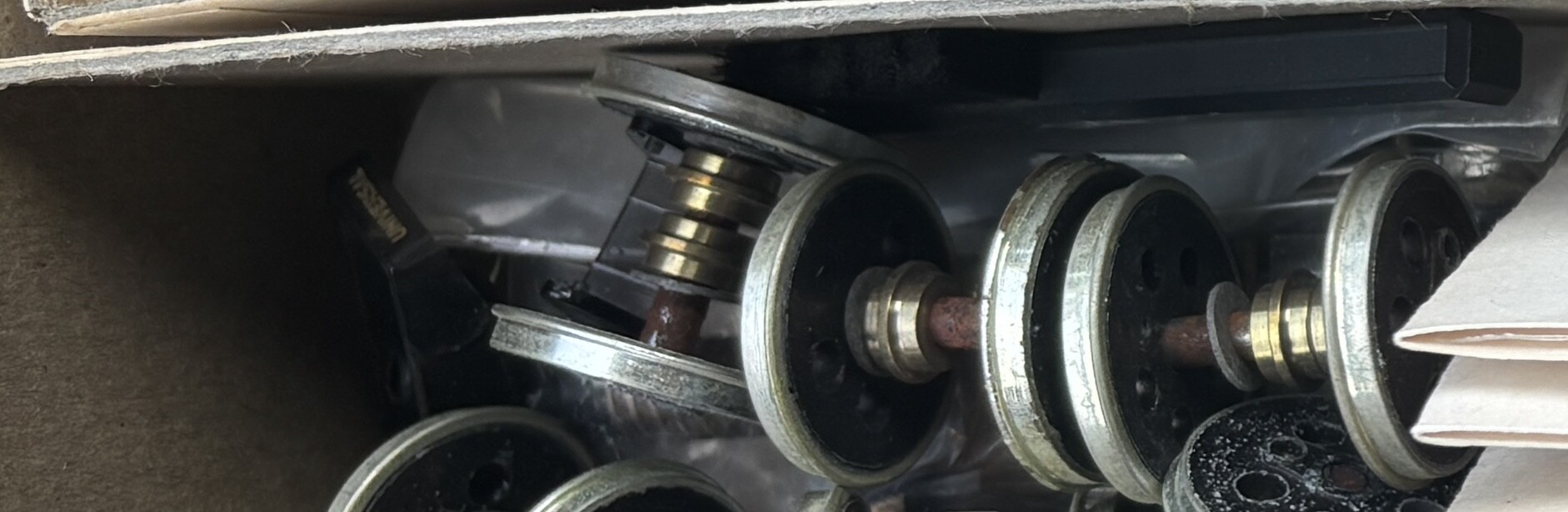
One thing I’ll have to tackle are the rust on most parts, looks like the previous owners of these two kits didn’t really store them very well. Do any of you have recommendations on rust removal? Particularly on the driving wheels and axles?
When I inspected the wheels at a glance it appeared to be surface rust. Interestingly it’s stuck on hard enough to have seized the brass bearings on the axle tight so they no longer turn anymore even with some force applied!
I’ve thought about using a wheel puller to pull them out and get better access to the axles but I’m not sure if that’s a good idea or not for now. Unless I can find a way to remove the rust reliably without damaging parts it looks like my only option for now might be to look for replacements.
If you can get PBLast’r, go outside with a suitably-sized screw jar with a lid. Gently spray in enough of the PB, add the deflicted parts, close the lid and shake, and let sit a while.
In a well-ventilated place, you can rest a (powered-on) soldering-iron tip on the frozen bearings a few seconds to aid the penetrant.
Note that neither WD-40 nor PB are intended as ‘lubricants’ once they have done their job as penetrants. My recommendation is to repeat the sealed-jar treatment with a proper evaporating solvent (or use a jewelry-type ultrasonic cleaner) and carefully dry, then use LaBelle or similar quality applied correctly.
If there is, in fact, corrosion in the bearing or journal surfaces, as opposed to Schmitz getting in there, you may be looking at disassembly and careful cleaning. I personally don’t think a little pitting in this sort of slow-speed low-load bearing is showstopping, but correct lubrication will be a bit more important.
Hmmm, I’m very likely to be extremely ham fisted compared to Simon, but I’d still try the “WD40” first but then try a little strip of fine (300 girt (??) sandpaper.
There is a lot of rust there, so the problem is that even if you manage to loosen the bearing, it won’t move on the axle due to the rust. That’s why I would remove most of the rust mechanically before applying any oil.
Try dropping them in some Evapo-rust for an hour to a day, then wash them off real good. The stuff might take some of the blackening off, but wheels can be repainted.
Sounds like a more safer solution for me and my clumsy hands! I might combine them with my ultrasonic cleaner, but I’ll test this method for one set of drivers first to see as a trial run.
Evapo-Rust worked great in my tank-type ultrasonics (made for jewelry and watch parts). I would recommend that you leave the ‘soaking’ in a well-ventilated place, with the tank lid on or the tank covered, and periodically check if the bearings are loose and rotate the ones that have a couple of turns on the axle.
Then flush out the Evapo-Rust for a few minutes with a light, evaporating solvent, as even traces won’t ‘play nice’ with many oils and greases.
I built the T1 kit a long time ago. The open frame motors worked reasonably well, but I did replace them with Sangami can motors.
I painted the brass tender and cast locomotive shell with automotive primer before painting.
I’ve converted most of my locomotives to DCC; my T1 and my NYC Niagara haven’t bubbled to the top of the list yet. They’re strictly for excursion trains, not for proposed operations, so finishing the railroad comes first.
The other thing I did with my T1 was to install a DC based Modeltronics brand sound system. You actually fabricate a switch on the back of a driver, to synchronize the chuff. It has air compressor sound too. It has a large Ish speaker, and it really sounds pretty good, I may try to keep that in place, then use a non-sound or Mobile-only decoder for the locomotive.