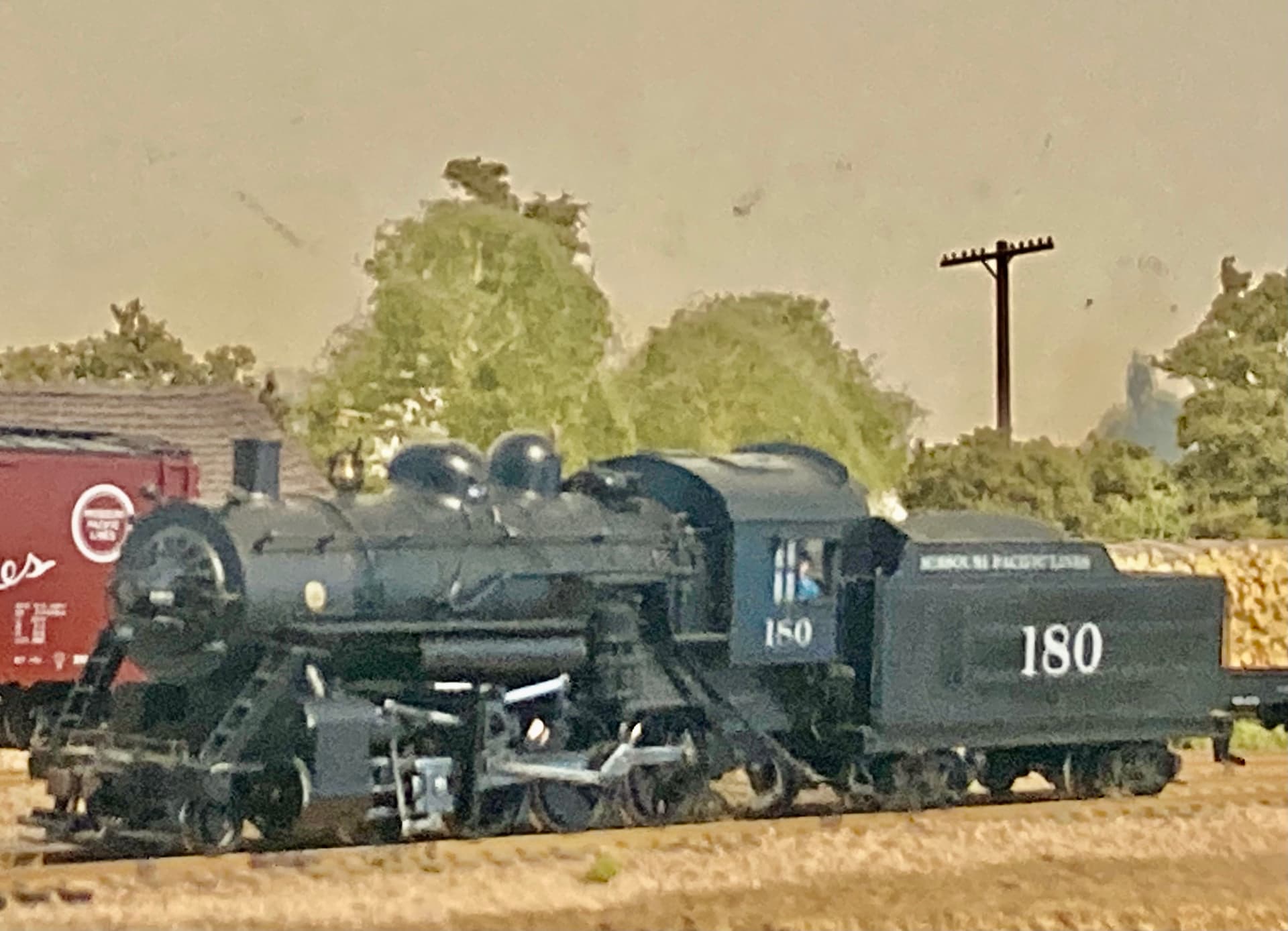
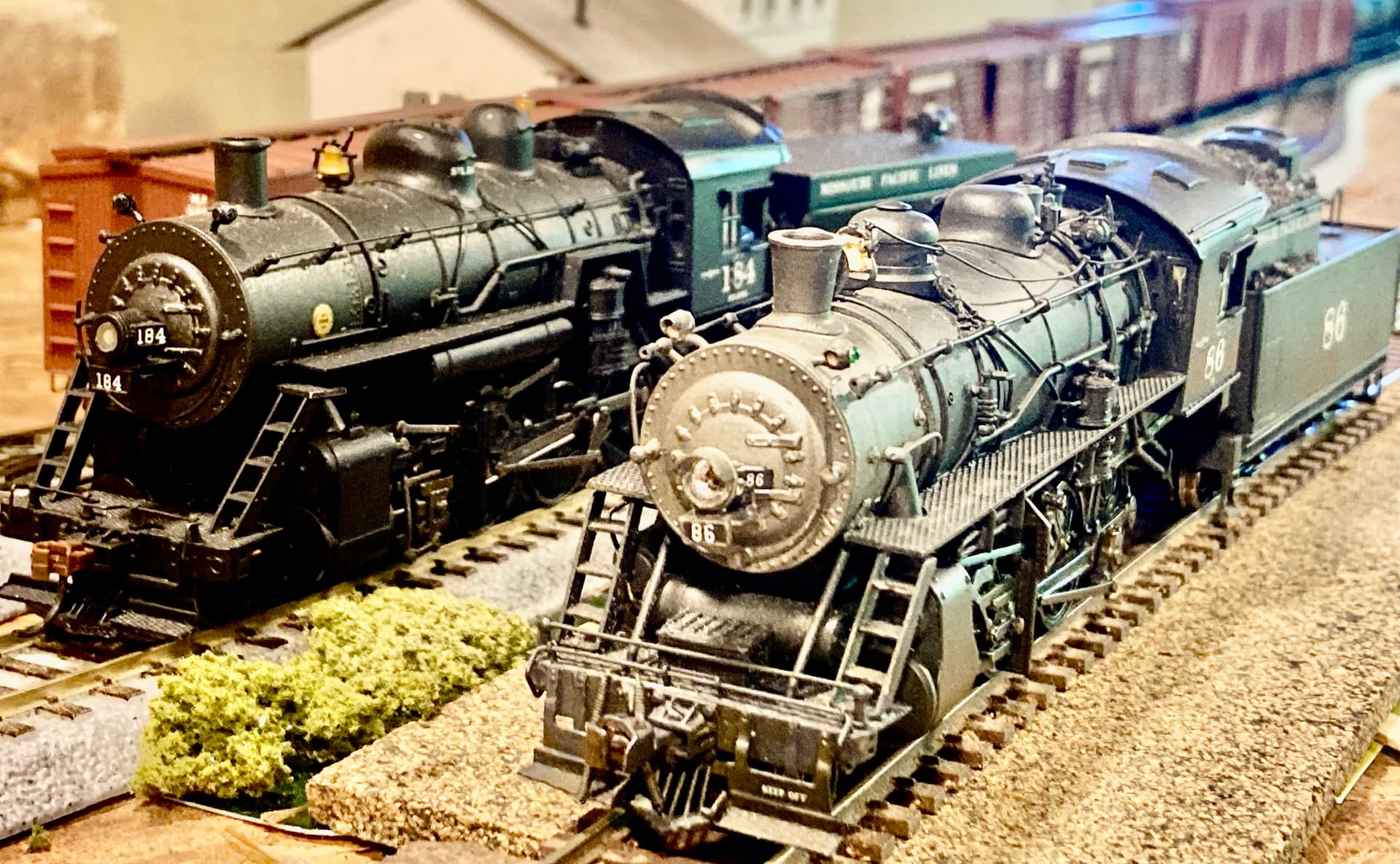
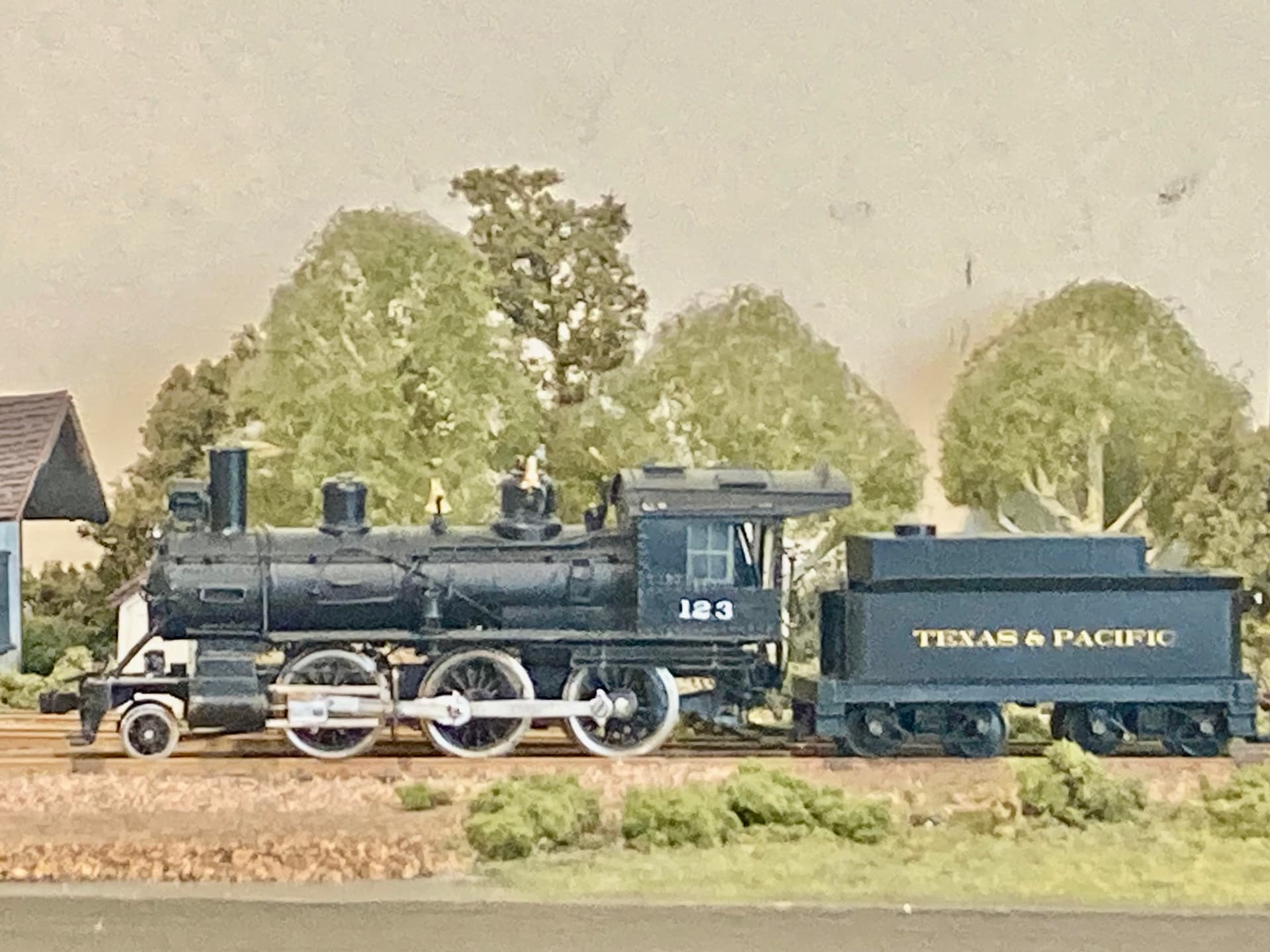
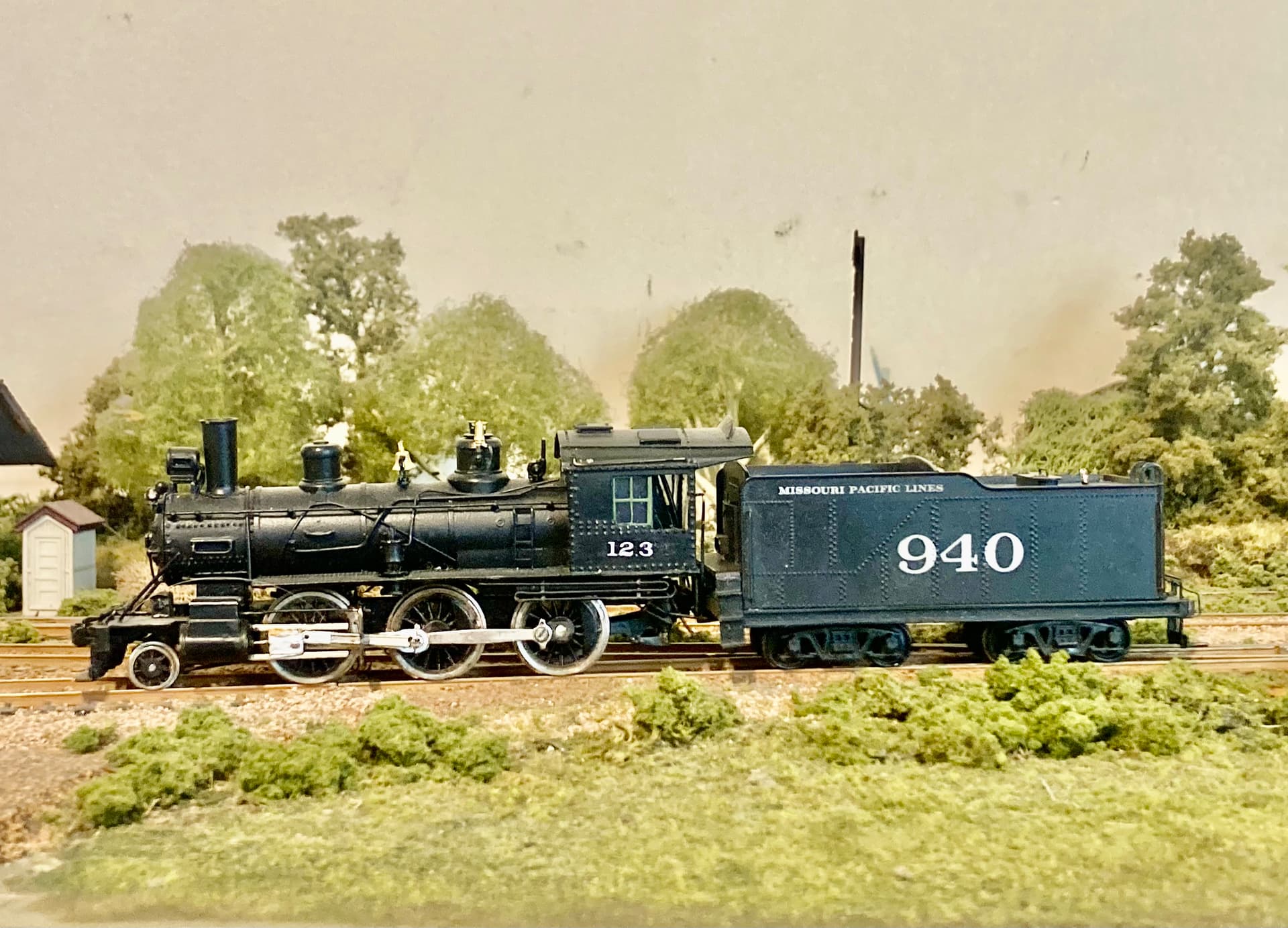
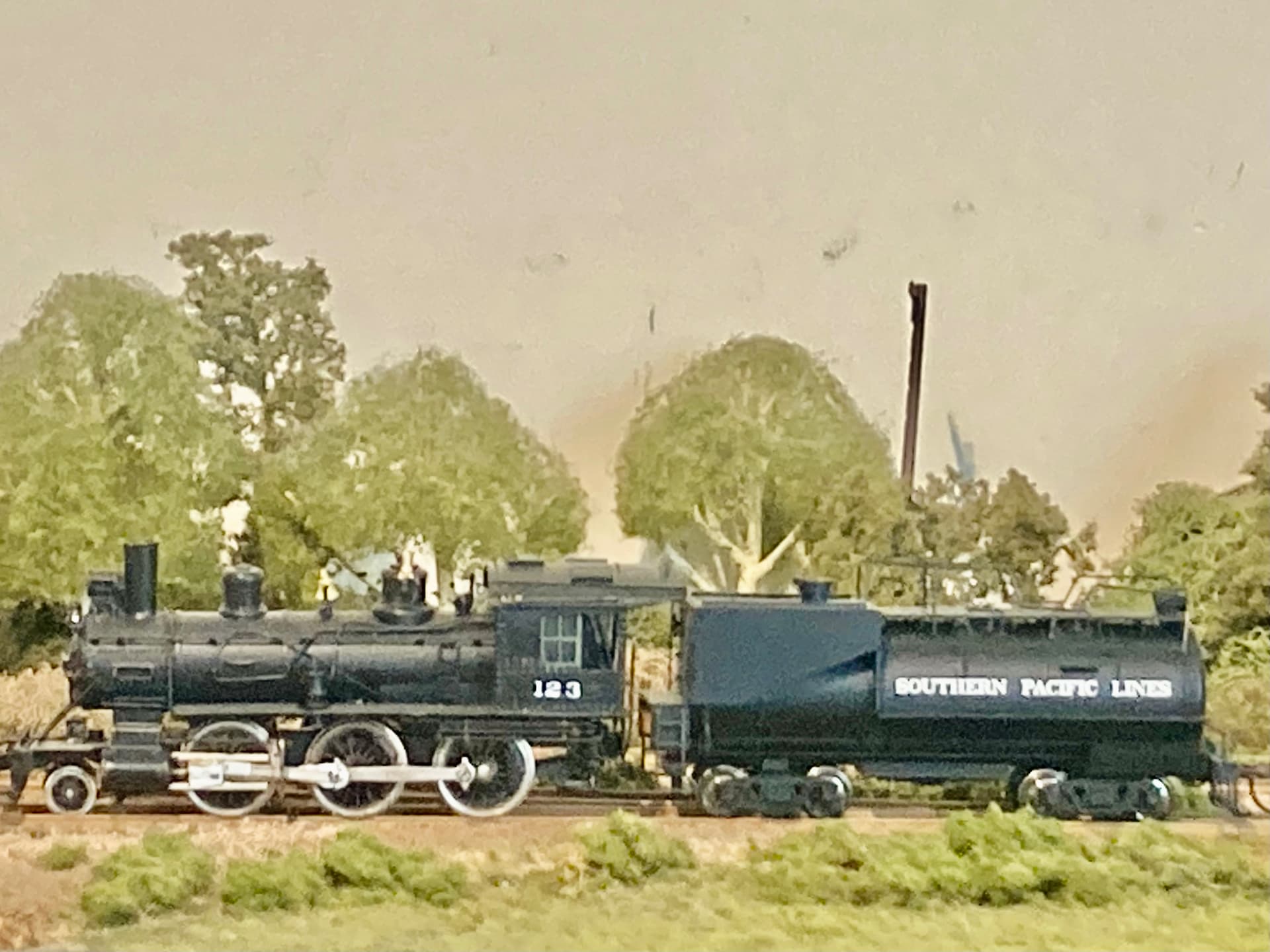
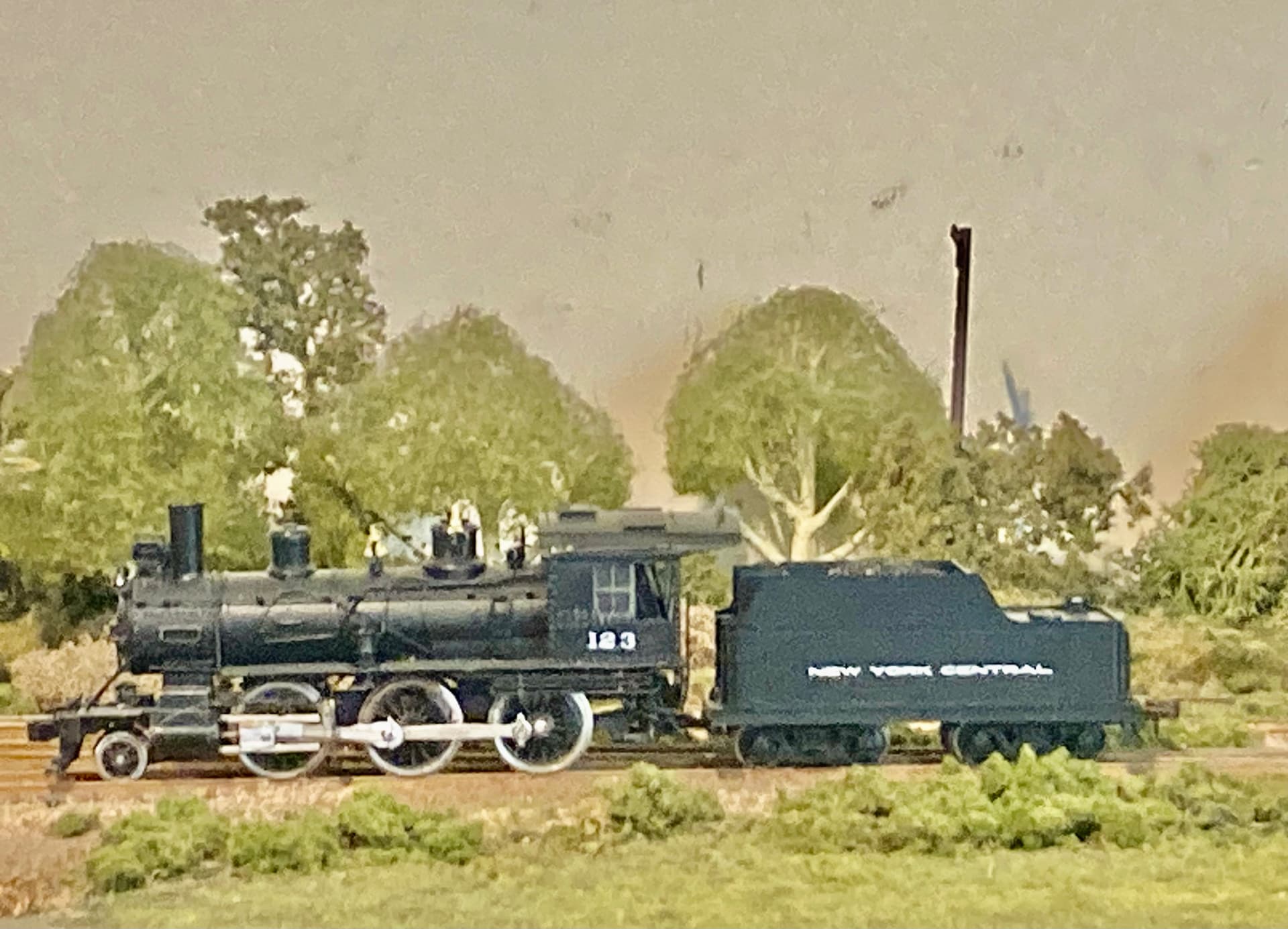
You wouldn’t get very far with a load with the right-side eccentric crank where it is set… if your engine actually used steam. Since I don’t know if you’re backing up in the pictures, I reserve judgment on the reach rod.
If I were you, though, I’d do something about that visible red pigtail on the backup headlight… I am trying hard to unsee it, but without success so far. It’s a bit like that miserable old psychophysical problem: 'Try not to think of a hippopotamus for the next sixty seconds.
You’re right about the eccentric crank. I appreciate that, it’s something I hadn’t noticed. It’s supposed to be set 15° ahead of the driver axle. I fixed that on a bunch of the Bachmann engines I have, but these brass engines have a leprechaun-sized screw that tightens them from the side of the crank pin. I know there’s a little screwdriver that can do that job, but I don’t have it. At my age and the according decline in visual acuity, I think I’m just just going to let this go and let the inheritor of this locomotive deal with it. I already know who my stuff is going to, to the son of my Model Railroad friend who is also a Model Railroader of high degree but in the military at the moment. He’s going to be out in a couple of years, when I’ll start thinning the herd and sending that stuff over to him..
I knew about the red lead going to the backup light and there’s also an unpainted white lead from the end of the tender. The only holding that up is a trip to the hobby shop when I can get there, which ought to be this week sometime, to get one of those thimble sized containers of flat black and some micro brushes.
But what I was actually referring to is that the stack is not set perfectly vertically on top of the smoke box, but rather leans slightly to the right. That engine came with one of the most beautiful paint jobs I’ve ever seen on a brass engine, and I’m not going to mess it up trying to move the stack slightly.
One of the very first four engines I bought upon reentering Model Railroading. It was close enough to the Missouri Pacific spot class consolidation to suit me.
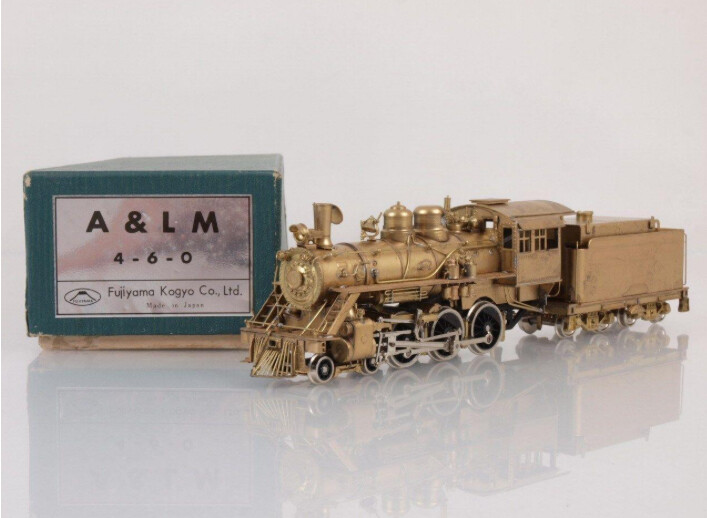
About to get this. It fell in my lap today. I bought a brass Southern Pacific 4-4-0 about 10 years ago and never really connected with it, it has sat in the box all these years. Waiting for the golden moment today when I could trade it for one of these 10 wheelers. Getting it shopped and painted is going to be expensive but it’s worth it. It reinforces my vision of my layout as being a short line associated with the Missouri Pacific. I will letter it for its prototype, Arkansas & Louisiana Midland no. 100.
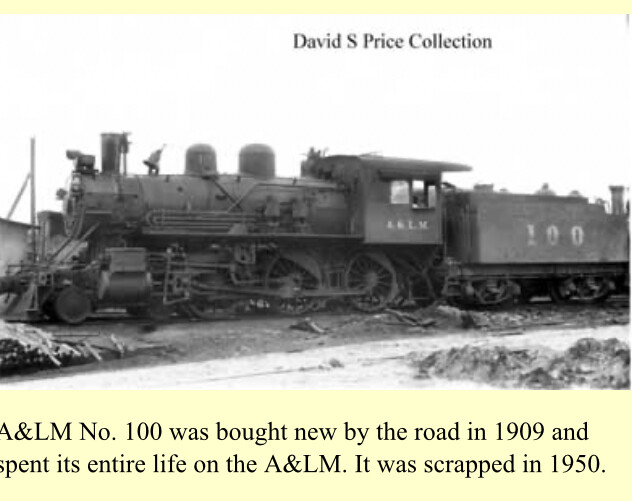
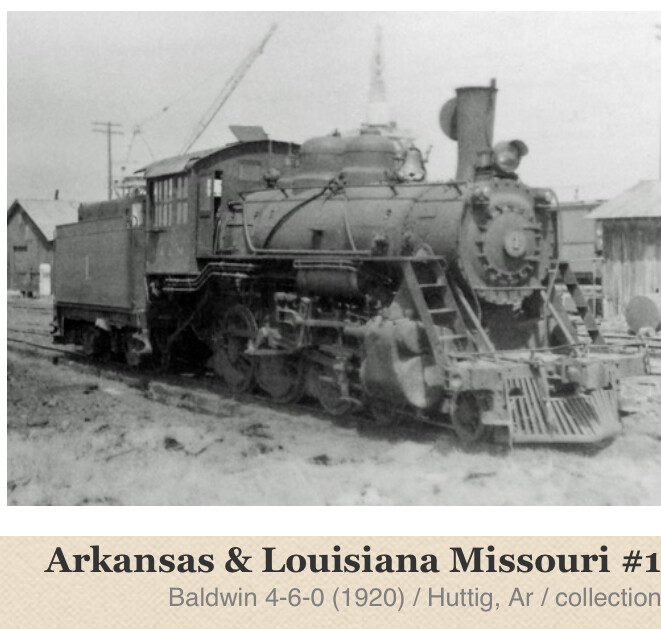
Looking quickly at the prototype picture, I see that the bell is in a different place than on the model, and a stack light has been fitted that completely replaces the hinged stack cover. The pilot wheels are completely different in casting profile, too. And what in holy Hanna is going on with that valve chest?
We might make a running list of things to ‘adjust’ before painting…
But, having looked at a lot of steam engines for a very long time , I know during in their long lives when they were shopped, steam locomotives were almost always changed around to some degree. Some changes were minor, others larger. In the past, I’ve seen other photographs of this engine, and I do intend going in a deeper dive for that. Of course, there could’ve been a sister engine too. I’ll find out..
If indeed Fujiyama missed a couple of beats on this engine it won’t really matter to me much at all. It personifies southern short lines and I have thought about one for a very long time.
I quit counting rivets long time ago, and I have had a much happier and peaceful life since. I am in the NMRA but won’t stay much longer. I have found no one in that entire organization that shares my interest in this kind of railroading, but it’s really hilarious to watch the rivet counters and operations hounds obsess.
They are. I think it’s a factor of being younger., and having energy to expend. I just don’t have energy for that kind of stuff anymore. I’ve only got a few years left on earth and I am going to enjoy them while I can.
I knew this photograph existed somewhere. I finally found it. This is the actual prototype for the Fujiyama A&LM ten wheeler. I erred and picked the wrong prototype photograph. Still a beautiful locomotive. A little more modern than the 100, especially with the piston valves. The piston valves, dome style, and smokebox door all look like stock catalog locomotives of the early 1920s,
Patrick, couldn’t agree more with your outlook. Nothing wrong with “counting the rivets” but it can sometimes just interfere with the overall enjoyment of the hobby, at least as far as I’m concerned.
So you’ll paint it as engine 1, not engine 100 as you said.
Note that 1 in the picture has spoked lead-truck drivers. I can’t tell from the picture if your model does, but that’s more than a rivet-counting difference (although certainly not something I’d obsessively complain about if I saw it running on a layout!)
The model DOES have the prototype’s stack light, now that I know what to look for. (As a peripheral note, the ‘right’ place to put these lights is behind the stack for best operation, ahead of the stack for best maintenance – the price paid for having the light ahead of the stack is that the cover ‘lid’ hinges to the rear, where it might tend to bang in the slipstream even at comparatively low speed.)
Yes, I’ll letter it as A&LM No. 1. I’ve seen numbers of this model for sale on the Internet lettered for someone’s Model Railroad. I thought about doing that, but the A&LM is in part a Louisiana Road and since I’m one of the few people that model railroad lines in Louisiana, I’m gonna stick to the prototype when it’s very clearly known..
About spoked pony truck wheels. Over long years of looking at I don’t know how many engine photographs, it appears that many of them originally had spoked wheels that were changed to solid in some shopping along the way. The first time this really affected my modeling was when I saw that the Russian decapods originally had spoked wheels when delivered to the MP, but all that I’ve seen photos of were changed to solid along the way somewhere. I can’t speculate why, but there must’ve been some issue with them because so many engines had that modification later in their life. The Bachmann decapod comes with spoked pony truck wheels. My first couple of engines, I changed them to solid wheels, but after my prototype adherence requirements loosened up over time, I decide to leave the spoked wheels in there because they just look so cool when rolling at slow speed. Besides, even though the MP only had eight of those engines, I have seen late date photographs of only some of them, so there may be a couple that kept those spoked wheels.
This engine came with a slight eBay lesson. If you look very closely at the crosshead, it is a wonky homemade replacement. I don’t think it will hurt operation, but all those shiny rods and oversized driver tires need to be blackened.
I cast my vote for #2, which should also fit in better with all the rest of the MoPac examples.
Looks to me as if the cross head and rod on that side were both homemade… and how on earth did the front end of the main get unpinned from the crosshead? Can we get a picture of the (presumably less modified) other side for comparison?
I would make a replacement crosshead only in the name of better sliding operation (since the rod is only pushing or pulling on it, and you can arrange a better shiny piston rod as you go…)
It does have slide valves, with inside Stephenson gear.
I was going to mention that he ought to straighten the croggled outside reach rod that goes from the bell crank to where the valve rod would be… but that might not be worth the necessary work.
For some reason very few inside-Stephenson models appear to be rigged to make the cranks operate prototypically – this is a very slight motion on many prototype engines, and perhaps not worth replicating in a model as Walschaerts ‘monkey motion’ is.