Okay so it’s a video PDF I just did for them and yeh, it’s a shameless plug for an MR product, but since this is the MR forum I figure it’s okay to promote one of their own products just a bit. For the record it’s also the first of a series of articles that will include some segments involving the need to do scratchbuilding.
As has been said, if people don’t write it, they can’t publish it … and when I made it, they seemed happy to publish it. So if there’s a plot by MR to eliminate scratchbuilding articles, I’ve never encountered it.
Actually, they had a great article in a recent issue about scratchbuilding a streamlined passenger car. The car was in O-scale, but it’s a great article.
Interesting topic. However - when those PDFs come down to what I consider a reasonable cost (a buck or so), I might try one. But while they continue to run at about the newstand price of the entire magazine, I’ll pass.
It’s been a long time since MR did regular scratch buinding articles. That’s what back issues are for when folks, perhaps by necessity had to build and had more time to do so. Even Craftsman kits or even simpler kits are not selling as they once were. Take a look at the ready to run freight car offerings, R-T-R vs. say a P2K tank kit. The kit is 1/4 the price, but you see them just sitting in favor of the open the box, put it on the track, look at it go kind. Maybe the skill level which also takes time to build uo to just is not there. My buddy was horrified to open a KD couple gage to find “it’s a kit Joe”. Not to worry, I assembled it for him in no time at all. Now on the other hand he is a computer whiz, while I’m lucky to typo. Scratch building, try RMC. Oops,[;)] can I say that?
I wish someone would compile an E.L.Moore collection only modify them to use modern materials,or the old Dollar models series modified to reflect todays prices say like $5 dollar model projects. There are a few books around 101 projects for your model railroad,by Robert Schleicher comes to mind. MBI publishing co. Anyways ,thats my [2c]
Joe,I think true scratch building is slowly dying out…[:(] My biggest question is why use styrene timbers on a wooden trestle? Maybe I am old fashion but,if I was going to spend the time scratch building a wooden trestle then by golly I would use wood.
Interesting comment … most of the text only PDFs are a compilation of various articles all on a single topic – reprints if you will of MR material. If you are new to the hobby and don’t have a huge collection of back issues, they are darn handy.
Many of the compilations run upwards of 20 pages or so, which is two-thirds of the article content of an issue of MR – and the PDF compilation will be about a single topic of interest. What would you pay for an issue of MR where two thirds of the issue were all articles you wanted?
Even if you have the content, having it all together in one place at your fingertips can be worth the cost of an issue of MR.
The video PDFs are an interesting case. No only do you get a text-based article of 3-5 pages, you get 8-12 minutes of how-to video. Most hobby videos these days run about 60 minutes and cost about $30 – heck Allen Keller’s DVDs run 60 minutes and cost over $40 each. That’s about 50-70 cents per minute of video.
If we assume the video PDFs average about 10 minutes of video, then at 50 cents per minute they should cost about $5. They cost $5.95 – but then remember you are getting a text article PDF as well, so $5.95 sounds like a bargain to me.
And there’s nothing like watching a technique demonstrated to really learn some powerful insights.
In short, I think you are being penny wise and pound foolish, Mark. Of course, I am the author of many of the video PDFs, so you could claim bias … [swg]
Styrene trestles go together amazingly fast and they are almost indestructible. Any wood trestles I have built take more fussing to build and are easy to damage because they are so delicate. Finally, as I show in the video PDF, you can easily make styrene look just like wood.
Styrene is such an easy material to work with that I use it for almost all my structure scratchbuilding projects these days.
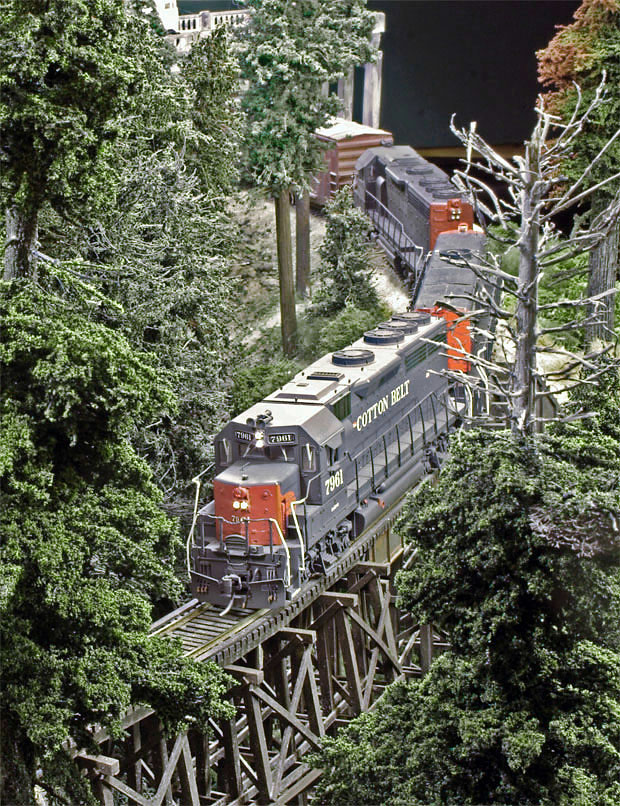
This wood trestle was actually made out of styrene!(click photo to enlarge)
Some of the dollar car projects were reprinted years ago under the title “Easy-to-build Model Railroad Freight Cars”. Using modern parts will drive up your cost considerably. If you’re looking to keep costs down you can use the old techniques of spikes for door guides and bent wire for handles, but I’m not sure there is enough interest to sell many books using those techniques.
No problem, that’s the beauty of this hobby … use the methods you prefer.
However, I would have to ask if you have done both – built a trestle with wood and built one with styrene? And if so, do you still prefer wood? I’ve done both many times and my material of choice is styrene, because of how fast and easy it is to get crisp detail and to get a structure that resists damage from handling.
It’s also very easy to make styrene look like wood, metal or concrete, as needed. Until you’ve tried styrene for model construction, it’s hard to understand sometimes why the stuff is so great to work with. I use a needlepoint glue applicator and when constructing a structure, I can glue the pieces together almost as fast as I can move. Try that with wood or cardstock structures … [swg]
I’ve use both wood and styrene for modeling. I prefer wood for wooden structures and wooden rolling stock and styrene for everything else. Granted, styrene can be painted and weatherd to resemble wood but I find working with the real thing easier when it comes to weathering although both look great when properly weathered. I model in narrow gauge in a larger scale than HO and for me wood is easier and more convenient to use for wooden structures. Styrene is great for representing metal, concrete, and other materials.
While I really like styrene for many structure applications, I also use wood or metal in some cases.
For instance, I’m working on a PDF installment in this series where I’m building a grade crossing for a gravel road. I’m using real wood for the wooden timbers, but I’m using 1/16" square brass channel for the railroad crossing sign post.
The real wood works just as easily as anything for the wood grade crossing timbers, but the brass signpost, when painted dark brown, is indestinquishable from a wooden post, but it makes the sign nearly indestructible.
If I can, I prefer heavy-duty construction techniques for things that are around the railroad track itself on an operating model railroad like my HO Siskiyou Line. That’s why I like styrene for wood trestles and brass for sign posts – using tougher materials for things near the track means they will survive with far less damage if you have a mishap during operation.
Since I host regular operating sessions on my layout, we get damage to something every single session. But if I can make something tough enough to endure the normal abuse of layout operation, then that’s one less thing I have to worry about fixing later. When you have a larger layout, building in lower maintenance is an important consideration. [swg]
Joe,To be honest my last scatch building project was a station and thats been years ago.While I will use ABS plastic shapes for loads such as I beams,pipes,sheet steel etc and other uses I don’t think I would care to it use on a scratch building project that calls for wood after all wood looks like wood from the start and there would be no real need to scribe “wood” into the plastic.I could see using thin ABS strips for vinyl house siding though.
Oh, but isn’t it less prototypical for there to be less damage? [:)]
Honestly, I haven’t done a whole lot of scratch-building, but I’ve been using a wide variety in what I do: hydrocal for footings, wood and styrene for small trestles, cardstock in buildings, a little metal for fine details. Whatever works in a particular place.
I’m not so worried about speed- heck, since I can frequently only get a few minutes at a time to spend on modelling, there is ALWAYS plenty of time for glue/paint to dry.
Regarding price of the PDFs, MR is welcome to charge what the market will bear. I’ve bought a few downloaded PDFs (mostly for gaming stuff, not modeling) in the $5 to $10 range, but they’ve typically been 20-30 “pages” of material. Not sure how that translates/correlates with the video portion.
Another thought regarding the “wood already looks like wood” argument. I frequently read how-to articles which mention further distressing the wood, since the grain of the wood doesn’t scale (that is, if the grain on basswood, for example, were “scale”, the growth rings of the tree would be inches across in HO scale). If you’re already going to be modifying the surface of the wood, to make it look more “in-scale”, then why not start with the styrene?
The argument about differences in finish, OTOH, seems a lot firmer to me. Wood takes up stains in a significantly different manner than styrene. As has been mentioned, the results can be comparable, in the hands of a Master, but some people may consider the styrene harder to get an appropriate finish/weathering appearance.
As always in modeling, YMMV. I’m always interested to hear what others are doing, even if I won’t end up doing it that way myself.
These are some of the reasons I like to use wood for wooden structures. Because wood is porous and takes stain and paint differently than styrene, it is much easier to get a good weathered look on it without the use of the advanced painting techniques needed for styrene. It is also very forgiving and versatile when it comes to staining and weathering. If you put too much stain on or the color’s not quite right - just sand it and restain for an even better weathered look. Granted, when styrene is painted by an expert using advanced equipment and techniques, it can look as good but wood is much easier for me to achieve the weathered effects I like using simpler methods. As far as drying time for glues, I’m in no hurry.
I guess this is where I would beg to differ … once you know the trick, you can get a weathered wood look on styrene just as easily as with wood. Knowing the trick is an expert “secret” I guess, but once you know how, styrene’s not any harder to finish than wood.
In fact, I now prefer making styrene look like wood over messing with real wood because I have more control in the final “look”. I often can’t completely control how the wood is going to take the stain, and often cement spots on the wood don’t take the stain the same – which can be almost impossible to finish properly without just painting over the entire structure and starting over.
Styrene takes the paint and stain the same all over cement or not. And for painted structures that have been kept up, wood or styrene looks the same once you put a good coat of paint on it.
So what’s the expert secret? If you need a weathered wood look, rough up the styrene a bit with 200 grit sandpaper (sand only in the direction of the wood grain) and paint the styrene a raw wood color, then let that paint dry for a couple of days first. Now you can paint on a thin weathering color stain coat. Paint it “with the grain” and let it streak to form grain like lines. Anything that shows through will look like wood because its been painted a wood color. The stain will settle into the grain lines made with the sandpaper and darken them naturally.
Joe,The question that pops into my mind is why learn a new trick" when wood takes stains so readily? IMHO that would be another con against plastic.
I dunno Joe…Maybe I am missing something? But,on the other hand I have seen ideas printed in MR,RMC and other magazines that wasn’t the best method of doing something…
Sorry Joe and with respect I just don’t think ABS plastic can match looks with wood.
 Learn scratchbuilding techniques for your next bridge project