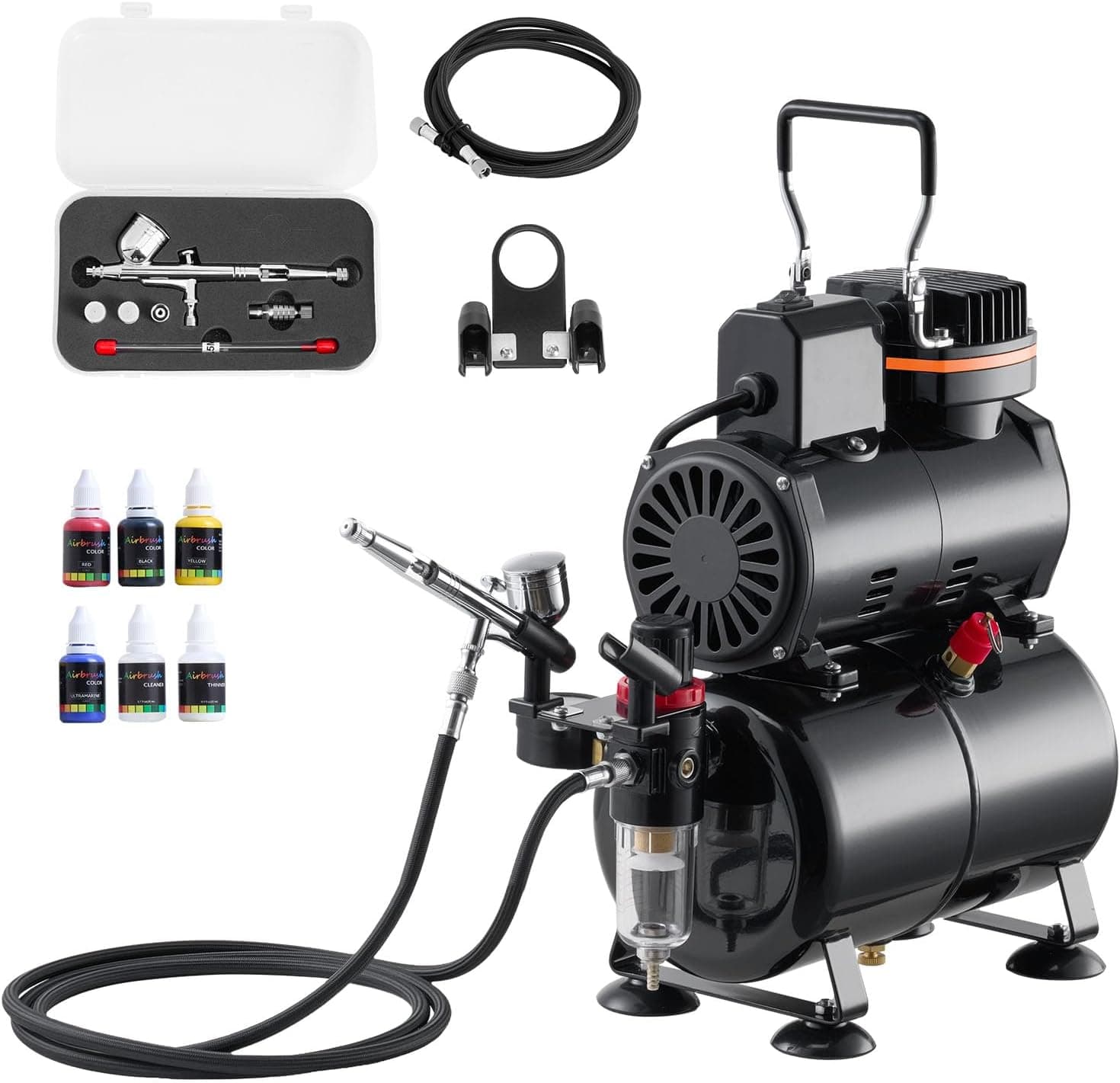
One issue with VEVOR is the documentation, somewhat poor or at least confusing,
Nowhere in the advertisement does it mention a pressure regulator, But I did find this in a third party manual for the TC-20B (the link that Bernie provided says that the compressor is a TC-20).
“If you need a smaller pressure and gentler airflow, you can reduce the outlet air pressure on the pressure regulator when the compressor is at the auto stop (clock at 4bar)”.
So, that would clearly suggest that the compressor does come with a regulator capability.
The manual that I found does contain two photos of how to operate the regulator, but the photos do not clearly show the procedure. From other sources, I have deduced that you lift the knob and turn it to the desired pressure.
The best advice is to wait until the compressor is delivered and test its capability before buying any additional parts.
That’s what I told y’all above that I went to the VEVO site and saw that it comes with a filter and regulator but it’s hidden behind the tank with the gauge in a weird position, but y’all said I need a better regulator than what comes with it. So I trusted y’all.
Ever heard of the old saw, “I know what I know, but I don’t know what I don’t know?”
Settle down there. You’re being a bit unfair to everyone trying to help you. VEVOR is not exactly a household word when it comes to air compressors. Furthermore, the meter that you initially referred to is not behind the tank; it is connected to the back of the moisture trap. And, it took a fair bit of sleuthing by several guys to determine that the unit you bought likely has a pressure regulator.
The actual filter and water separator is the thing in front of the compressor. The actual regulator is the screw handle on top of that thing. The pressure gauge reading likely has nothing to do with regulated supply pressure out to the airbrush.
Multiple people have now said ‘wait for the compressor to arrive and see how it does’ before buying anything else. The only potentially missing piece would be transition fitting between the compressor and your chosen airbrush hose, and we can take that up if you post photographs after you have the equipment set up.
That reminds me of a question that I meant to ask earlier.
Besides my HF compressor (Central Pneumatic) that did not come with a pressure regulator, I have a larger air compressor, Campbell Hausfeld, that I use for other purposes. That compressor has two gauges, a pressure gauge and a pressure regulator gauge. You dial the desired pressure on the pressure regulator gauge, and the pressure gauge shows the current PSI output.
Now, my question. How does that work with only a single gauge. In other words, how do you know what amount of air pressure is being set/regulated? Is it trial and error?
It’s what I’ve been saying… apparently without enough sense.
The single gauge appears to be monitoring tank pressure (see the discussion of pump deadband in the manual that was provided) BUT when you have automatic pressure control, that gauge isn’t particularly meaningful.
When there is no regulated-pressure gauge, either you have to guess, or you rig up some way to test pressure with a suitable gauge or manometer. As noted that can be as simple as putting a Schrader valve on a quick-release fitting and using an automotive tire gauge (with sufficient resolution; my digital gauges read to 1/2psi).
Now, if that compressor’s regulator works as I expect, the number of turns to open it from ‘closed’ to some measured pressure should be consistent over time. So all he would need to do is make a little table of turns vs. pressure for the common ranges of pressure being recommended, and then easily close and reopen in a few seconds whenever he wants or needs to change pressure.
Note that the test Schrader valve could be plumbed into the arm of a T fitting with the tool air inline. If he wanted to work with smaller-size fittings out of the regulator/separator, he could probably adapt Presta valves, but I wouldn’t wish those on a dog.
That’s probably a retaining ring for the screw-regulator body.
Sometimes it does pay to RTFM.
Note part 35, “manometer”, which appears to screw laterally into the regulator-separator right where it would read regulated output pressure as it should.
The knob gives him full pressure regulation from “0 to 4 bar” which is likely suitable for anything he’d use a modeling airbrush to do.
At delivered mass flow I don’t think there is much difference. The compressor cycles between about 3 and 4 bars, so the pressure going to the regulator is always higher than the range of spray pressure. The manual appears to be saying to adjust the pressure with the airbrush activated and “4 bar on the clock”, which for all intents and purposes would give airflow through the brush as expected to the nominal regulated pressure.
Of course now I’m even more confused about where the compressor actually gets gauges. The pictures in the manual show a setscrew plug in the port where the ‘manometer’ should attach in the exploded-view drawing, and the instructions seem to bear out that there is a tank pressure gauge that reads up to the equivalent of 4 bars… so we’re back to two-gauge operation being useful and more-or-less-easily provided… but he’d need a second gauge from VEVOR to do it.
I’m glad I read this thread. I don’t own an airbrush either, but have considered buying one. I would have thought all you needed to worry about laying the paint is having an airbrush to modulate the paint and a compressor to push the air. Regulating the amount of paint would be accomplished by simple one motion finger trigger pressure and the ratio of thinner to paint. About 50 percent thinner to 50 percent paint, to keep the paint thin and the nozzle clean. About 80/20 for weathering. Things seem much more complicated than that.