Opinion/Question: Do we need more mainline steam restorations?

There are many steam locomotives that I personally would like to see brought back from the dead. Who wouldn’t want see an AC-12 locomotive running?

As other posters have stated, are there enough resources and competent leaders? We’re lucky that the UP program still exists.

I have heard some people ask why the UP took six years to get the 4014 running. They say in the old days, steam locomotives were rebuilt in a matter weeks.

Of course, in the 1940s a typical class 1 railroad had thousands of people working 3 shifts rebuilding steamers. Because of the advent of the diesel locomotive, the number of steam locomotive rebuilders drastically declined.

It is easy to say lets do something. The fund raising, problem solving and managing different people who know how rebuild a steam locomotive, some of whom might not get along, is the tough part.

Well said Joe!

The only thing I could add is back in the old days backshops had bins of replacement parts ready to hand. That situation doesn’t exist anymore either. Many have to be fabricated from old drawings or using the old parts as patterns.

Any good machine shop can do it, but that takes time and costs probably more money than it did years back when there was a steady market for said parts.

Has anyone done a serious study to examine the size of the steam locomotive market?

Suppose money were no object I started a company for new build steam?

How many locomotives (standard gauge) could I sell in a year, or two?

Kevin

Realistically, the market would probably come to two or less locomotives in a given year. Lining up subcontractors to manufacture the necessary parts might be possible but their prices would be high for what is basically a custom job.

There was an outfit building new steam engines. Ever hear of Crown Metal Products? They’re not around anymore, but here’s the story.

https://en.wikipedia.org/wiki/Crown_Metal_Products

They have a fansite, but most of it’s under construction, here’s the link…

www.trainweb.org/crownmetalproducts/

As to whether there’s a market for standard guage steamers that’s anyone’s guess. Changing tastes, for lack of a better term, in amusement parks are one of the things I believe led to the fall of Crown Metal that the Wiki article doesn’t mention. For example, about 25 miles up the road there’s an amusement park called “Kings Dominion.” They had a steam railroad there, but when Paramount bought the park 30 or so years ago they altered the park with a “sci-fi” vibe that a steam railroad didn’t fit with, so they sold it off. Paramount doesn’t own the park anymore but the steam railroad never came back.

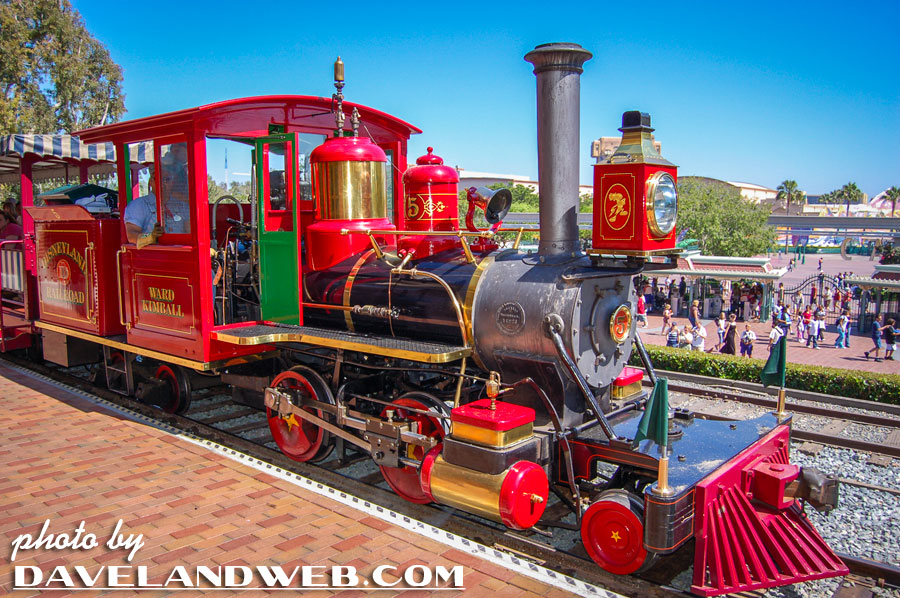
C.K. Holliday of the S.F. & D.L.

The sooner the better and cheaper.

Costs just go up with time.

It would be difficult to produce a locomotive for mass production in the US and hope to make a profit.

There is a group in England that is working on a new-build 2-6-2T with the idea of building more copies over time for the numerous small operating tourist railroads in England.

http://www.82045.org.uk/

Of course, over in the UK steam locomotives are much smaller units than most US steam locomotives. Consider that the P2 three-cylindered 2-8-2 with 43,462 lbs of tractive effort were the most powerful locomotives in the UK and the Class 9F 2-10-0 had the most tractive effort of any UK locomotive at 53,328 lbs of tractive effort.

Consider that the E-3 4-6-2 Pacifics of the Omaha Road had 51,567 lbs of tractive effort for comparison.

Taking up the premise of money being no object, if I were a billionaire and wanted to build new-build steam as a hobby, for the US I would probably develope an oil-fired version of the Boston & Albany D1A 4-6-6t that could be useful for “out and back” tourist operations such as the New Hope & Ivyland, Mid-Continent Railway Museum, North Shore Scenic Railroad, Boone Valley Scenic Railroad, etc.

Image result for boston and albany 4-6-6t

41,651 lbs of tractive effort

63 inch drivers

215 lbs boiler pressure

1,585 gallons of oil

6,000 gallons of water

There’s a long, rich history of outfits either setting up to build ‘new’ steam engines or proposing them, with the premier outfit (no one seems to have mentioned it yet) being SLM/DLM with Roger Waller. One thing developed in Europe that we haven’t tried (enough) here is the use of ‘Plandampf’ both for freight and for things like commuter passenger, for which very careful economic and capital feasibility plans have been worked out. Here the use of reasonably high horsepower (or to put it a different way, relatively low factor of adhesion) makes sense even in fairly small designs, as there is some value in ‘pulling any train you can start’ at what might be high peak speed to clear passenger-oriented traffic.

In this country, we have David Kloke as a promising source of new engines of a particular style (which could of course be modified to suit what many operations think they’d most benefit from). I think there has been some resistance to ‘foreign-looking’ engines – in part this argument hinges on whether a given operator has most of their income stream from ‘railfans’ or from families who love steam of even the most ridiculous kind for “passenger” service – and some of Kloke’s designs are resonant with romantic conceptions of what steam ‘should look like’ if you are running, say, a Western-style thing complete with daily newspaper butchered on the train and the obligatory feigned outlaw stick-up, etc.

There is a long and tattered history of people who wanted to set up companies to sell ‘new steam’ to the tourist market (vast and growing in England, for example) – the whole of the 5AT project was geared toward that as practical use of their product ‘most of the time’, I think very intelligently. Of course the lion’s share of the work both to produce that engine a

This is laudable … but did you read down far enough to get the weight on drivers and truck axles? A great many of the out-and-back operations will NOT like the size and weight of that thing.

Meanwhile, for nearly the same amount of money (and, in fact, probably far less, considering the tender sits at Steamtown available for a pittance) you could have a full J1e modified for effective excursion service, a far better use of the money (and not that much longer, or difficult to run bidirectionally with modern and very cheap camera technology. And there would be some market for multiple production. Just resist the temptation to build a J3 rather than an advanced J1 for this historical purpose, even though the former is ‘technically’ a more advanced and efficient design… don’t give me the ‘streamlined-to-compete-with-5550’ argument as there is historical precedent for the Dreyfuss streamlining on a J1e.

Don’t make me grind my teeth over an ‘optimized’ J2 with its lower and nominally more “practical” driver diameter. Just – if you do it – fix whatever made the cabs sag.

A couple of things…

First, a thank-you to “Penny Trains” for the posting of the “C.K. Holliday” under restoration at Disneyland. As a life-long railfan and steam freak Walt Disney insisted on a live-steam railroad for Disneyland, and then Walt Disney World in Orlando. There’s been rumors of both steam ‘roads being converted to “steam profile” locomotives, probably unfounded. Walt would come roaring back from the dead "…kickin’ ass and takin’ names…" as we used to say in the Marines if anyone tried. Don’t think it wouldn’t happen! I wouldn’t take the risk!

Second, kgb’s idea of a steam tank engine isn’t such a bad one, a short run “Out-and-back, taste-of-steam” is a fairly practical option for some organizations, and a small six-coupled steamer is a fairly economical machine to run. I’m surprised Steamtown didn’t resurrect CN 47, a 4-6-4 tank engine instead of the 0-6-0 they did restore just for that “…taste of…” purpose, but what do I know, I wasn’t part of the process. What it would cost to build a new tank engine I don’t profess to know.

Third, Overmod’s comments. David Kloke crossed my mind earlier but I really don’t know just how active he is in producing new 4-4-0’s. He’s built three so far, whether he’s planning any more I couldn’t say, so I didn’t bring him up.

If I remember right “low-cost operating steam” to save wear and tear on originals was brought up as far back as the '90s in “Locomotive and Railway Preservation” magazine, and with parts standardization as well. No-one’s picked up on the concept of course, at least not yet.

As much as I’d love to see a new Hudson myself, we get back to the problem of where to run it. Without a sympathetic host 'road w

The C&O 614 would be a great “best of both worlds”. It’s a Hudson, it already exisits so no need to try to build a new boiler, it’s unique, and close enough to the Western MD to be used there, or any other railroad friendly to steam. As for Amtrack rules, those can be changed at the stroke of a pen from Congress, or the Smithsonian Institute (what’s wrong with a moving museum… could reach a lot more people!).

[quote user=“xboxtravis7992”]

To clarify what I am trying to ask in the title… I have been wondering do we need more mainline steam programs/restorations than what we currently have going on right now? With the success of Big Boy this week I have been starting to wonder, “what’s next?” and I began to sort of tally in my mind some of the ‘big steam’ that has ran mainline runs in the last ten years or so, or is currently under restoration/replication. To sort of show what I mean a list of ongoing programs I can think of include:

UP Steam (UP 844, UP 4014 both under steam; with UP 3985 sidelined for possible rebuild down the line)

Oregon Rail Heritage Foundation (SP 4449 operational, SPS 700 and ORN 197 under restoration/rebuild)

ATSF 3751 (rebuild)

ATSF 2926 (restoration)

Milwaukee Road 261 (operational last I heard)

Iowa Interstate (two operational QJ locomotives)

Ft. Wayne Railroad Historical Society Nickel Plate 765 (operational)

NW 611 (operational)

Altoona Memorial Museum PRR 1361 (restoration)

T1 Locomotive Trust (recreation project)

Western Maryland Scenic 1309 (restoration… I don’t know if this will ever see ‘mainline’ service but I think its worth mentioning due to its sheer size)

Tennessee Valley Railroad Museum Southern 630 (operational, last used on mainline under former 21st Century Steam program)

Nashville Steam Preservation Society 576 (restoration)

Looking at this current list, I
That’s very right, EXCEPT that the NYC/B&A 4-6-6 is no more a ‘small’ engine than a PRR G5 is. The ex-CN tank engine at Steamtown (or the Jubilee) are contenders, but all the argument so far has foundered on their inadequacy to pull the length of consist that Steamtown operations would require even for marginal operating-cost break-even over the routes that would pay out of Scranton. Other operations would love them … once very expen$ively fixed to run, on light oil, with all the mod cons for inexpensive maintenance and easy safe operation…

The only one even remotely qualifying for what’s necessary was Repton. Which aside from looking a bit weird to American railfan eyes was repatriated to a land that cares properly for her, long ago.

The last I heard “Plandampf” is moribund over in Germany, Deutsche Bahn is cold on the idea.
[/quote]

As is the Swiss community that was considering steam operations, according to Andreas Schwander. Alas. Gives you some idea of how practical the idea would be over here, where there’s less ecological but much more stringent financial concern… and much more legislation and NIMBYism.

Good points Mod-man.

However, as far as Steamtown is concerned the “out-and-back” runs I mentioned are exactly what they’re using the 0-6-0 for. The long-distance, for lack of a better term, aren’t being done with steam at this time, the 2-8-2 and 4-6-2 they were using for the same are out of service. For the long distance runs they’re doing now, when they do them, they’re using borrowed diesels, either from the Delaware-Lackawanna (who run vintage ALCOs, interesting in their own right) or from other sources. So lack of pulling power on a long consist isn’t an issue at the moment.

I don’t know. Maybe steam for excursion runs isn’t as important as it used to be since mainline steam has been gone for over 60 years and the nostalgia factor isn’t there anymore, at least as far as the general public is concerned.

And again concerning “Plandampf,” I heard the demise of the same was a corporate decision on Deutschebahn’s part, ecological concerns and NIMBYism didn’t have much to do with it. I also heard it wasn’t a very popular decision with the Germans, they love their vintage steamers!

I’ll bet Juniatha raised hell over it, wherever she is! I’ll bet Sir Madog (Remember him? "People in Hamburg don’t tan, they rust!) raised hell over it too!

And you’re suggesting what? that we spend multiple millions on a strange prototype to take over the job an 0-6-0 already does cheaper?

Doesn’t matter; they’ll be run with the premier small-excursion engine in the world, 3713, for which the funding is already appropriated and, in large part, already spent/utilized. And when they run it I shall be there.

The only thing comparable to that (aside from 576, another done deal ultimately) would be the aforementioned 4-8-4 now at NH&I, with which something should be done before another penny is spent on new small ‘spec’ builds.

You must not have chased any of the UP steam expeditions. The ‘general public’ comes out of the woodwork, and many of them prove to have continued interest in restored steam.

How you monetize that is another issue, discussion of which I temporarily reserve to those who have lacking souls.

I was referring to the United States version of the idea. Yes, they lost the combination of political will and interest to promote the idea, in part because any carbon has become bad carbon in

I think I’ve been misunderstood.

Let me back up a bit. I’m not suggesting Steamtown go with a new build. That doesn’t make sense, given the material on hand.

If and when Steamtown goes back to being Steamtown, and not “Steam N’ Dieselville,” I’d say a good set-up for them would be like this…

Short rides, for those who want the taste of steam, but not the “full meal.” A three-mile in-and-out, pulled by a six-coupled, the 0-6-0 or the restored 4-6-4T. The 4-6-4T wouldn’t be used on the longer excursion runs. Remember the Jersey Central “Scoot?” That’s the type of run the tanker was made for, and it could run at a better speed than the switcher. An 0-6-0 can get “wobbly” if you push it too fast.

For the cross-county excursions, say Scranton to Carbondale, that’s what you want big power for, and when Boston & Maine 3713 is done they’ll have their power for those runs.

Now bear with me just a bit longer…

Keep in mind Steamtown’s a big place, it’s got the museum and the nearby Scranton attractions. If people take the long ride, they may not have the time for anything else. If they take the short ride they will have time for everything else. Both options, short and long rides, have to be available.

I can speak from personal experience having been to the Durango and Silverton twice. If you ride the train, you can’t see the museum, the train ride takes all day. If you visit the museum (which is superb!) you can’t take the train. It’s either-or. Which is why I advise people if they go to the D&S allow two days, or at least a day-and-a-half. Steamtown should be able to avoid that situation.

I may have downplayed the public interest in steam a little too much, if I did it was a poor cho

Okay, so when I hit the Powerball, we’ll work on slide-ruling down the B&A 4-6-6t down to something that will only need 80 lb rail for the Mid-Continent Railway Museums and Abilene and Smoky Valleys out there, and then we’ll work on the J1 Hudson for the more ambitious groups who need to pull 10 cars on heavier rail.

I read you kgb’, but if I hit the Powerball that 4-6-4T at Steamtown’s gonna get a resurrection, and it’s gonna get a make-over into an erzatz Jersey Central 4-6-4T! Hey, my money, my rules. And besides, it’ll go well with all that Jersey Central rolling stock they’ve got up there.

And then I’ll go looking for a USRA Pacific somewhere I can turn into an Erie engine!

Actually, ’76, if the 4-6-6T is slide-ruled down to run on 80 lb rail, it is going to be very close to CNR 47. Keeping the 3-axle bunker will just give a little more range for those Polar Express weekends! C’mon Powerball!

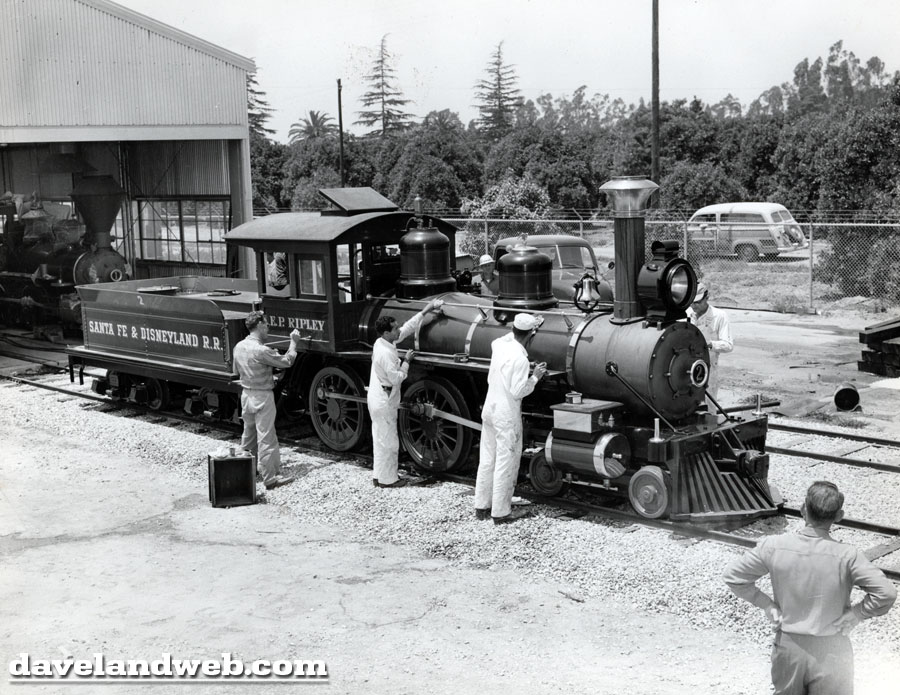
Actually, it was a completely new build. Both engines were built at the Disney Studios backshop:

The Wilmington Iron Works and the Dixon Boiler Works, both of Los Angeles, fabricated the boilers. Granted, that was 1954/55 and locomotive shops and their employees still existed who had been building steam locomotives.

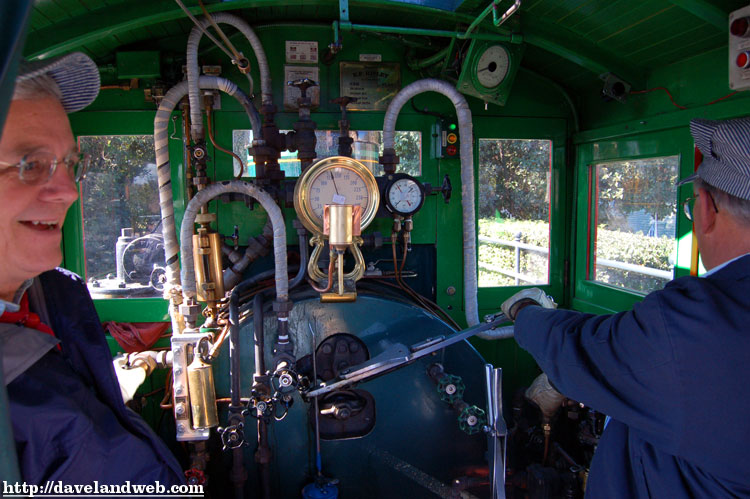
A look at the Ripley’s cab:

After the original 2 were built, Disney started acquiring locomotives for rebuilding, mostly from south of the border sugar plantations.

For example, this locomotive:

is dear to my heart as I rode on and behind her many times while she worked the Cedar Point and Lake Erie Railroad as the “Maud L.”