Opinion/Question: Do we need more mainline steam restorations?

Interesting, I didn’t know “C.K. Holliday” was a new build, I assumed it was a “rescue” like the Disney World engines.

And isn’t the “Ward Kimball” a stunner? I wouldn’t mind owning it myself! Most engines back-dated to an earlier appearance don’t look “right,” but the “Kimball’s” an exception. It looks like it always looked that way.

How ‘bout that woodside station wagon parked out on the street behind the Ripley!

Oh yeah man, that woody’s a classic in it’s own right! I wonder what happened to it?

Probably chopped up for Toyotas a long time ago.

That woodie wagon appears to be a 1949-50-51 Ford, but it’s possibly a Mercury. But without a doubt, made by Ford. The car with the split windshield could be a Studebaker, I’m guessing. Didn’t the Ward Kimball actually belong to Ward in his backyard railroad?

Ward Kimball owned two steam engines at one time, the “Emma Nevada,” a 2-6-0, and the “Chloe,” an 0-4-2T. Both were eventually donated to the Orange Empire Railroad Museum.

Ward’s railroad was called the “Grizzly Flats,” and here’s the story…

https://en.wikipedia.org/wiki/Grizzly_Flats_Railroad

I would hate to see so many that the novelty wears off, and public interest wanes to the point that excursions no longer draw sufficient revenue to be self sustaining.

I’m not sure where that point is, but I’m sure that it exists. Hopefully we will never find it.

The experience needs to be novel enough that demand for ridership is maintained, which supports ticket price levels that make the excursions worth all the work to organize and operate.

Personally I don’t see myself paying for 10 steam excursions over the next 10 years…and suspect that a great many people feel similarly.

I’ve even seen talk by some of the well-known restoration operators to delve into narrowguage “amusement park” type operations for the bulk of their tourist operation.

Somehow riding the captive two foot guage tour past the standard guage stationary display “big duke” just doesn’t capture my imagination.

The question would need be answered this way…look over at the U.K. and see how they do it. There doesn’t seem to be a shortage of people willing to ride mainline steam trips over there and they have several that are run annually along the same routes to the same destinations. I could see that happening here going to places like the Grand Canyon from Los Angeles, Ca or even from L.A. to Las Vegas, NV, Oakland - Reno…doing those trips behind steam 3 or 4 times a year would be practical and I doubt if you’d run out of people willing to take them, but then it’s possible, you aren’t selling it as a steam trip though but a jo

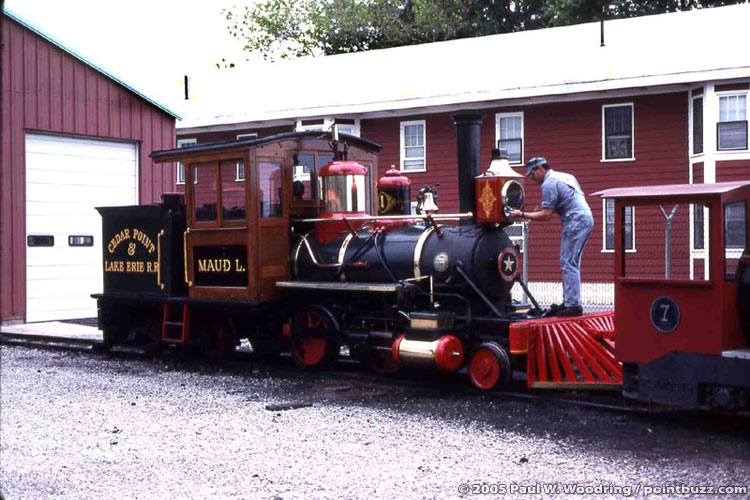
This is the way I remember her:

The story from: https://www.steamlocomotive.info/F22004.cfm

“****The Cedar Point & Lake Erie Railroad, circling the grounds at Sandusky, Ohio’s Cedar Point Amusement Park, was inspired by the Disneyland Railroad.” "****Beginning in 1960,Roose( George L., real estate magnate who bought and revitalized Cedar Point) crossed the country looking for small steam engines for the CP&LE. His first purchase in 1961 was the Maud L. (now at Disneyland) that he acquired from Arthur LaSalle’s American Railway Equipment Association of Billiard, Florida. It was rebuilt by LaSalle and ready for service in time for the CP&LE’s opening day in 1963."

Concerning the original Ward Kimball:

Interesting story about the “Ward Kimball,” ex “Maud.” When the text mentioned #55’s rehab into an ersatz Chicago Elevated 2-4-4RT I knew there was something about the “Ward Kimball” at Disneyland that was familiar. It looks an awful lot like the steam engines that ran on the New York elevated around the turn of the 20th Century, just not as big, those NYC engines were standard gauge. And it goes without saying by that they were nowhere near as ornate, just “basic black” as it were.

Anyway, I found some old film from 1899 of the same.

https://www.youtube.com/watch?v=8VJaNgmAqvY

Not Disney World, but Wayne’s World:

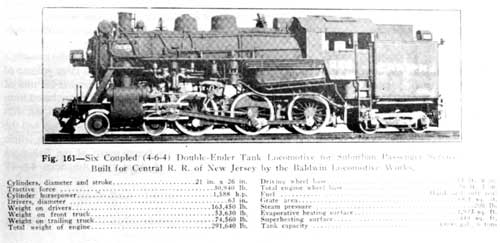
locomotive

Image result for central railroad of new jersey 4-6-4t

Maybe this gets closer to the universal new build steam for the small out-and-back operations to be funded by the railfan billionaire Thursteam Howell III.

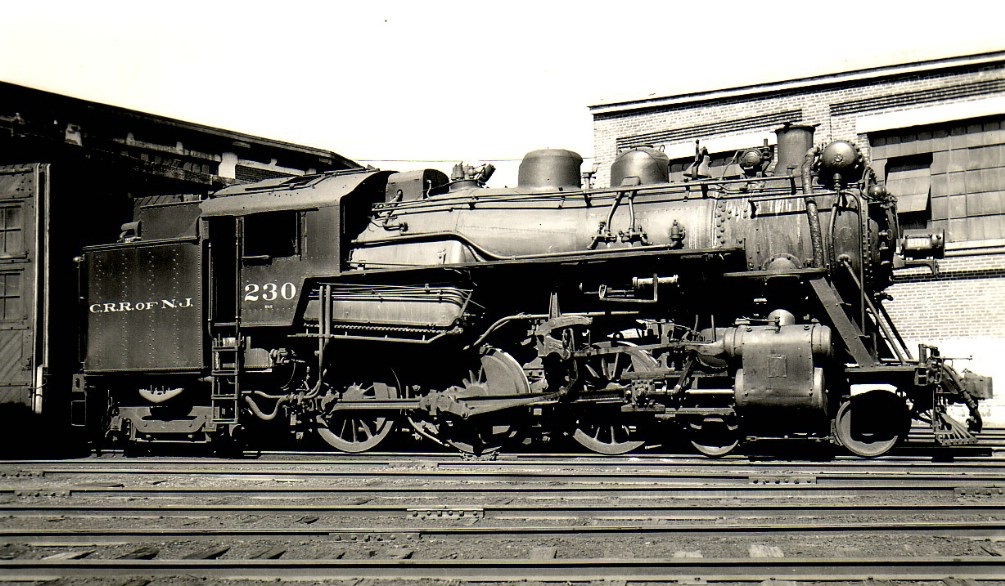
With all due respects, CNJ 225 looks like it was assembled from an assortment of spare parts of at least six different classes of locomotives.

A diesel equivalent might be one of the re-powering jobs from the mid-1950s.

“A camel is a horse designed by a committee!”

Yeah, I suppose you could apply that to CNJ 225! The thing is, the inspiration for that CNJ engine WAS the Canadian National’s engines of a similar type.

The CNJ had been running a shuttle from Newark to Elizabethport and back for a number of years, eventually it was called “The Scoot,” and had been using 2-6-2T engines, some of which went back to 1904. Well, they needed something better, looked North, and said “That’ll do nicely!”

They did!

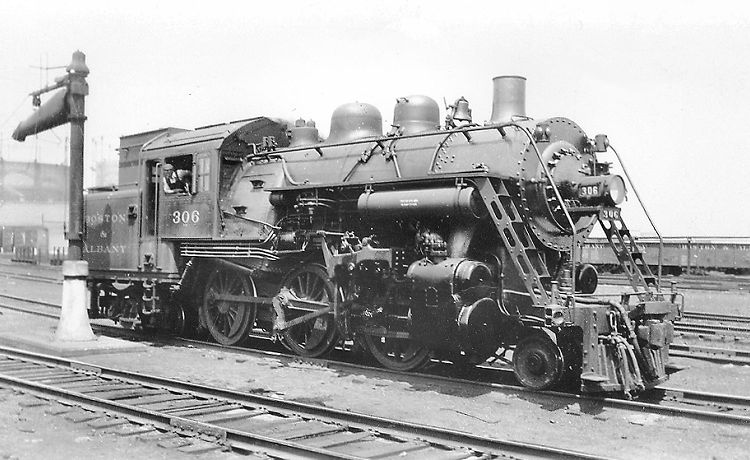
Boston and Albany also had some similar 2-6-4T and 4-6-4T suburban locomotives.

Logically (I know, I know) there are people starting from scratch when there are plenty of has-been excursion engines that are now dormant but could probably be brought back to life cheaper but there isn’t the money available.

Here is an older CRRNJ 2-6-2T that has a somewhat British flair to it, built in 1902:

Image result for central railroad of new jersey 2-6-2t

Further east, Boston & Albany had a large fleet of 2-6-6Ts that could run on 80-pound rail, built in the early 1900s and rebuilt by Lima in 1920:

Image result for boston and albany 2-6-4t

In 1928 B&A upsized a bit with five 4-6-6t units which were the culmination of tank locomotives for suburban service in North America (looking a bit like a down-sized Hudson) - these required 100-pound rail:

Image result for boston and albany 4-6-6t

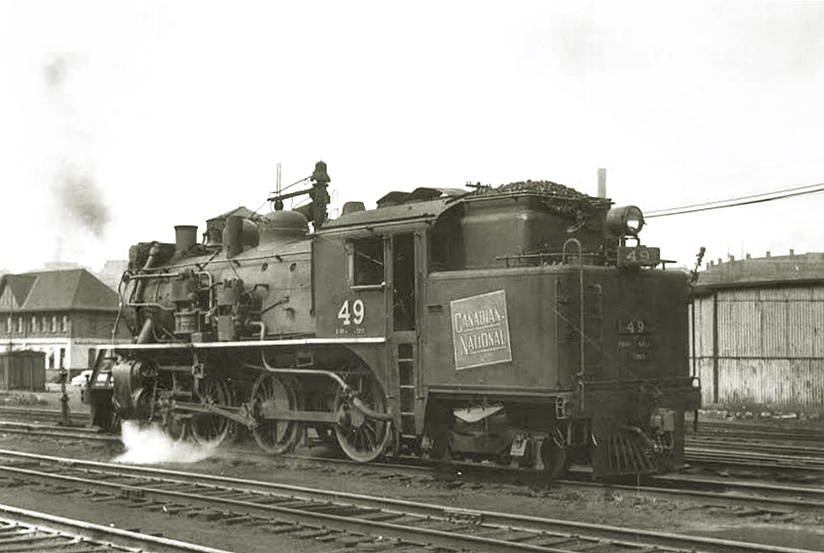
Meanwhile, north of the border in Montreal CNR developed their plucky 4-6-4t units in 1914, capable of running on 80-pound rail:

Image result for canadian national 4-6-4t

When CRRNJ went for increased power for their tank engines, they worked with Baldwin in 1923 to develop a unit very similar to the CNR 4-6-4t units, but a bit heavier, needing 90-pound rail - some of their “chunkiness” comes from what looks like the very wide Wootten firebox needed to burn anthracite culm:

Image result for central railroad of new jersey 4-6-4t

Perhaps a new-build oil-fired version of the B&A 2-6-6t would be the most suitable for our theoretical "railroad museum steam in 212

Other than the two 1955 Disney built locomotives, the other ones that come quickly to my mind as ‘modern American steam builds’ are all either replicas of things like The Rocket or Tom Thumb, the two steamers at Promontory Summit and the Leviathan which was built following the Promonotory examples. Of course the PRR T1 currently underway to is worth mentioning again here. I know there are more, that is just what comes to mind. Its not that new build steam isn’t happening, its just happening so sporadically for even just 3’ gauge let alone standard gauge stuff to sort of make it not a reliable buisness in my opinion. Even shops such as Wasatch Rail Contractors that have done work on operational and static steam displays for standard gauge equipment, seems to run a small side buisness of live steam and small amusement park engine repairs to keep the lights on for the bigger projects; and mind you their entire buisness is really focused on repair and restoration of existing engines with very little ventures into new builds.

Now if you could somehow convince a tourist railroad to buy some 0-6-0, 2-8-0 or 2-8-2 new build using vegtable oil fuel or something you’d probably find a market somewhere for it. But I am willing to bet the number of US tourist lines looking into completely brand new power right now is small with most of them preffering to restore older engines. While restoration of a vintage steamer is pricey, most places can aquire them at near scrap value making them cheaper to obtain than any new build has a chance to be.

Yup. Sometimes it is just fun to have a “what if” discussion, which is what part of this thread was doing.

At the same time, the Brits are realizing that for steam to be around after another 30 years or so when all their current stock of steam locomotives are 90-100 years old, it is going to require a modicum of new build construction, so that is what they are doing to ensure steam is around for the public to enjoy in 2100.

Eventually that will happen in the US. Maybe not for another 20-30 years or so, but eventually.

No matter what is new built or restored to operation - there needs to be a place for the locomotive to operate. Without owning track the projects are doomed to be ‘stuffed and mounted’. Memorials to a bygone era. Getting the engines is the easy part - getting the railroad to operate them on is the cost that no one thinks of.

There’s one other thing concerning the success of a steam operation that no-one’s mentioned yet, including me. It’s a phrase real estate professionals use all the time…

“Location! Location! Location!”

As I see it, for a steam operation tobe successful, it needs more than “one-time” visitors. It’s going to need visitors that come multiple times, and a good population base to draw a good amount of “one time” visitors as well.

A location within easy driving distance, say two hours or at the maximum three hours, of a major population center is almost imperative. It’s no wonder that an operation like the East Broad Top is just about inactive, if it’s not in the middle of nowhere it might as well be.

A good location is almost as important as trackage is.

Unless I’m mistaken, the rebuilt (1920) Reading 2-6-4Ts had more than 6 tons bunker capacity and could run on lighter than 65lb rail. It might be interesting to see if the weight of the ‘full’ boiler went up or down with the increased tube spacing, and whether the benefits of better circulation were realized in practice.

True all that. The successful operations that will hopefully be here 50 years from now all own their own track and typically (though some exceptions) run smaller power (no Mountains, Northerns, Berkshires, Articulateds). A few representative operations which by no means is a comprehensive list:

Valley Railroad

New Hope & Ivyland

Strasburg Railroad

Great Smoky Mountains Railroad

Everett Railroad

Tennessee Valley Railroad Museum

Mid-Continent Railroad Museum

Lake Superior Railroad Museum

Boone & Scenic Valley Railroad

Abilene & Smoky Valley

Durango & Silverton

Cunbres & Toltec

Niles Canyon

Even the Grand Canyon Railway runs a light Mikado as its largest unit, and then only occasionally.

Granted a few places will be running larger steam on a more frequent basis. Reading & Northern will run their Northern 2102 a bit more frequently than most large power can get out, because they own the track, as will the Western Maryland Scenic with 1309 (although it will be interesting to see how fuel and maintenance costs compare to a 2-8-0). And the Black Hills Central run the 44-inch drivers off their logging Mallets out of necessity due to the terrain.

But even Jerry Joe Jacobsen ran his light Pacifics the most frequently when he owned Ohio Central, and places like the Cuyahoga Valley Scenic Railroad and Steamtown might run steam more often if they had smaller power to run. (Though the 765 visits are fantastic!)

The big units we all love - 614, 765, 261, 844, 4014, 3751, 4449 all get out sporadically, and for that we are most thankful.

Reliable lighter power for the operating museums will continue to be crucial to keep steam operating in to the latter half of the 21st Century.