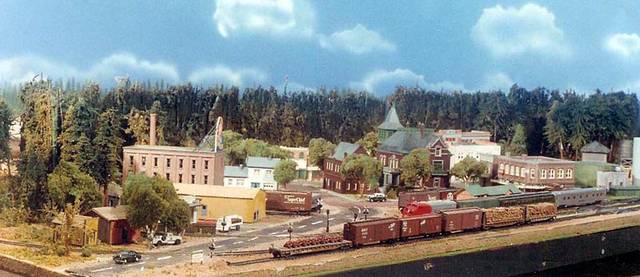
Philosophy Friday -- How did you develop your track plan?

As I don’t have a current track plan I can’t answer the question straight up. But I as anyone who has been over on the layout design forum know that I have been quite active over there (I think one summer pcarrol and I helped at least 6 people design their layouts).

Any way I believe a good track plan can be realized from every method and every starting point. I’ve seen good plans come from the limitations of a bench or room. I’ve seen good plans come from a prototypical arrangement smushed into a given space. I’ve seen good plans come from the published track plan books. I’ve even seen good plans designed around a given structure. But the best plans come from people who have operated on many different layouts with many different operational goals. It is only when a plan is exercised by actual operation that its personality becomes apparent.

What I hate?

  1. Any time I see someone say, “a good plan has to have xxx”. Through time the xxx has changed but as a general statement it just isn’t true. People who use that statement are probably those who have just learned enough about operation beyond toy train layouts that they want to be helpful to others who have not crossed that threshold. Sort of the knowing enough to be dangerous category.

  2. People who simply lambast the simple track plans in 101 track plans or the Atlas books as being old fashion or just as marking to sell as much track as possible. It was just two months ago that someone wrote me a personal note and said how much better people would be if they used one of my plans and listened to m
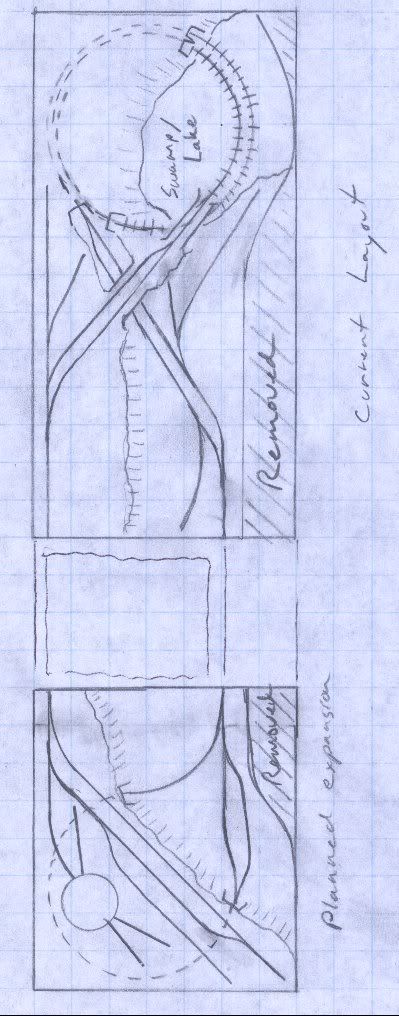
Mine actually started about 35 years ago: I built an N-scale version of the Epithet Creek Railroad (published in MR) and its terminal while I was in high school and college. Having hand-laid the track, I have those plans permanently fused in my mind. One thing that I really liked about the plan is that the upper terrace of track had a built in limit preventing more than a single loco or car to get there. It made for interesting switching at first, then it became tedious.

About 15 years ago I was pondering a return to the hobby in HO scale, so I started by sketching out those plans. I decided to eliminate that bottleneck, so I tweaked it, then I adjusted for my available space and after 4 years of sketching, I finally built it. Overall, I’m happy with it:

TZ,As food for thought…

Your 2x8 could have been operated as a point to point layout either from a coal mine to a interchange-thinking a shay powered industrial road or it could have been a logging road…

A great design for a small layout.[tup]

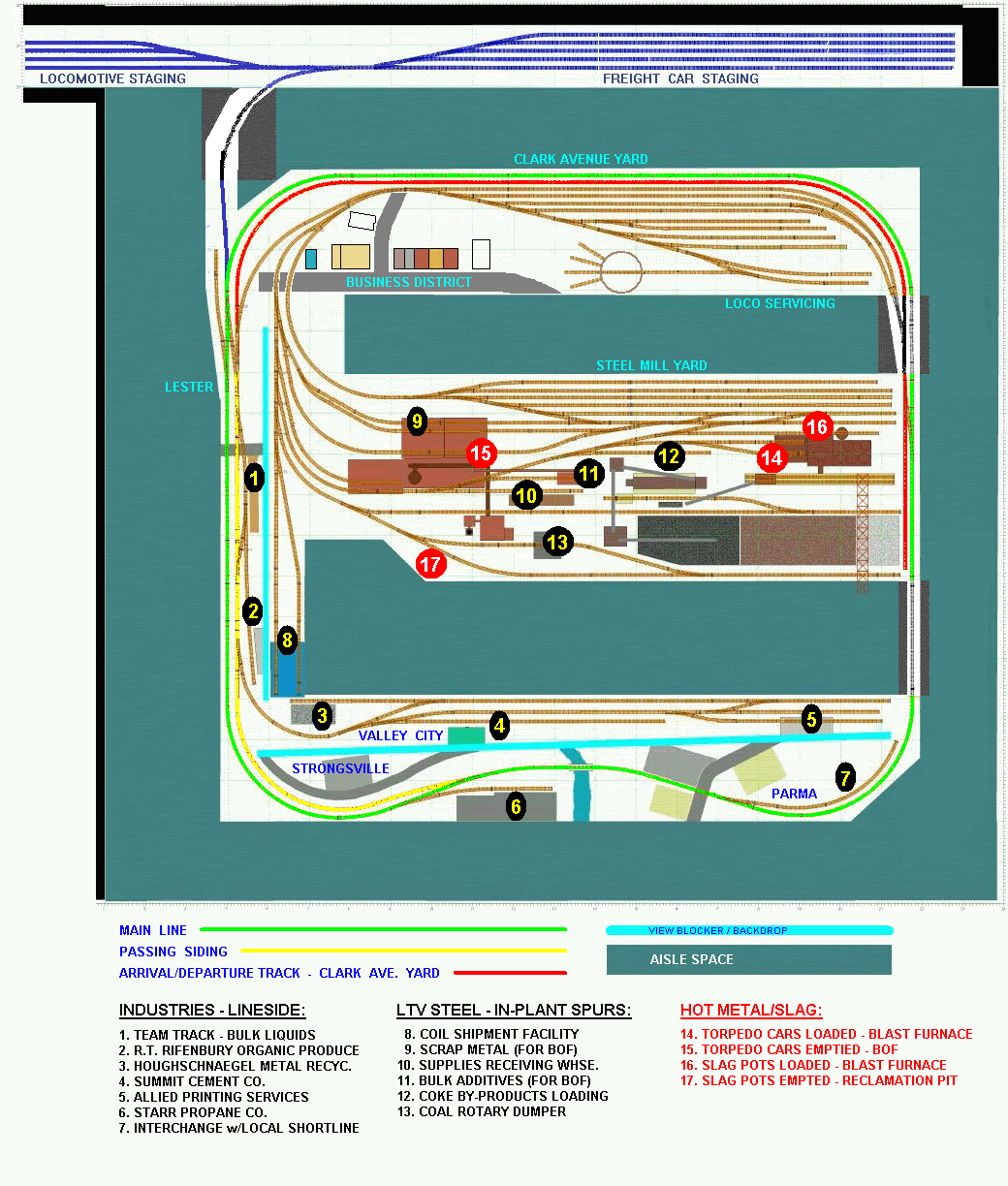
Yes, I planned it; well, sort-of. As to what came first, I’d have to say the town - except substitute it with the phrase “steel mill”. I had been wanting to model a Great Lakes waterfront steel mill ever since I was 9 yrs old, and thanks to AbraCAData planning software, I was able to devise the plan shown below. My trainroom was a 2-car garage whose walls were lined with shelves, so I had to make it an island-style layout. [Later on I added a staging yard on one of the adjacent shelves.]

Initially I figured the steel mill would generate enough traffic to keep things interesting, so all I wanted at first was a main line to circle the mill, with view blocks. One of my main line sections was to be a single-track ‘country’ main line which I would use for ‘railfanning’. I got all the benchwork built and the track laid according to the original plan, but then a friend invited me for an op session on his club’s layout, where I was put in charge of a ‘way’ freight. I had such a blast, I realized I needed to add some lineside industries on my own pike. Adding the turnouts was easy since I hadn’t yet ballasted the track.

As I mentioned above, I soon realized I need an “off-layout” destination for my trains, so I put a staging yard on one of the shelves. The tracks weren’t quite long enough to hold full-length trains, so I put in a separate yard for locomotives. I had several op sessions which kept 3 guest operators and myself busy for 3 hours at a time, so I was quite happy with what I had. Until…

[quote user=“jwhitten”]
… If you had it to do all over again, knowing what you know now, what would you change?

My current (3rd, 2nd in N) layout started loosely based on the prototype, then evolved.

Givens:

  • Needed to be transportable (I was living in rental accomodation at the time)
  • Had to fit into bottom of ‘L’-shaped living room my housemates were letting me use
  • AT&SF Prototype
  • 18" minimum mainline radius

Druthers:

  • Plenty of operation - preferably a yard
  • Had to have a roundhouse and loco servicing facility

I did some research, and found that the town of Las Vegas, in New Mexico (the other Las Vegas) had an AT&SF yard with a roundhouse. I fired up RTS, and drew up a 9.5 x 4’ table, marking out a 7.5x3 area in the middle to house the yard, with a 1’ margin for staging. It currently looks something like this:

The siding along the bottom with the river crossing is an addition, along with the passenger station on the branch line to the resort town of Hot Springs. The Branch did exist, according to a railroad atlas, so I decided that making it an active branch would add to operation. The four stub-ended sidings on the right were double-ended on the prototype satellite photos, but I didn’t have the space to do that. And I am aware that there isn’t a lead track, but that doesn’t really matter - it’s a one-man job, and only one train is running at a time. Staging is mostly provided by a traverser (details here) and there are two sidings curved around at each end (the west end one was added after this plan was drawn). It’s everything I want, and a single session keeps me busy for around 3-4 hours.

I came to the very same conclusion about british layouts after years and years of planning: “Less is more”. It was a time I thought the more turnouts you could put on a layout meant it was getting better. I built a large basement layout (never went to scenery step) mimicking Quebec Port in the 40’s-50’s. Large, looking and operating like the prototype and… boring. It was too large to be convincing, too muck trackage and no possibility to ever complete the scenery (I love to built and weathered buildings, trees, cars and all that make a lyout like a part of the real world). I then decided try to shrink down the scale to something smaller in my new house.

The actual track plan is a complete no-brainer. I wouldn’t call it track planning, there’s nothing original about it. A runaround with 3 sidings. Boring, no modelrailroading tricks, nothing special, nothing worth to be written about it. And you know what? That’s the same track plan the real railroads built over and over around the world in thousands of exemples. The same one we always follow while railfanning. It took me something like 20 years to finally understand that we are always modelling the “extraordinary” instead of the ordinary. What is interesting is to model the typical station that found its way in our memory…

I started with a 4’x4’, then a 5’x4’… I rebuilt it twice. Never got satisfied. Then, I decided to opt for a shelf layout with minimal trackage. Less is more said an architect.I read a lot about that and found out how you could keep somebody busy with a few well-planned track.

Prototype. I wanted to model the QRL&PCo but found out I should go back in the 20’s to make it interesting. And I couldn’t set on a exact location/station to model. So I decided to do some generic CNR station in Quebec area to put in good use some of the rolling stock I’ve been collecting since many years.

Recently, I found a track plan that met my need, mocked it up on a hollow core door

Great topic. Ken, I’m looking forward to see how your layout evolves. Your steel mill is amazing, and connecting it to a more complete transportation system will really make the operations hop!

In my train room, the planning always starts with the room. Afterall, it’s the room, and the space available that drives most of the design decisions. In my case, the main limitation of the room is that it’s in the attic, so I’ve got 45 degree sloped ceilings to contend with. That forced my table height to be lower than I’d like, and seriously limited my ability to do add an upper deck for ops and a lower deck for staging.

I start by laying out the general location of aisles that are wide enough for my “above average” carcass, then I locate the general location of things like the work bench, and where I’d like to have a yard/engine facility. Next, once my “dominoes” are established, I’ll draw out a general route for my mainline. I’ll look at that diagram, and think about how it relates to the prototype geography, and decide what elements can be worked in with consideration of track location, key scenery elements, and of course, operations.

At this point, I’ll play with several options on paper. I cultivated several designs based on different facets of the Western Maryland’s operations in the 1960’s. I looked at being hyper faithful to a short segment of the line, as well as a more general concept employing vignettes that might be less prototypically accurate, but offers more operations possibilities.

A few things that are “must haves” are always a working yard, a substantial amount of staging, and scenes that can be isolated for close up photography, even if in person there might be a little more “spaghetti” than some might like to see. I also like to work in a separate branch line to provide some point to point and switching action if I can.

The trickiest part in all of it is thinking three dimensionally. Making sure y

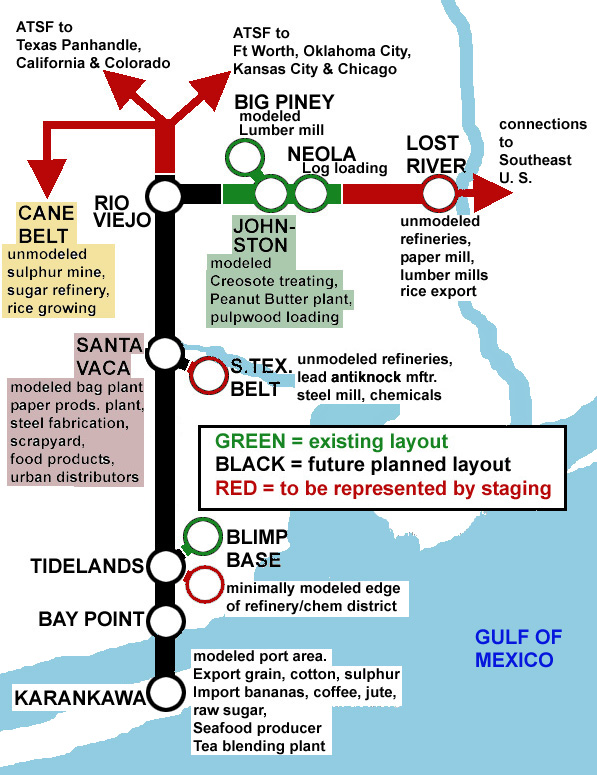
Since about 1975, I have wanted to build a layout with a big city scene similar to Houston with the Santa Fe passenger trains that were running in the 1950s, Texas Chief, California Special, Mail express #5/6 (former Ranger). And a classification yard with through trains dropping and picking up cuts of cars.

Didn’t have the space, but built a 3 x 7 N layout starting in 1980, which was one part of a scheme for an overall huge railroad…a Santa Fe secondary line the piney woods of East Texas 50 miles north of Houston. I wrote up the track plan as “Lost River District of the Santa Vaca & ,” in Model Railroader Feb85 p.106 and it was reprinted in Top Notch Railroad Plans.

I thought of trains south of Houston going to staging representing Galveston,

And if you never learn another thing in MRing you will still have more understanding than a vast majority of the modelers.

This manifests itself often in the freelance world where someone says, “I’ll make up some exception for every thing that tickles my fancy.” The layout ends up looking bizarre and toy like. Too many extreme exceptions an not enough rule. Or a prototypical modeler who collects all the one off paint schemes or unique locomotives and they don’t have enough of the typical locomotives in the common schemes to make it look right.

You are definitely lucky in that regard. I live out in the 'burbs and haven’t seen a railroad track in decades. [:(] Leastways, not around here.

Well, who’s does? Very nearly everyone has to make some tough choices when selecting the scenes they can model. Even if their intent is to model the original as faithfully as possible. Even if money were not a consideration, the technical challenge of recreating absolutely every nuance in miniature would be daunting, to say the least, and more like “overwhelming” in all likelihood. The art of the modeler is in the selection of the details and the ability to omit the parts that won’t be missed-- or at least the parts that can be edited out and still have a story to tell.

“Protolancing” seems to be a pretty popular alternative from what I can tell. I think a lot of people choose to do that so they can have some history and guidance to turn to when they need help or inspiration, and yet there is a bit of the artist in there who wants a shot also. The idea of building a railroad to suit your whims is very appealing-- but of course we have to appease the “Plausibility Police” (and they know who they are) so w

I definitely know and can relate to that feeling… [:-^]

I, myself, didn’t start out to build a ‘temporary’ layout-- but owing to a number of factors, that’s what I’ve done. And over the weekend I just built a pretty nice, and large, extension to it-- well, am building, got part of it finished. The rest will go pretty quick though, just need to finish up adding legs and tying it in to the existing “temporary” layout. But it is “temporary”-- and that’s not just something I’m telling myself-- regardless of how long it has to last. For awhile (a couple of years really) I was negotiating territory with my wife-- but we’ve finally gotten all that settled (I hope) and now its just a matter of getting the stuff to finish putting the basement back together-- the tile mostly, the wallboard and studs are cheap enough. Its going to be longer than I figured t

Congrats! There oughta be some sort of ribbon you get for every decade or something… [:)]

Yeah, its that “where possible” bit that gets most of us-- I decided I’m not going to have any more than a 2-1/2 degree curve on my layout.

(Where possible [swg])

I know what you’re saying though-- its a tradeoff whatever you do. If you’re lucky enough to have lots and lots of space you have the luxury of being able to set “gold standards” for yourself and maybe meet them. There’s a lot of people out there though who would count themselves lucky if they could only dictate 24-inch radius curves and stick to it. As for myself, I have the room to make the pronouncement, but I have a strong desire for more mainline and (so far) the only way I’ve been able to see how it can be done is to specify smaller curves-- I’m thinking in the 30-36 inch radius range-- so my turnbacks will be skinny enough to fit a couple side-by-side. I’m also double-decking most of the layout so that will add to it of course. And while I would love to have 48-inch (or even bigger) curves all over my layout, I just can’t fit it all in. So I’m going to use the age-old artifice of the “tunnel”, or some other misdirection, wherever I have to cheat and use smaller radius curves (28-30 inches) on the turnbacks.

That one I agree with wholeheartedly. The only drawback I’d say is that its not always easy to find a plan for the prototype, nor a

I think that, or something like it, is the situation for many modelers. Personally, speaking for myself, I like the look of the shelf layout-- with one addition-- I like “bump-outs” (or “Lobes” as Tony Koester would term them). I think they do a lot to “disguise” the “shelf nature” of the layout while contributing quite a bit to the layout. They don’t have to be deep. Even an extra few inches can be enough to add some variety or “obstruction” to obscure the view, so you can’t just look up and down the line to take the whole thing in at a glance. Another thing about “Lobes” is that you can use them to place industries at interesting angles and / or to provide additional operational space or access, which can improve the enjoyment of the layout.

I wholeheartedly concur with that opinion. Even though I know I have a really good representation of my basement space set up in the computer, and I know that the computer can lay out a curve to millimeter precision-- I often find there are things I can do that the computer says I cannot. And not just inconsequential things either, I’m talking about entire benchwork placements and such. Being able to see it and work within the space often makes a big difference in how you think of and perceive the space. While I know the computer is completely correct in its depictions, its hard to substitute the “being there and seeing it” human aspect. And to be fair, I know t

Urban planning & development at its finest… [(-D]

He’s a lumberjack and he’s okay

Works all night and he sleeps all day

Then on the weekends he goes shopping…

[:P]

John

Based on the comments I’ve seen, here and elsewhere, that seems to be either the number one or number two reason given for “Why I picked what I did to model.” (The other answer, btw, is “Because its what I saw growing up.”).

On a small plan I think you may be right. Having an off-stage fiddle yard is probably a better idea.

Cringe?? Why on earth should they cringe? I should think they would applaud you for doing your homework, figuring out what you want and what you have space for, and then figuring out a reasonable, practical way of getting it accomplished. I think you should be commended for your efforts!

That’s what counts!

John

I’ll bet that once you really start thinking about it an elegant and clever solution will present itself. One of the things that I did in my own space was to relax my notions regarding scene “depth”. You can squeeze a track into about a 4-inch shelf (less if you like living on the edge… umm, literally! [(-D]) and maybe 6-8 inches if you want a little bit of scenicking to go along with it. When you think of it that way it gets a lot easier to figure out how to squeeze in something that can work. That means you can take a 24-inch or maybe a 30-36 inch depth, split it in half with a backdrop or scenic divider, and get two very interesting and usable spaces out of it (front and back). Another thing is that there is no rule that says your bench has to be evenly divided right down the middle with no variation at all down the line. If you put a gently undulating curve in the backdrop, you would have naturally-occuring spaces that would lend themselves to a little more scenicking (“depth”) as well as some visual appeal-- trains on shallow curves-- and break up (“separate”) the modeled scenes a bit more.

I look forward to seeing your progress photos (feel free to post a URL if you already have some!)

John

Hey, that’s what I said!

Oh, but I guess you said it first [;)]

John

All your Givens are Druthers!

“Givens” are absolutes and immutables-- things you can’t change (or at least not practically or without great expense) that you just have work around. “Druthers” are what you want.

You have an interesting track plan. That’s very cool!

For some people the joy is in the building. Other people just like watching the trains. Nothing wrong with either view, or something else if you’d prefer.

Thanks for letting us see your track plan and hear your ideas. I’m hoping you’ll tell us more as you make progress!

John

I’m surprised you were able to get him to stand still that long…

[:P]

(Sometimes I just quack me up! [(-D])

Actually you just hit upon why I often have problems with a double main. My uncle keeps pushing me (gently) toward a double main. And I know he has a pretty good perspective on it, but in my mind it doesn’t seem right. I know I have a decent-sized layout space and everything, but it really cuts into shelf depth and “fattens” everything up visually. And if that’s not done exactly right and well-controlled, it can get “toy train-like” really quick, IMO. Not that other people haven’t done it well-- they have and I’ve seen (in pictures) some very good examples of well-done double and multi-track lines. Particularly Pennsy lines. People just sort-of expect them to be double or even quad-tracked. And oddly enough, it doesn’t seem as bad to me to see a three or four track Pennsy mainline. Just double-tracked for some reason-- maybe I just need to get out more, who knows?? [:)]

John