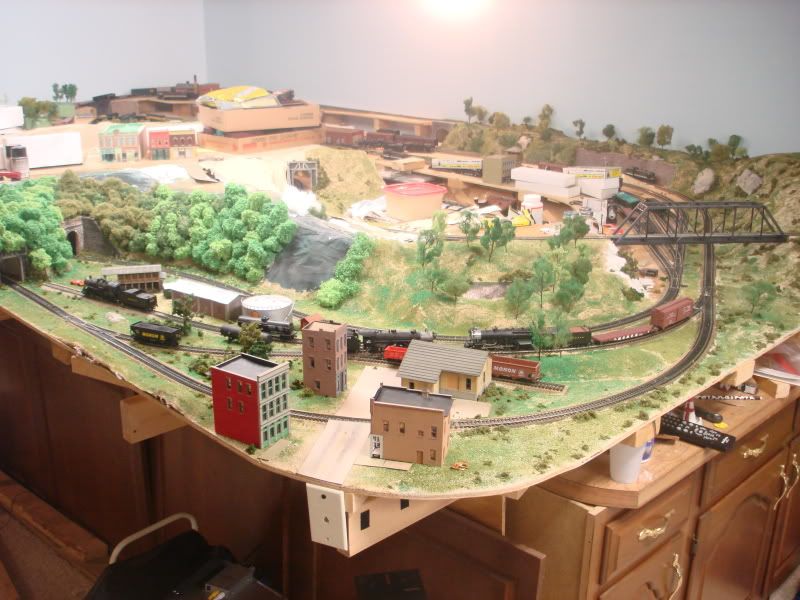
As the new owner of a shay and wondering how I’m going to fit it into my layout and operating scheme, I find that I have newfound interest in logging and mountain-region coal / minerals operations. I hope you will keep us up to date, from time-to-time, how your layout is coming along.
Those sound like practical suggestions and a good starting plan for building pretty much any type of layout.
This, I think, is a most interesting statement-- even though I think it, in truth, is largely the ubiquitous methodology employed by most modelers-- if they even have a well-reasoned theme at all. I think it is interesting because there are some who get so caught up in “modeling the prototype” and go to great lengths to accurately detail and depict a particular locomotive or piece of rolling stock, and yet give not one thought to the accuracy of their locale, beyond the generalities. And beyond that, I think many people-- prototypers included-- who are “scared” (for lack of a better term, please forgive me) of attempting to model a “recognizable place” for fear people might not recognize it-- or worse, that someone will recognize it and be able to spot substantive differences. But-- for me-- I say “To heck with them”, model it anyway. Do your best. Tell your detractors to take a long walk off a short pier while everyone else just enjoys your handiwork. So what if its not exactly the same? Chances are neither is their memory of the place.
You are what this hobby needs a lot more of-- a person with knowledge and experience who can explain this type of stuff and make it accessible to other modelers. Sure Armstrong wrote a book about it-- and its a very good one BTW, “Track Planning for Realistic Operation”, but it would be nice to have additional viewpoints and perspectives on the subject. Or for more in-depth or expanded coverage about this detail or that. I really enjoy reading about “operational tidbits”-- stuff that maybe doesn’t warrant a whole chapter but is “nice to know” or just interesting that might come in handy someday in some situation.
Why a yard in the middle? It is often suggested that having a yard directly after coming out of staging-- or else just before going into staging-- is a good idea. Why did you select the center?
For myself, I am coming to the decision that having a yard wherever I need it is the best method. Also I find that people often use the term “Yard” generically and without distinction-- or else to generally reference some sort of “classification” facility-- whereas I’m starting to understand that there are many different types of yards and each one is best suited for a particular aspect of railroading or another. For example, some “yards” are designed for interchange-- setting out cars for one railroad and picking up others in return. That “yard” may actually be nothing more than a siding or two. A different “yard” could exist for the purpose of marshalling coal-filled hopper cars from different branches, until sufficient numbers have been accumulated to warrant a trip down the line. Still yet another yard may be utilized by an industry to receive and store blocks of cars from various shippers until they can be processed and unloaded. Each one of these is a “yard” but each one has a different purpose, look and operational characteristics.
You know, I am constantly amazed by the kindness and generosity of Model Railroaders with respect to the “average Joe”. The MRR builds a layout in his spare bedroom and gives space and consideration to the non-railroader if / when they come to call for an overnight visit. Yet how many “average Joe’s” give Model Railroaders the same consideration and have set aside a small switching layout or some such in their spare rooms to meet their needs? Not many I’d wager. It just goes to show you the caliber of people we’re dealing with in this hobby! [:D]
Sounds like you’ve got a nice layout going! Show us some pictures!!!
I disagree to a large extent. I’m not the least interested in DCC, so DC’s a given. Tucked in a basement corner is the only location where I could build, so that’s a given. I’m a lone wolf, and there’s nobody in my circle of family & friend who’s interested in model railroading, so single operator is a given. I’ll concede that the other points are probably Druthers, though.
Yes, that is a common situation it seems. That is one of my own pet peeves, if it can be characterized as such-- but at the same time I can understand the desire to have lots of track to run and switch trains on. And if space is at a premium, as is all too oft the case, then one or the other has to give way.
Yes, those seem like reasonable goals. Particularly the ones listed under #2-- people often under-estimate just how nicely shifting tracks away from the edges and introducing curves, even shallow ones, into the mix can make a significant visual improvement. And the judicious (or even downright scandalous) use of tunnels and bridges can go a long way to breaking up the layout and making it seem larger.
I’d like to see your coal mine-- do you have any pictures??
They say that “familiarity breeds contempt”… perhaps that spur marks the beginning of Epithet Creek?
What kind of equipment do you run on your layout (as though with a name like “ShayFan” I should have to ask… [:-^]) Is it mining or logging or both or something else?
I read an article back in the early '60s in MR with a tag line that said something to the effect of “My railroad just sort of grew.” So when I finally had a chance to build I put up benchwork to define the area and then started “growing.”
First up was a small three track yard. OK, that will go here. Now I need a drill track for the yard. From there we need to get over to where the mainline comes in to town. And on the way, let’s put in a siding here for some industries. OK, this works. To add a couple more industries and to add to the general confusion, let’s put a couple industries on the drill track, oh, and another one on the track leading to the mainline. It may not be a very realistic plan but it does add a lot of switching moves to a small layout.
OK, let’s get this train out of town. I ran a loop of track around the wall and behind the backdrop (where there’s a passing siding to allow for staging) to the other town. Similar philosophies were used to develop the track plan for the second town.
Each town has some street running and multiple industries. With few exceptions, spotting a cars almost always requires moving another car and then returning it after the move is complete. One track of the yard is designated as interchange. Cars spotted there are rotated back in after one round. Trains are limited to six 40’ cars (the length of the sidings), a small to medium size engine (EMD A40’s double headed up to a GP9) and a caboose.
Some of the track is along the edge of the layout but most is buried in the scenery behind other buildings, requiring the operator to actually get into the scene to perform the various switching moves.
I did provide a cutoff to allow continuous running for the occasional visitor but that is seldom used. I also provided a turntable hidden behind the hills (but visible from one spot and one spot only) that allows me to turn engines if needed.
A quick aside for the formalities-- which do you prefer: CSX or Mr. Slug???
[(-D]
[track plans]
That’s a really nice railroad you’ve got there-- er, had there. And I like the improvements you’re making too-- looks like its going to end up being a really good layout to operate on. I think you’ve done a great job of designing a layout around a single industry. Good mix of stuff too.
Those are good goals and surprisingly easy to achieve. I had much the same desire on my own layout. Note the three tunnel portals in this photo:
One of the tunnels hides track running parallel to the layout edge. The other two disguise the track going up grade and looping back on itself. You can only see both portals from limited viewing angles, and even then a reasonable-length train will disappear completely into one portal before emerging from the other. Plus, putting all that track under a hill creates more opportunity for scenery to draw one’s attention.
I’ve found that can be something of a double-edged sword. Sometimes I like to just let trains go and watch them from my work desk while tinkering with my latest project, but I only get glimpses as they pass by from one viewblock to the next!
I agree with you that its better to have a mixture between areas with lots of track (stuff to do-- switching and whatnot) and areas where the train is just ‘traveling through’. It also makes for a nice visual break and gives the observer a chance to take a break and see something different as well as emphasizes the cities and such when they come around. If everything is all city or all country or all track, it makes it harder to actually “see” anything.
You sound like you’re in need of some Whitten Wisdom previously dispensed… [:D]
I really don’t understand everyone’s lack of imagination and inspiration. Sure, even the best of us will get down in the dumps once in awhile-- but you can’t let lack of a basement or an undersized bedroom keep you away from your love of the hobby. So what if your wife needs the spare bedroom for a sewing room? So what if your dreams and aspirations are bigger than your basement-- you can’t let a little thing like THAT get you down, no sir-- not when there’s the ROOF to consider…
You gotta admit, most people don’t ever consider the largest single section of square-footage they own. There are generally very few encumberances, perhaps a chimney or a standpipe or two (don’t stick your nose in one, btw-- don’t ask me how I know…) Its flat, its big, its wide-open and just begging for some tracks! True, in some cases it may be slanted, but you know, sometimes you just have to play the hand you’ve been dealt. Stop looking a gift-horse in the mouth and all that. Afterall you did just discover 800-1200 sq feet you’ve never thought of before. You want it to be level too??? Besides, you can level it up, just add taller risers on one side is all you need to do.
Another nice thing about modeling on the roof is that visitors don’t track mud through your house to get to the layout room. They can just stand out in the yard and see ev
In seriousness, one of the things that helped me immensely-- something that I didn’t plan for but just happened to have all the materials around serendipitously-- is a lot of 1-inch tall by 8-feet masonite strips that I cut for eventual use as spline roadbed, and a lot of pre-cut 1x2-inch lumber sections for use as joists, and a ton of clamps.
Whenever I get to the point in my thinking that some visualization is required, I mock it up with the wood-- whatever is required to get a “space platform” to work with, and then use miniature clips-- I have a ton of little $0.99 cent metal clips and also the smaller $0.33 cent clips from Home Depot, and another ton of regular wooden clothes pins-- and I use them along with the lumber to hoist into place the masonite strips which represents the right-of-way.
Since its ultimately intended for use as roadbed anyway, you know whatever it can do you can really do. And it doesn’t take much time to mock it up and check it out. And since its all clipped or clamped together, its easy to move around, adjust, rearrange-- whatever to see how this would look or that-- and you yourself know this since I’ve sent you pictures before of my mock-ups.
You can also use cardboard strips to put view blocks where you want them-- just use the clothes pins to pin them together and an occasional large clip to attach them to the wooden structure. Add a ruler and you have everything you need.
If you want, you could even lay some track and hazard an old car you don’t care much about–I suspect anybody building a layout has one of those-- or will soon… [:-,]
Agreed, except there’s also the point that it can go to far in the “real life” direction and end up looking boring.
Something an old GF said once in another context really stopped and made me think, and its applicable here too-- she said “People go to the movies to escape real life”-- and I think people build model railroads to escape real life too. Maybe to go back in time, or to a place they have fond memories of, or to a “simpler world”, or maybe somewhere that reminds them of someone they miss.
I think, just like with the movies-- too much “real life” on a model railroad is too much like “real life”-- and that’s what people are trying to get away from for awhile.