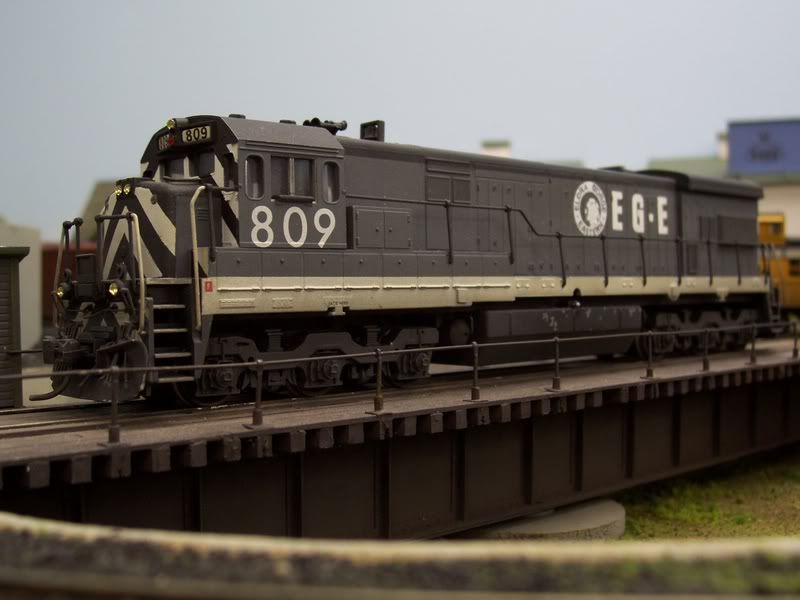
In one of my sleepless moments I was wondering if the horsepower rating of a prototypical locomotive actually translates to the pulling power of the same models on my pike?
For example: a GP 40 is rated at 3,000 hp, a GP 38-2 is rated at 2,000 hp; which, for the sake of argument, has one-third less pulling power.
Given that both the GP 40 and the GP 38-2 I own are from Bachmann, I was wondering…If they are assembled from the same components: prime-mover (D/C motor) and traction motors (dog-bone to worm gear to B-B trucks) how can they have differing pulling power as per the prototypicals?
The only thing that scales is the physical volume that the object takes up. An HO scale GP38-2 doesn’t weight a ton and a half, does it? That’s 1/87th of the weight of a real one.
I suspect there is some, but little correlation. Most Big Boys will outpul moguls, however…
But more specifically, for example, I have a Genesis GP9, the prototype having 1750HP, and a LifeLike P2K E6, having two engines that total 2000HP. I suspect my HO E6 would outpull two GP9s, as the E6 has 50% more wheels per loco for traction, and it’s more than 10% or so (the HP difference per loco) heavier (has a huge weight). And tractive effort is more related to torque and friction factor than horsepower per se (more acceleration related, IIRC).
And of course you get into pulling power (ala torque in an auto) versus accelleration ability (ala acceleration in a dragster which is HP related), gearing, max speed, etc.
I think you should stop drinking coffee before bedtime.
Horsepower and pulling power (better known as tractive effort) are, at best, nodding relations. Two steam locomotives could each develop 2,000hp. The high-drivered but light weight 4-4-0 could go like the wind with a three car train. The low-drivered 2-8-0 might reach 35mph, but there would be fifty freight cars behind it.
So-called ‘slugs’ make use of the horsepower available but not used at low speed to provide more tractive effort for use in shoving a full-length train over the hump of a gravity yard. The horsepower of the prime mover is the same, but the tractive effort is doubled.
As for the mass of a model, and equivalent HP and TE, you have to divide the prototype number by the cube of the scale to get an answer. This is useful if you are tank testing ship hull designs, but I don’t think it need concern us as model railroaders.
The HO GP38-2 might be on a tad on the heavy side. Weight would scale with volume as a cube of the scale. A full size GP38-2 weighs about 250,000 lbs. That’s would scale to only 6 ounces (16*250,000/87^3) in HO.
The pulling power of your model locomotive is controlled by four factors.
The first is the number of powered axles. An old AHM with only one truck powered will not do as well as a model with both trucks powered. An E-unit or PA with all 6 axles powered will do better than the prototype which only had 4 of the 6 axles powered. And a model with 6 powered axles will generally pull more than one with 4 axles.
The second is the weight of the model. A heavier model will usually be able to pull more, where a lighter one will have wheel slip.
The third is the wheel tread. Rubber traction tires provide good grip but do not look right. Even metal wheels seem to vary as to how slippery they are.
And finally, the fourth is the efficiency of the motor installed in your model.
You will notice that the comparative power of the various prototypes is not a factor in model form. A 1,000hp RS-1 and a 3,000hp GP40 each have 4 axles. If weighted the same they should be able to pull the same. An E-unit with its 6 axles may outpull them, which is definitely not prototypical.
For a model with no traction tires or other artificial aids, about the best you can expect is a tractive effort, in ounces, equivalent to 25% of the locomotive’s weight.
Here’s an example, a twin motor Athearn U-boat, weighing 33oz., its as-tested drawbar pull was slightly over 8.3oz:
Real locos fare about the same, although modern wheelslip control does add some capability.
If you’re having trouble sleeping, read the info available in the link: it didn’t put me to sleep…on the contrary, it was a real eye-opener. [swg]
This thread is little bit pointless, a model’s performance will not match up to the prototype.
It likely that if you have say a GP9, GP38-2 and GP50 from the same model manufacturer, they will have similar drive designs and probably very similar performance, even though the prototypes are greatly different in HP.
And of course, a Bachmann, Walthers/Proto or Atlas GP38-2 will all have different motors and drive trains and have different performance although they’re models of the same prototype.
And also, real locomotives have a separate traction motors on each axle (except for specific examples like the E8 that have an unpowered middle idler axle to spread out weight) while most model locomotives have a single large motor in the shell which drives all the axles via a series of gears. Very different sort of concept there.
Well there is another way to look at it. A ton and a half divided by the weigt of the model will give a number when divided into the tractive effort may yield a comparison that a given model has a greater comparative tractive effort for its equivalent mass. God help us if in addition to wanting scale engines capable of overcoming small radii we add scale tractive effort which most people couldn’t use any way.
A lot of our locos can actually pull more then their real life counterparts. Problem being is our grades are a lot worse then their real life counterparts, so that extra pulling power is sometimes needed.
This was a somewhat benign thread up until the above was posted, turning it into another one of those threads where someone goes off on the general public’s lack of knowledge about an esoteric point that means nothing to almost everyone else!
I’m just amazed! However, the above post does take care of making me sleepy!
This “scale weight” discussion seems to come up about once a month on different forums and every single time there’s the “our models should weigh a literal ton LOL” response, and for some reason it kind of grates after the 20th time reading it. Sorry I lost my patience.
I disagree that it’s such an esoteric point though, it’s fairly basic geometry, it’s just people don’t think about it. A 10 inch cube is a 10:1 scale of a 1 inch cube, but it’s not ten times the volume/amount of material; it’s 1000 cubic inches. If both cubes are made of the same material, the 10" cube will be 1000 times heavier than the 1" cube.
Au contraire, I took 3 years of high school physics, plus biology, chemistry and a hatful of math - not unusual for the Bronx High School of Science. Then, two years later, I aced my one semester naval architecture course. My major was Marine Engineering, which is almost entirely physics and math.
(My actual major was named Lynn, which is why I’m a retired sergeant, not a retired admiral.)
Not only are our grades usually steeper, our curves are MUCH shrper as well. GOod thing we have more than scale pulling power (typically).
E units have been mentioned as being way off in weight scaled down - at least the Proto ones are, since they have a huge metal casting that makes up most of the interior, so they are even heavier than a properly scaled down representation would be. Another one that far outpulls the prototype are the Proto DL109’s - much the same reason, a HUGE slug of metal fills up the interior, making them proprotionally heavier than models of other locos.
Real world example - the Reading tested E units for dieselizing passenger trains. They had problems meeting the schedules though, and in the end they went with FP7’s. The FP7 has less horsepower, but more weight per axle so higher starting tractive effort, which on a passenger train that stops frequently is pretty critical for getting back up to speed. In the model world, at least if we compare the Proto E’s to say an Atlas FP7 - the E unit will probably outpull the FP7 due to the much heavier weight.