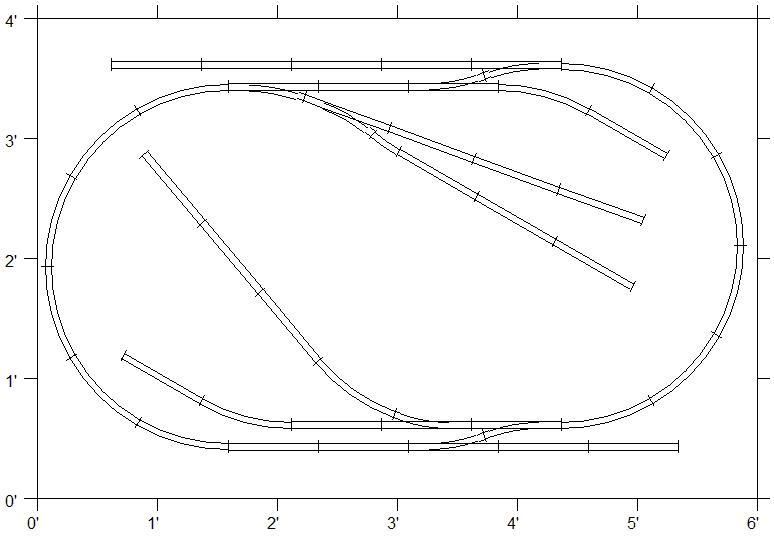
First post here, thought I would pick the brains of this community for a bit of direction. I’m building my first layout (HO scale), but unfortunetly I’m severely limited by space and money (paying for college + small apartment). I originally was going to go with a 4x5 layout, but decided I could squeeze in a 4x6. This is the layout plan that I’m most likely going to go with:
The period will be loosely in the early 1950’s, since I have an SW7 unit that will be my primary motive power on such a small layout. My issue at this point is I’m not sure what industries would be good on such a small layout to allow some operational variety. On such a small layout I’m not as concerned about prototypical operations as I am about a layout that I can do more than just watch trains go around in circles all day.
I’m open to any suggestions about possible industry/placement/operations, etc, or anything in general about ways to improve the layout design.
In terms of the layout design, since you have spurs coming from the mainline in two directions and no other runaround, you’ll need to go around the whole oval to get the engine on the correct side of the cars to be spotted. If you recognize this already and made that choice consciously, fine, otherwise a runaround would be easy to add.
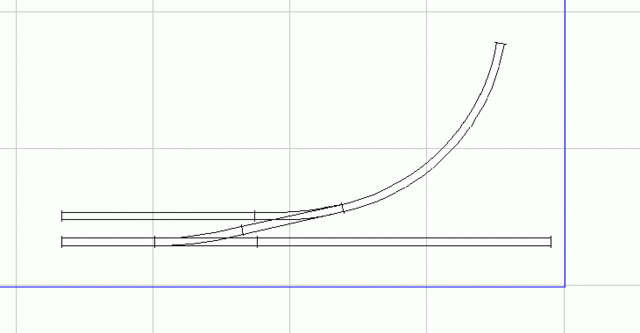
The s-curves created where the two crossovers connect with the end curve on the right-hand side may prove troublesome, especially for backing moves. Replacing them with another arrangement to ease that s-curve won’t cost you anything and will improve the chances of reliable operation. Here’s one way, the angled crossover:
First of everything, you need a passing siding as there are spurs facing in both directions. Second, an island layout isn’t in general the best solution because you are forced to create a loop of tracks and this is usually not prototypical. Why not to build a shelf layout? It can be small, easy to build and also easy to expand in case of extra space or money.
No you really don’t need one. It should be noted that the loop makes a wonderful run around track. On the other hand a real passing siding type run around track can localize switching into one area making it seem like a larger space. If you run counter clockwise I see only one facing point spur on each side of the space.
You could take this exact layout and tilt it just a little so the straight track isn’t running parallel to the edge of the board.
To the main point of the thread, Do you already have a set of frieght cars to use, or will you be purchasing them after the industries are determine? I mean you would not want to design the lindustires around a midwestern grain theme, if you already have 5-20 ore cars.
Also don’t get caught up in the “closed system syndrome”. Nothing says that the cars have to go from one industry to another one ON the layout. Make at least one of the tracks an interchange to the rest of the world. I would design operatiosn to make MOST of the traffic will come from that track to your industries and then return to that track. Otherwise the industries would be using trucks for a short term haul.
It was during the 1950’s that freight cars started specializing and the
Good “industries” on a small layout are ones that take up little (or no) room, like a team track for example. It’s just an open area next to a track to unload freight directly from a car to a truck (or in olden days, a wagon with a team of horses). It can paved, or just dirt or gravel. It can have an unloading ramp, but doesn’t have to. Nice thing is any car pretty much could go there - boxcars, reefers, flats, etc.
How about an oil dealer?? I go by an oil dealer in Bloomington (MN) every so often that is basically a small office building and a rack for loading oil into trucks. Rest of it is just an open lot with gravel; the tank cars unload into underground storage tanks so except for some piping by the rails and the loading platform, the office is the only above-ground structure.
Thanks for the input everyone. I actually hadn’t considered a shelf layout, probably because I over-estimated the usefulness of a full closed loop. My other issue is trying to use track that I already have in order to keep costs minimal, but on the other hand no one said the track had to be layed all at once.
I was doing some more measuring today and I might actually have a little more area to play with. I can probably get away with an 8x3 and 5x3 in an “L” shape, which opens up some new options (and cost… oh well, it’s worth it…). So now back to the layout drawing board.
Texas Zepher, you raised a good point about car types that I haden’t considered. While I don’t have an abundance of any type of car, I have 5 ore and 5 tank cars that could make a good start to a collection (and industry types!). The rest is mostly mixed freight.
So now it looks like I’ll be looking at slightly larger L layouts. This could at the very least allow me to do some point-to-point with a small staging yard at each end and maybe some branches off in the middle.
3’ might be a little wide for a shelf layout, be hard to reach the back. My 12’ x 13’ shelf layout (first stage of an eventually much larger layout) is 16" wide shelving sections made by John Sterling. Once you put the vertical tracks up (to mount the shelfs on) it’s nice because you can adjust the height until you’re sure it’s right, and you can put shelves under or over the layout for storage.
BTW mine will eventually be a two-deck layout, right now I’m just using the upper level with the lower level being storage tracks. You might be able to do that too, but I wouldn’t go wider than 2 feet. In my case I’m modelling essentially two different parts of the same railroad. The upper and lower level don’t connect (no helix etc.).
Good points. I was actually just playing with track plans on a 3’ deep shelf (in XtrakCad) and found it rather difficult to fill the space with anything useful. I’ll try a somewhat shallower shelf.
Has anyone built the NMRA Gateway Central IX? (here). I was trying to input the layout into XtrkCAD using code 83, and then again with code 100, and I can’t seem to get the layout to fit properly with either. Is this likely a result of “fudging” done while building that can’t be duplicated in CAD?
The web page says they used Code 83. From the High-resolution photo, it looks as if a number of the turnouts were trimmed a bit at one or more ends to make everything fit. When things get this tight, it can be harder to use CAD because the trial-and-error process of trimming turnouts is pretty tedious in most of the CAD programs. Xeroxed paper templates sometimes work better, because you can trim them easily just as you would the real turnouts. Just be sure that you take care to line tracks up so that they meet squarely if using paper templates.
They might have trimmed the turnouts a bit. I can (apparently) get fairly close using unmodified Peco code 75 switches - except for the two diamond crossings, which I don’t have in my Peco code 75 track library:
Sharpest curves is 18" radius, turnouts are a mix of some Peco small and some Peco medium turnouts.
Link to xtc 4.0.2 file (right click on link and “save as” to download to your computer): gateway.xtc.
Hey thanks a lot steinjr. I also got pretty close using Code 100 #4 switches and flextrack when the rails didn’t quite line up. Standard snap witches didn’t fit too well.
The upper diamond I believe is a 19D, and the other one 60D. The 19 I got to fit correctly with #4 switches, the 60D one though was off by about 5-10 degrees.
Ah - I didn’t notice the first time that they had used Atlas Code 83 sectional track. Btw - I would think the bottom diamond would be a 90D rather than a 60D ?
FWIW if you do decide to look into a shelf layout (or two, one above the other) - once you eliminate the need for continous running, your minimum radius etc. can go up quite a bit. On my 16" wide L shaped layout I’m using Kato HO Unitrack with 31" minimum radius (and a few short sections of 34" radius) and No. 6 turnouts exclusively. 31"R curves fit nicely in the corners on 16" shelfs, it’s a tight squeeze but you can just fit it in on 12" wide shelving too…but a little tighter curve (26"-28") might work better.
Do you know anywhere I can find plans (or partial) plans for shelf layouts? I tried designing one myself, but my layout design skills are sketch to say the least. I’ve found some shelf layout plans but they’re all for large layouts (like around the outside of the room).
I suggeest you locate a copy of the Kalmbach publication Smart, small and practical trackplans by British modeller Iain Rice. He has good ideas for shelf type layouts, include how to handle staging, stacking to or more levels of shelftype layouts above each other etc.
I think it is out of print, so check the usual second hand sources besides your local hobbyshop.
Further, Tony Koester came up with the idea of Layout Design Elements, see his Kalmbach book about this: http://kalmbachcatalog.stores.yahoo.net/12405.html. Using stations as building blocks for a layout.
If you haven’t done so, join the historical society of your favourite railroad and check their sources. There are usually a number of branchline endpoints or inner city locations that can be converted to a shelftype layout. Condensing the length of those stations will get you a long way.
Many shelf layouts are drawn for a straight shelf, but can easily be bent somewhere along their length to go around a corner. N scale plans can be re-sized for HO and vice-versa, so don’t let different scales throw you off.
I also posted the following in another forum a few days ago, apologies to those who will be seeing it again.
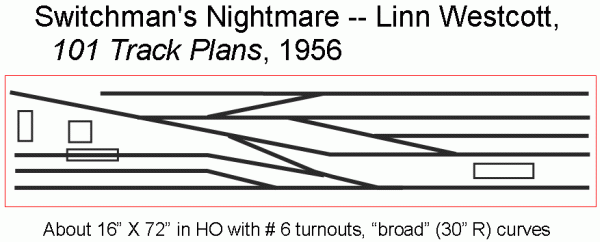
The first is the classic switching layout that has inspired so many others (including John Allen’s more-famous, but less realistic, Timesaver). That’s Linn Westcott’s “Switchman’s Nightmare”. This is one of the few truly buildable designs from Kalmbach’s 101 Track Plans.
This HO version would also fit on a hollow core door. With more length, you could make the switch leads at each end longer as well as extend the central runaround. I’d probably build this as a small switching terminal where the yard tracks on the right represent an interchange yard with another railroad and the tracks on the lower left become a multi-spot large industry. I’m not crazy about the switchback in the upper right corner, but that’s easily remedied if desired.
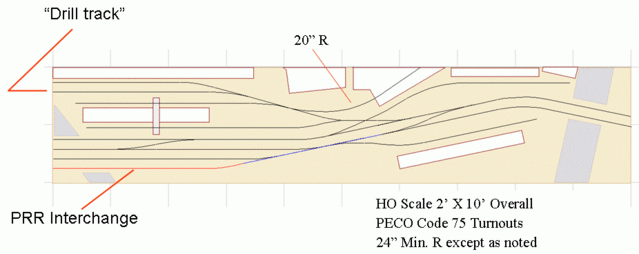
Jonathan Jones built a terrific urban 2X10 foot layout in HO scale described in the May 2001 Model Railroader. My slight modification shown here made some small changes that might make operating the layout a little more fun by eliminating switchback industry spurs that must be disturbed in order to switch other industries.
Another is my own N scale Alameda Belt Line layout from Model Railroad Planning 2005 magazine. The main part of