I would like to thank everyone in this thread for their suggestions, thoughts, links, information, and ideas. I’m still reviewing my options here and deciding what I want to do, so no doubt I’m going to have some more questions shortly. So far everyone has been a great help and I’m learning a ton. Thanks again.
I certaintly like some of those shelf layouts. I’m really betwixed inbetween doing a small layout with continious run and some switching or a shelf layout with tons of switching. I have a small collection of rolling stock (probably about 20-30 cars), but it’s heavily mixed (which isn’t necessarily a bad thing I suppose for switching!). I’m still trying to keep the costs realistic for a college student so I can’t invest too heavily. Decisions decisions…
You know, the one does not have to exclude the other.
Time and especially money will be your major problems as a student right now I think.
Think of it this way: build two small shelftype layouts, you can store them above each other on a wall and still have operating capability (with a little thougth with regard to staging). Make two curved segments and put it all on legs and you can have a layout where you can go round and round if you want it.
Even if the curved segments and one straight (you do not even have to have switches on it, just a straight track) are without scenery, you can still go round and finish it as time and money allow.
Probably you cannot keep that one up all the time but it should not take too long to set up and have fun on a rainy sunday afternoon.
Let me step away from all the Evil Plywood Tales for a while. I wish we could give that a rest and just relax for a while. That argument totally harshes the mellow.
One nice thing about a small layout is that you can get away with small industries, because the mind tends to measure building size against the visible “world”. I suggest taking a look at E. L. Moore’s articles in past MR, many of which structures have been kitted in plastic over the years. He was good at making a small building look impressive. One favorite of mine is his VC Fertilizer mill.
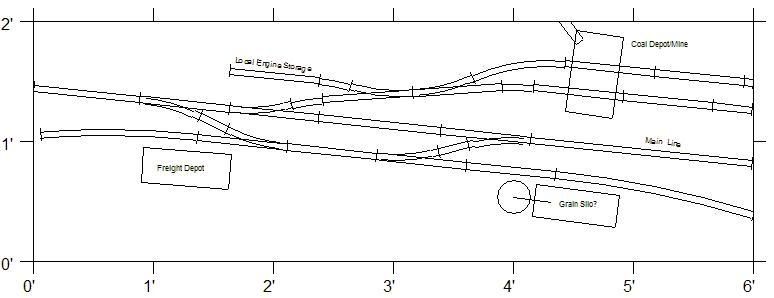
I looked at the layouts on Andrew Martin’s website, and his modified Turtle Creek extension (he calls it “Tuttle Creek”) caught my eye. It’s a modifacation of the Turtle Creek extension that appeared in MR.
I did up a version of it in XtrkCAD:
I played around with running some trains in Xtrk with it and it appears to offer a good deal of running options.
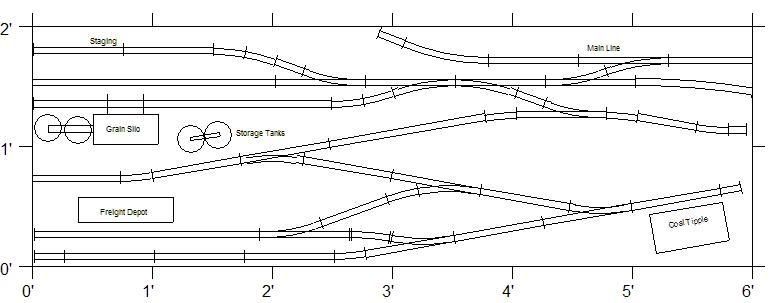
The other one I looked at was this one here:
Personally, I like the first one better. It doesn’t have as much track or industries, but the second one is really starved for space on a 6’ shelf and doesn’t have much room at the ends of the lines for shunting more than one or two cars at a time; seems like it would be more of an act in frustration than anything else. The “Tuttle Creek” shelf won’t allow for as much operating but I think it will be more fun to model and still offers enough option to have fun operating sessions. It also allows for easy expansion onto another shelf or larger layout.
If you had read the thread, you would have seen that some of us posted both 4X6 continuous run and shelf layout suggestions. The OP decided he’d like to look at shelf layouts along with the 4X6 oval.
To each his own, but both of those are really packed with switchbacks that can only be handled one or two cars at a time – unless you have room for extensions at the ends for the switch leads. Many people find that the back and forth on these layouts as drawn grows tedious very quickly. If you are interested mostly in a “moving diorama” and don’t think you’ll ever be interested in having more operating fun, they could work.
Westcott’s Switchman’s Nightmare or something similar offers more potential for longer-term engagement and enjoyment after the building is done, IMHO.
The lack of switch leads was something I noticed and I wouldn’t mind trying to fix it, though it seems that on such a small run (~6’) I’ve either run into having no switch leads, or no runaround. Getting rid of switch leads makes enough room for a runaround, but no room for shunting on either end, whereas placing in switch leads doesn’t seem to leave enough room for a runaround. I’ll play with the designs some more but it seems that in such a small space in HO scale there are unfortunetly some compromises.
I stumbled across this design here, and it looked like it offered quite a significant amount of operating potential in a small space. I’d be tempted to do it on a 2’x6’ instead for a little more modelling room, but same idea.
Scott Osterweil’s layout you linked to is derived from the Westcott design I keep suggesting.
You are right, Osterweil’s layout would probably be a better operational choice than the other two you showed because it offers the opportunity for more complex operating patterns if you ever choose them.
On wider benchwork you’ll have more room for industry modeling. One of the first things I would do on the Osterweil plan is to change the track at the upper left from an industry track back to the switch lead of Westcott’s design to avoid a pesky situation where you have to empty one industry to switch another. But that’s just me. It would be relatively easy, especially with more depth, to keep the switch lead and add back an industry track.
Cuyama - I do not have the Kalmbach book and you suggest that most of it won’t work but I am intrigued by the switchman’s nightmare. I think it would make a very workable small yard with #5 turnouts as I only have 18" of shelf width.
My question relates to how to finish the ends of this yard? I kind of wanted to create a wye at the end of the yard and the other end needs to feed into a main line on a curve. And I am trying to stay within 22" radius as I have some 6-axle locos.
I hope I am not presumingtoo much to ask you this? [bow]
Quick question - if you really had room for a 4x6 in the room where you wanted your layout, it really means that you had more than 6 feet of length - since you would have needed to access both long sides of a 4 foot wide island, and thus would have needed at least a 2" wide corridor along one of the short ends to squeeze past the table to the other side.
Maybe you should start by showing us the room you have (showing where door and windows and objects that cannot be moved are, so one can determine if you have room for a 6x2, or a 8x2, or a 10x2 (perhaps curving around a corner) - adding two or four feet to a six foot long layout is a pretty significant increase in layout space.
I did read the thread. I just think that sometimes people get too hung up on shelves. I have found that I enjoy my 4x8 more than I enjoyed the shelf switcher I had once (when I’m not, um, enjoying a complete rebuild of my front porch) I liked to switch, but I couldn’t do anything else. Now I can switch, and do lots of other things.
The area of the room it is going in is about 8’ square. One end is going against a wall, the other end stops just shy of a door, hence I can’t do any overhang, but I can stand there to operate the layout. My other reasons for wanting a smaller layout is cost (I don’t have the money do drop on a huge layout), and I’m going to be moving in 8-12 months so it’s impractical to build a larger layout. 4x6-ish is a lot easier to transport.
So, if I see it correctly, you can basically chop an 4’x8’ in two lenghtwise and have one section of 2’x8’ (for transportation purposes that would be two 2’x4’) on one wall and another on the second wall with one unscenicked bridge between.
If you want to you can bring it out to another room or house or show and bolt the two halves together for continous running if you want.
4’x6’ chopped down lenghtwise would also work and when time, space and funds allow you can always build additional sections to fit
4x6 layout in 8x8 room - 2’ aisles on 3 sides to reach - 20" radius curves, mainline length one loop about 14 feet, will see entire layout as one scene at the same time (unless you put a center divider down the length of the table, h
There’s one thing that should be noted about the wall-hugging plan, however. It’s a lot easier to work track into the middle of an island plan, which can all be benchwork, than into the narrow shelves of a minimum-sized wall-hugger. Looking at scene #1 and scene #2, track spurs are going to have to come off the outside to have much usable length, and in scene 1 it might be difficult to fit in more than one switch on the main. Adding a passing track might take up most of the usable space in scene 2 and 3. Switches become a devilish problem when you have narrow shelves mostly taken up by curves.
I noticed this when I entered Chip’s 10x12 layout contest. The area seemed big, but was surprisingly restrictive.
I’d probably agree that a wall-hugging shelf with no turnbacks could be better than a 6 x 10 in a 10x12 room, even with the duckunder, but when the size goes down, it’s harder for me to see the advantage of using the walls, when you start putting actual track on boards.
The Westcott design is pretty efficient for the 1X6 foot space, but I’m not sure it’s the best solution for what you are describing. There are some compormises to make it self-contained that wouldn’t be necessary in a larger space.
Probably your best bet would be to start a new thread posting some sketches of what you are trying to accomplish. There are a number of folks who will likely have good ideas for you.
That’s a great layout you have there. I’ll have to concede the point in your case. There’s no way I’d get all that on an island in a 6 1/2 foot wide room. Still, the thing that really makes your plan, besides ingenuity, is that nice, roomy 2 1/2 x 11 1/2 foot shelf at the top, which gives you some real estate for trackwork, something that might be missed on a much shorter plan. I guess width isn’t always needed, if a modeler is happy with modeling the track and hinting at the scenery (which can be fun, too, although I personally don’t prefer this method.)
Maybe I’ll take a whack at 20"R on a 4x6. Might be tough. [:)]
Still, if we traded layouts, neither of us would be happy. My workbench would be crowded, and you’d only have a crowded space to work in alongside my 4x8. I suppose there is no single solution, and that goes for islands as well as shelves.
Now, we could trade workbenches, I think, and the major effect would be some moderate increase in tool-finding difficulty. Mine and yours seem to look just about the same. (Yours is neater.)