That top shelf is 2 feet deep by 10 feet long (from the chimney to the opposite wall). If I had dropped the lowermost of the three yard tracks (and river road), I could have fit it into a shelf 10 feet long by 18" deep, if I had added a triangle in each corner for the curve.
Here is the layout with the depths marked off :
I can certainly agree about that. I am not saying that you cannot make a good looking layout on a 4x6. I am just saying that it is not all that hard to work in sidings and tracks on a shelf layout - real railroads, after all, tend to have a fairly narrow right-of-way.
Like that corner you mentioned on the rough sketch for flyboy - scene 1. You want a passing siding and some scenery there ?
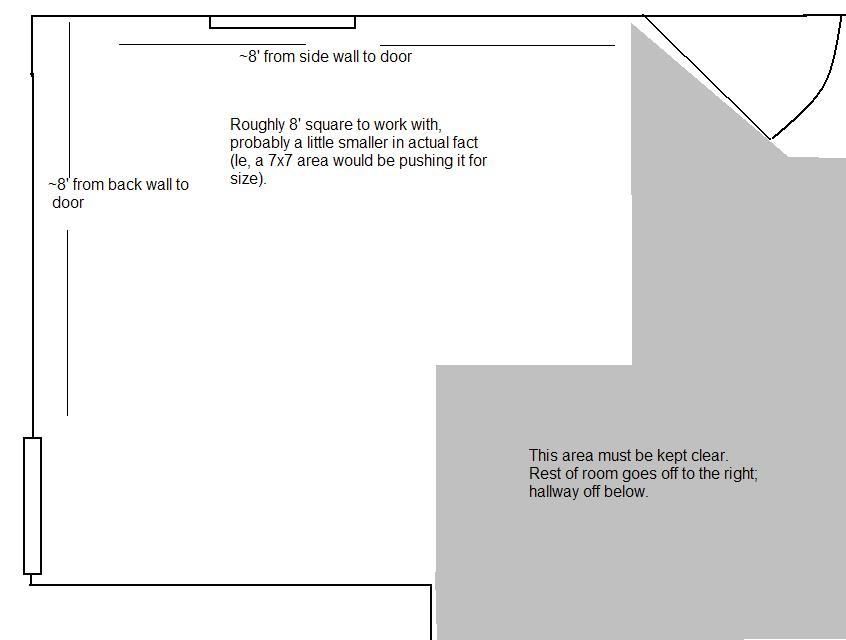
Ok, thought I would do up a better drawing of the room I have to work with here, since it’s not a full room (rather, part of a room). Sorry I wasn’t very clear with my poor ASCII art skills.
This is on one side of a living room/dining room. I can’t extend it out one way beyond 8’, and an “around the outside” seems impractical, considering it won’t be going around the outside of a room.
The other things to consider is, as I said, I’m trying to keep the costs down. While I of course don’t need to build a fair sized layout all at once, I do need to build at the very least a small section that offers some modelling and operational use. My other problem is I may be moving out of the city in a 8-12 months when I’m done college, so a larger layout is not really a good option unless it can be built to be easily disassembled (which, I’m afriad, probably offsets the cost issue). It would be nice if I had the luxury to build an open-benchwork unit, but I don’t imagine those are overly portable.
Anyways, I’m more and more liking the idea of the shelf layout. A 2x6 version of Scot Osterweil’s Highland Terminal (the one based on Linn Westcott’s Switchman’s Nightmare) looks like it offers me the best compromise of size, cost, and operation, and could easily be modified for expansion at a later date. While I wouldn’t mind a 4x6 with continious run, I’m not convinced it would have the same operational value as a shelf.
I will say, I never thought there was this much to layout design. Should have known better of course. [:)]
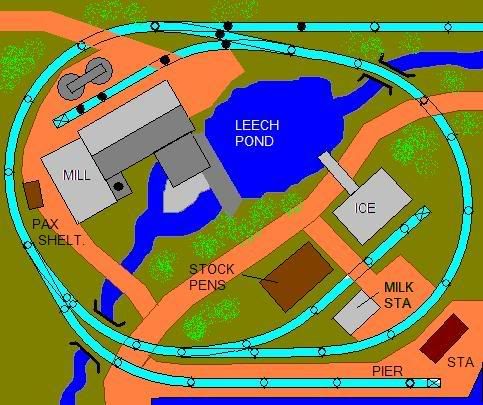
Okay, Stein, I took your challenge…sort of. I didn’t design a 4x6. I took a 3x4 with 15" radius curves that I had laying around and stuck 18" radius curves into it, which made it a 4x5. I know this radius isn’t what was asked for, but the way I see it, the operational difference from 18 to 20 is so minimal that we might as well stick with the common radius.
I dressed it up as a rural short line something like the Narragansett Pier, connecting a small dock to a single important industry, with minor local business along the way. I picture the mill as representative of a fairly large textile mill or widget factory (I suggest string or zippers) that would receive lots of coal from the pier to run its machinery, formerly wholly waterpowered. Perhaps the pond still runs a turbine; perhaps the tailrace is weedy and the water is only used for fishing and ice harvesting. Ice is hauled up, in winter, on an elevator chain across the road. The stub at top right, the only facing track in the plan, is an interchange,to a fiddle yard or future extension. Passenger traffic would include mill workers from the town, hauled in an old combine or coach, every shift change, and through cars of the Class 1 connecting road to the pier…the station would serve both the rail and steamship line. Occasionally the factory might send a boxcar to the interchange or the pier, or originate a load of scrap; milk and livestock would also be hauled.
Of course, something more urban is possible. This is just one idea. I think it would provide interest through contrasts - the big (shorty ) heavyweight mainline cars next to the creaky old combine, the towering stone mill behind the unassuming stock pen, milk shed, and ice house, and the evidence of former waterpower next to a newer brick powerhouse.
Just for fun, here’s the same plan, opened up and converted to a 5 1/2’ x 5 1/2’ L-shape, usi
Now that your room is clear I want to point out another possibility.
Check Kalmbachs 48 Top notch track plans. On page 68 is the article titled A trackplan to share a familyroom or bedroom, the Spokane, Pasco and Wallace by Kenneth Gentili (sorry no scanning capability right now).
It makes clever use of two 4’x8’ sheets of plywood. Making for two shelves forming a corner and a peninsula jutting into the room from the corner. It gives you both worlds, shelves for switching and a peninsula for running trains around and around with industry on the inside. It seems that it can be shortened if necessary. And remember, you can use the room in front of the door so long as that part of the shelf is removable and the door not frequently used during operating traintime (ditto for the window but that part is less critical).
Hmm - don’t have the book, but from your description it may be somewhat similar in basic shape to Byron Henderson’s N scale Santa Maria Valley RR (SMVRR) - the one where he introduced X-factor staging.
Maybe possible to get some inspiration from if thinking about a track plan with corner island w/shelf wings along the walls ? The actual track and scenery plan of course depends on what one is modelling - urban, rural, granger country, maine two footer, colorado mining or whatever.
Another possible shape for a corner layout with continuous run would be the “dogbone” or “butterfly” shaped layout - narrow in the corner, wider on the sides.
But which challenge is it that you are taking ? And what are you trying to illustrate ?
The 4x5 you have designed here will not work very well into a room that is 6 1/2 by 11 1/2 foot like the one I have my layout in. Any 4 foot wide island style layout would still demand more aisle space than what would be easily available in a 6 1/2 foot wide room.
One of course could put the layout on wheels and go on the short end and wrestle it back and forth from wall to wall to squeeze in along one or the other side of the layout, but it would be a pain.
And necessiate that the layout have the room to itself pretty much - you couldn’t even have much in the way of storages shelves on the walls, since you would bonk your head on the shelves as you worked in the 2 1/2 foot wide aisle between the island layout and the wall along the longest side of the layout.
Are you trying to illustrate that a shelf style layout which doesn’t form a closed donut shape and doesn’t have turnback blobs at the ends won’t have continuous run ?
That is pretty obvious - to have continuous run (unless you are running a tram line in pendulum service) you need a closed loop of some kind - either one you look in on from outside the loop (ie on an island style layout) or one you look out at from inside the loop (ie an around the wall shelf style layout or donut style layout with a central ope
I have been leafing through the book 48 top notch track plans again. It has some worthwile plans.
One interesting is the BTR RR by Art Curren, the Break The Rules railroad, page 38. In a 5’x9’ space he managed to cram 18 (!) industries…
Tonight I visit my sister, I’ll try to get her to scan a few plans for me so I can post them here (note to self, buy a new printer/scanner). Even in 4’x6’ there is more possible than one realises. It does depend on the compromises one is willing to make though.
Well, you did mention a w h i l e back in the thread that I was welcome to try and design a 4x6 with industrial spurs, so that’s (roughly) what I did. [:)] It’s not designed for your space, but for the OP’s. Of course I realize that 4’ in your space would crowd the room. I did the L-shape to show how the same basic plan could be opened up and placed on shelves. This can often be done with table plans, or shelf plans can be bent and placed on a table. The famous Inglenook Sidings plan was originally part of a small continuous-run oval, IIRC.
Obviously, I can’t fit as much as you have on your own plan, but your own is about twice as big as a 4x5, so it’s not exactly apples to apples, is it? [:)]
The island layouts you posted are interesting. I’ve seen RRT’s pictured here before. None would suit me perfectly as it is, but that’s how this stuff always is, and they all have some good features, and some I might change. I don’t like backdrop-type scene dividers, for instance. I’d rather use a scenic feature, like the river and pond in the 4x5 plan. The feature doesn’t even have to physically screen one scene from the other; it just has to provide some sense of separation.
You’re right that my 4x5 plan has only one facing spur, the interchange track. MY 4x8, which has four relatively long spurs and a three-track yard, is like t
Now I understand what you meant. Guess we just misunderstood each other. I had meant to ask you to demonstrate how it would be “far easier” to put industry tracks into the center of a 4x6 than it was to add industry tracks on fairly narrow shelves - say a 18" deep or 12" deep shelf [:D]
Guess it depends on why you are comparing two alternate solutions.
If you are comparing what will fit into a given room, you can e.g. for my layout room choose between a 24 square foot 4x6 or 32 square foot 4x8 that won’t fit and a 42 square foot (if I did my math right) 9-24" deep around-the-walls shelf layout that will work in the available room [:)]
Anyways - the OP seems to want to build a fairly smallish switching layout and is looking at Scot Osterweil’s “Highland Park” layout, which is a variety o
Still looking at Osterweil’s layout. It’s probably the one I’m going to build. It seems to offer the best compromise of size, operation, portability, and cost. It’s easily expandable in the future as well.
As for period, etc. I was originally going to do a fictitious branch line of the Canadian Pacific set in the early to mid 1950’s. Though with this layout since I’m not going to be using any of my steam equipment I may just do it a decade or two later. Industries available will be the primary deciding factor on period.
In stead of doing the traditional oval layout, have you ever thought of cutting the 4X6 in half and doing a switching puzzle layout? I live in an apartment without much room and have a Modified Time Saver layout. This plan along with several others were included in the 2003 Model Railroad Planning Annual issue. I have really enjoyed the layout (HO Scale) had have not been disapointed in my choice.
Have you tried looking in a phone book for potential industries?
How about checking the local Chamber of Commerce if they have really old promotional material?
I found a civic promotional book from 1907 - I live near a VERY good public library - and simply listed off every company that bought an ad, was mentioned in an article, or had somebody on the membership roster. Some possibilities:
Trolley company, typewriter maker, Frigifax (freezers), book printer, specialty steel molder, bakery, wholesale grocer, house construction, dredges, sailboat builder.
In the middle of the 4x6 loop, you can buy a Merchants Row kit and lable the buildings for a number of customers who would need a freighthouse or LCL service or a team track, rather than whole cars delivered to their back door
Purchased all the track and switches I need… hopefully the lumber is tomorrow so I can start construction. Thanks all for the ideas, I’ll let you know how it turned out.
If you want an idea for an industry that takes up very little space, how about this.
Based on a real industry in Baldwin, GA that currently exists…
<>A tallow loading track.
<>It’s very simple. All you need is a short stub end track, a truck and a tank car. There’s no building at the prototype. It is an industry that is affiliated with Fieldale Farms (feed mill). They send tank trucks full of chicken fat to this spur, which is located off a main road in an open lot. Just a little dirt road from the main road to the spur track, and lots of weeds and rocks about. The tanker truck pumps the chicken fat into the tank cars, and they are left there until full, then a local switcher picks up the loaded cars and sets out new empties. Generally there will be one or two cars on this track at a time. It could easily be modelled as one in and one out on a small layout.
Similarly, up the road in Cornelia, Ga there is a plastics unloading track next to the old depot building. It holds up to 5 cars on the spot, is stub end as well. Trucks come down a dirt road beside that track and pump plastic out of the cars for delivery a local industry that apparently doesn’t have rail access.
I’m not sure how protoypical these two industries would be to a 1950’s era layout, but I’m sure this might give you some idea.
<><><>Another industry you might consider is a brick yard. You wouldn’t need much for this either. The main thing you’d need would be a loading ramp (concrete, not wooden…because of the weight of bricks being unloaded). A company called Model Railstuff sells HO scale models of palletized bricks and blocks which would look great as part of the scene, they come 4 pallets to a package, so you’d probably want to get atleast 8 or 10 packs so you could fill your brick yard up to a believable level. You could get some
bladeslinger, thanks a ton for that information. I especially like the idea of the brick loading area as it would fit into my limited space mixed-industrial setting quite well. I’ll be looking into most of those options. All my track is layed but at the moment I only have 2 industries (both walthers kits, the large concrete grain elevator and the mill).

 ) heavyweight mainline cars next to the creaky old combine, the towering stone mill behind the unassuming stock pen, milk shed, and ice house, and the evidence of former waterpower next to a newer brick powerhouse.