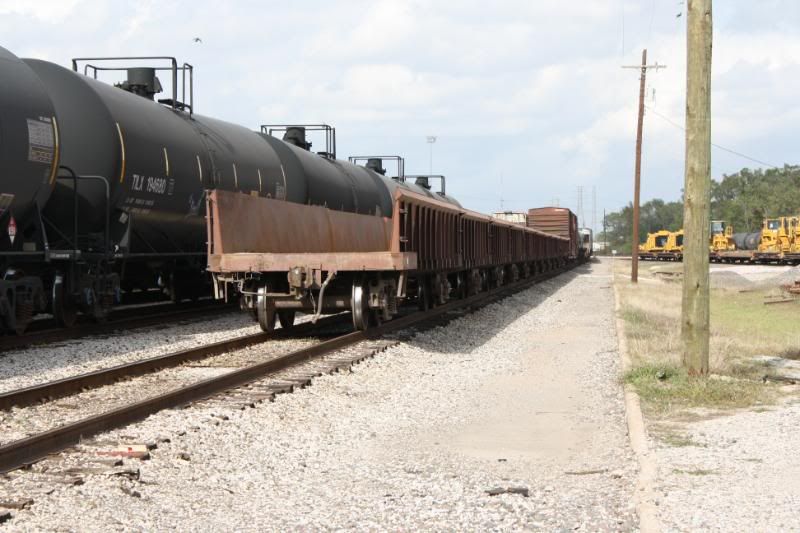
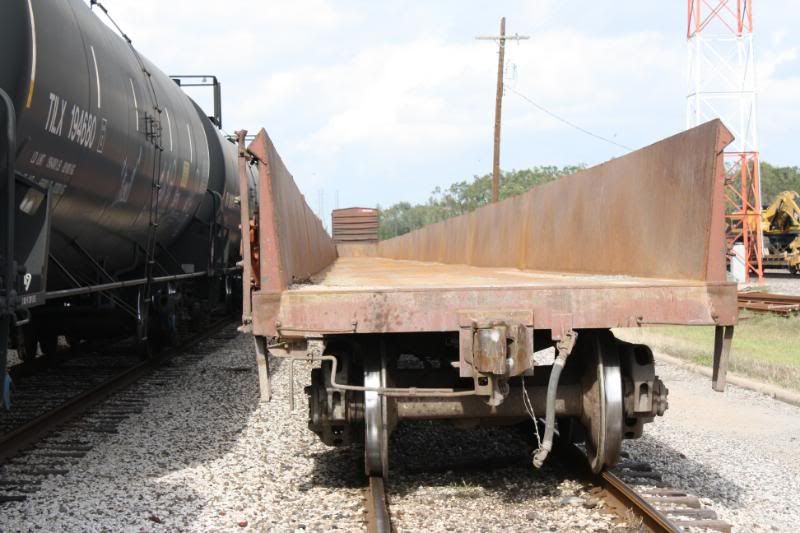
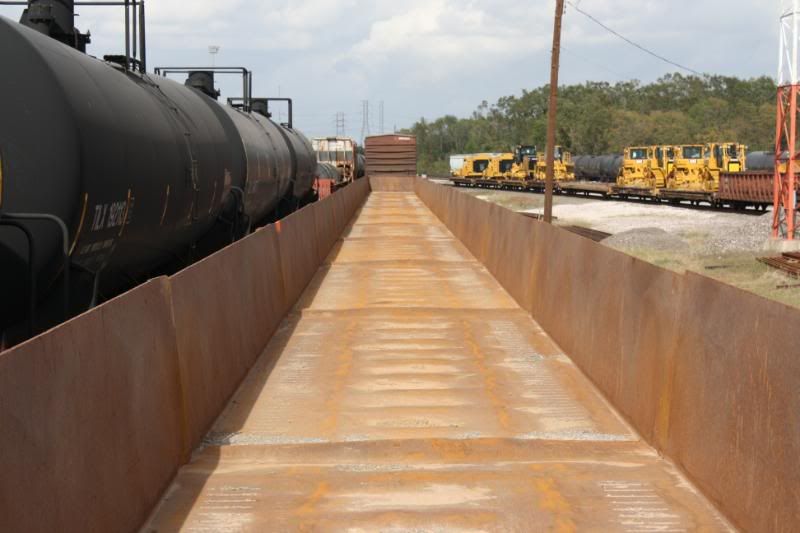
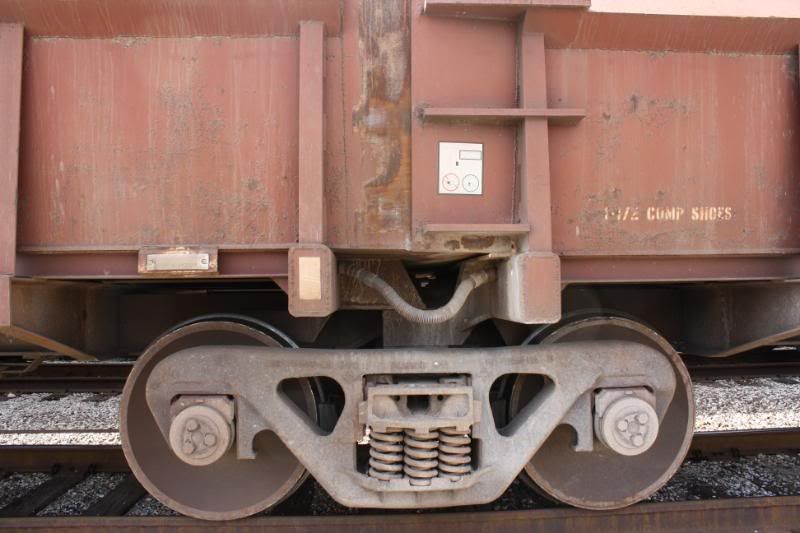
…Unusual and unique. Wonder just what it’s purpose is…? Wonder how it handles sharp curves in a yard…? Looks like the mating ends {along it’s length}, have to slide past each other…and not be bent in so doing.
Quentin, it’s for dirt, ballast, or whatever that has to be unloaded off the right-of-way. The car has this barrier-free construction so a front-end loader of some sort (probably a Speed Swing) can go the length of the train and clean it out. I’m sure that MC, once he calms his ruffled feathers from the Nebraska trip, can further enlighten us.
Don’t be too hard on the boy. It could in fact handle “ribbon” or welded rail. It could also allow for a crane of some sort to ride the side rails to lift ties, etc. on and off the car(s).
Wait a minute - I volunteer with a tourist railroad!
It might work, as long as we weren’t using our RS-3 the way it was running last summer. Everyone would have returned from their trip dressed a la Henry Ford - any color you want, as long as it’s black.
Gotta admit, though - someone put some thought into it.
The slot train is designed to operate with one or more hydraulic excavators (i.e trackhoes) on board which unlike a front end loader have 360 degree range of motion. Google “Georgetown Rail” for detailed info and pics. They also have a self propelled version which uses a diesel electric power unit.
They are designed for handling Ballast, fill, and OTM (other-than-track materials such as used ties).
The company is a subsidiary of GRR that builds and operates specialized MOW equipment (much like Loram,Plasser and Hulcher). Typically, RR’s will rent or lease a train set complete with operators from GRR. Amtrak has one of the self propelled units that operates out of it’s Pawtucket, RI MOW facility/yard for NEC work that I’ve seen in action.
It is not designed for laying welded rail, a ribbon rail train has roller equipped racks (I believe Georgetown rail builds and operates some as well)…
I had never thought about your point about the plow cable needing to be guided to follow the curvature of track. But I have a couple of photos showing a Lidgerwood Unloader on the M&StL RR about 1905. They do not show the plow close up, but the cars are all flatcars. And all their stake pockets are fitted with short, fat stakes about 2 feet high. I was thinking that the stakes were to guide the plow, but that seemed sort of iffy with the gaps between them. But they would seem to be a good way to guide the cable.
That first of those two posted photos of picking up that Alco is particularly interesting when you blow it up. There is a lot of drama and tension, both in the cables and in the workers making decisions. That guy with his hand on that cable seems to know what he is doing, but I would not be hanging onto that cable or that close to it during the pull. If that knuckle or knuckle pin happens to break, he could get quite a bruise.
It’s a logical progression for the Company as their M.O.W business evolved out of equipment they built in house for aggregate service, I understand they’ve always been a big player in supplying Ballast rock…