Among the efforts to increase transportation efficiency in the Johnson County area, a study to determine the feasibility of a passenger rail between Iowa City and North Liberty has been approved.
The $50,000 study is being funded largely in part by CRANDIC and the Iowa Department of Transportation, with help from Iowa City, Coralville, Johnson County, and the University of Iowa. The study was approved June 24.
Typical current journalism. Tell the new grad reporter to find a pitcure to go with a news item. Goes to the web and finds train pic and inserts it into story. No clue as to relevance.
Among the efforts to increase transportation efficiency in the Johnson County area, a study to determine the feasibility of a passenger rail between Iowa City and North Liberty has been approved.
The $50,000 study is being funded largely in part by CRANDIC and the Iowa Department of Transportation, with help from Iowa City, Coralville, Johnson County, and the University of Iowa. The study was approved June 24.
Being a native Iowan (and a U of Iowa grad), I’m all for the proposed service. But what bothers me here is that this particular proposal makes me think that this is something akin to trying to grow a toe without a foot here. I think something like this would make much, much more sense if there was additional Chicago - Omaha service serving Iowa City on IAIS or on UP’s “Overland Route” via Cedar Rapids.
Among the efforts to increase transportation efficiency in the Johnson County area, a study to determine the feasibility of a passenger rail between Iowa City and North Liberty has been approved.
The $50,000 study is being funded largely in part by CRANDIC and the Iowa Department of Transportation, with help from Iowa City, Coralville, Johnson County, and the University of Iowa. The study was approved June 24.
What they ought to be looking at – if anything – is restoration of Crandic’s original Cedar Rapids-Iowa City service. Anyone who has driven the 4-lane between those cities would acknowledge the traffic is there … for the right kind of rail alternative.
The “Corn Belt Rocket” is a will o’ the wisp. CR-IC has the potential to satisfy a real need. (With subsidy, of course.)
I doubt that any improvements to Crandic’s track to provide passenger service capable of luring people off of I-380 (i.e. fast enough) would be more cost effective and popular than the current plan in the works of changing those four lanes into six.
I don’t know, BL; how much difference does a few minutes’ travel time matter between cities 26 miles apart? To escape the hellish shooting gallery that is 380 morning and evening (and sometimes in between)?
For sure, upgrading Crandic and subsidizing a rail service for years and years would be a heckuva lot cheaper than two more lanes of Interstate. (And how many more in the years ahead?)
I know, I’d love to see it happen, too- but there are some insurmountable negatives to overcome with the public. One big one that comes to mind is the fact that Crandic’s CR-to-IC line runs right past the ADM complex (on the east side, to boot)[xx(].
But isn’t most of that line almost unused since IAIS changed its yard location and the West 900 project was completed? That in itself might be a powerful incentive for time-separated railcar use. schlimm’s picture of the ‘classic’ Crandic car might be a more reasonable depiction than we were thinking!
That alone is a possibility that should be included in that study, although it appears clear to me that conventional ‘passenger rail’ is nowhere near as useful in this context as an adaptation of low-floor equipment to “interurban”-style ad hoc stops would be. Has the project reached an adequate stage of discussion to indicate whether time separation of traffic is practical for this service over ‘enough’ of the route to make “ADM commuting” practical at the times it would be preferred?
Now to figure out how to make it safe at 85mph speeds… [;)]
Crandic still uses that section of the north-south line to switch the industries, including ADM, nearly 24/7. If the commuter service were to be terminated on the north end at the Eastern Iowa Airport, however, Crandic wouldn’t mind at all I would guess.
Perhaps the NJ Transit River LINE operation would be a useful example to emulate. Notably, Diesel Multiple Units are used to function similarly to Light Rail Vehicles without the cost of ovehead electric power lines (catenary). See:
Question: Is there likely to be enough traffic to justify operating two or more of those cars in MU as opposed to the same number of cars spaced apart to give more convenient service? I’m beginning to think that a line like this (running in strict time separation from other traffic) might be a poster child for autonomous vehicles, using machine vision to recognize flag stops (etc.) which would reduce at least some of the overall incremental cost of running multiple separate cars.
Something for the hopper regarding DMUs functioning similar to transit:
Sonoma-Marin Area Rail Transit (SMART) DMUs…
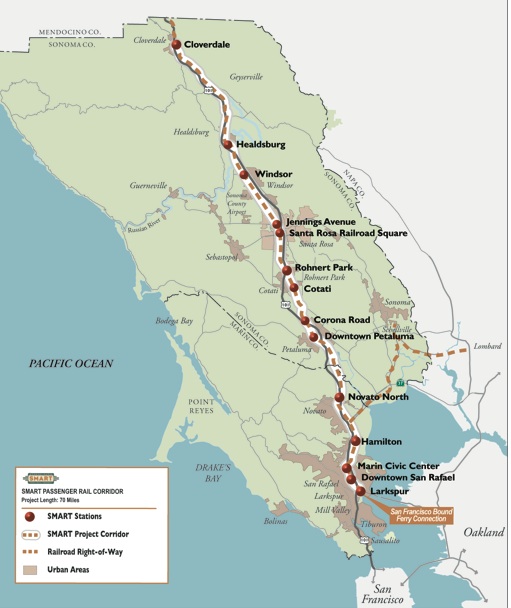
It actually runs on the roadbed of the former Northwestern Pacific that is still a functioning freight hauler - SMART route map…
SMART train at San Rafael Station (still under construction - note canopy bases on the right)…
They went wtih DMU for exactly the reasons mentioned previously in this thread - relatively low start up costs compared to a separate line with catenary as would be needed with light rail.
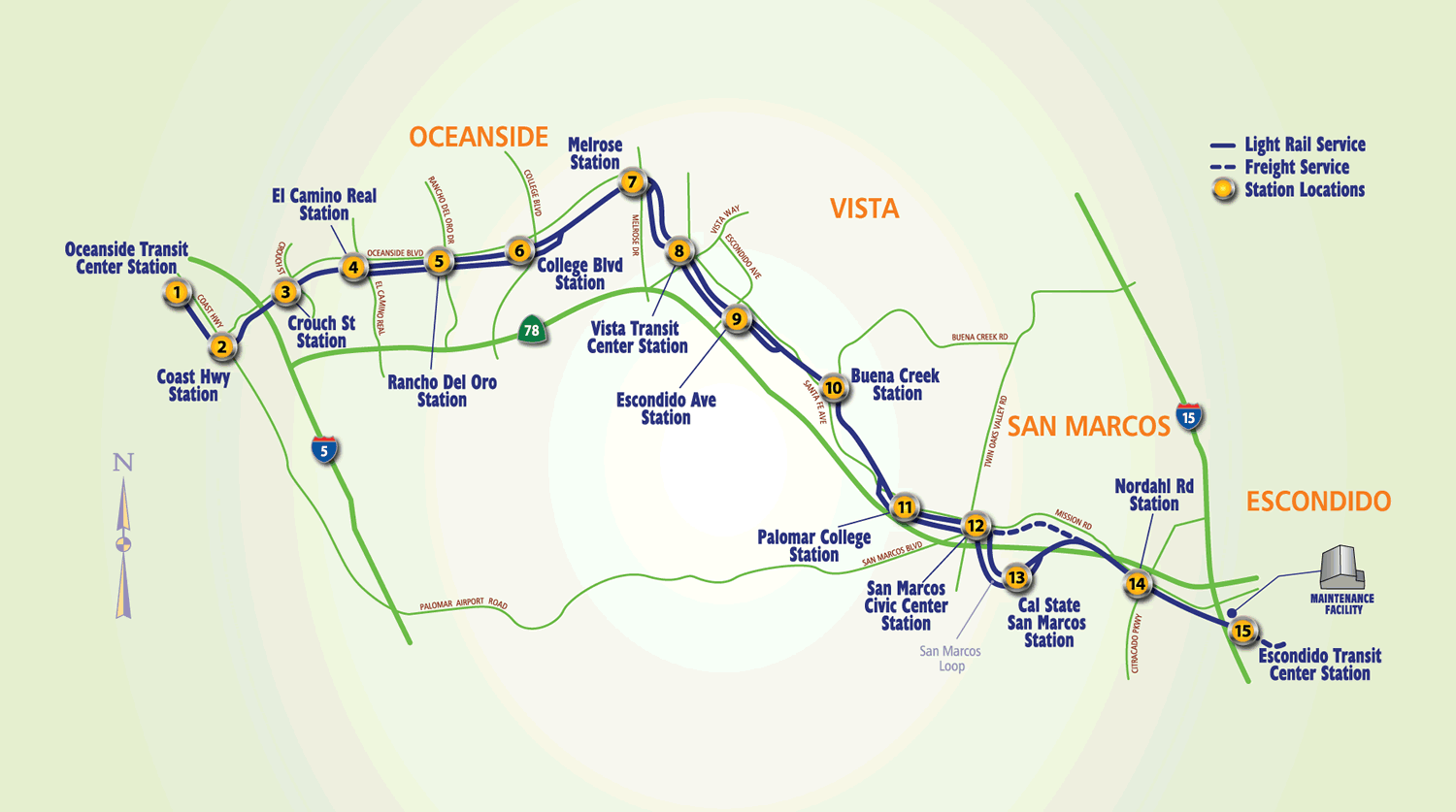
Farther south in San Diego County, a service called “Sprinter” operates between Oceanside and Escondido on an active freight rail line that is still operational as a freight line during hours when Sprinter is not running. This service also uses DMUs.
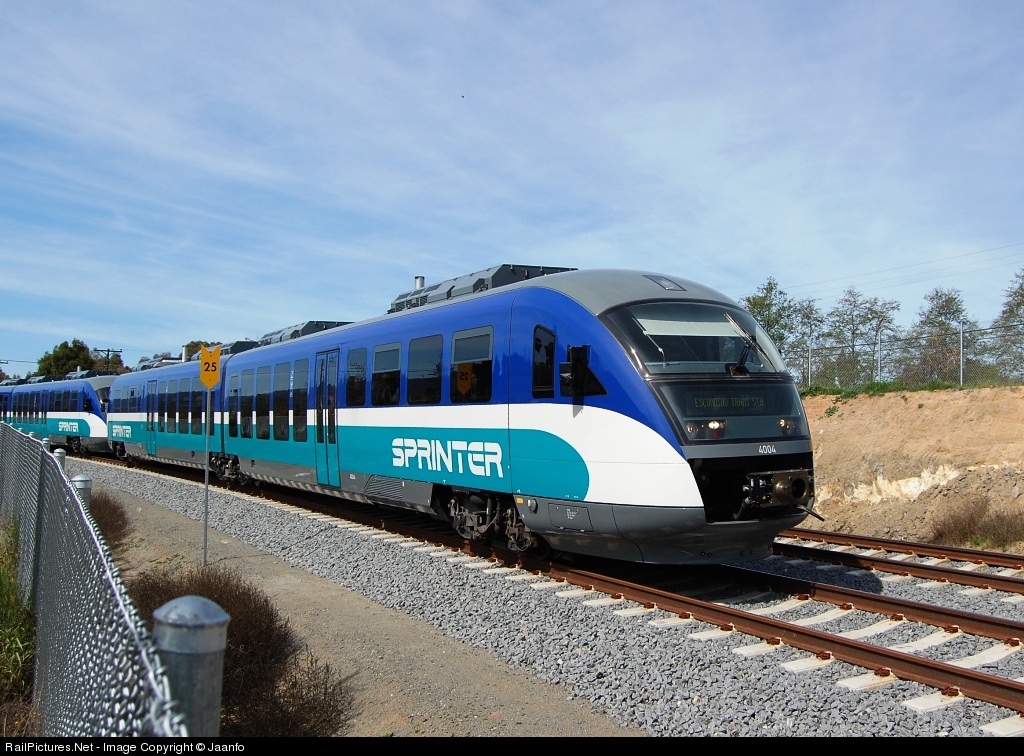
Sprinter DMUs…
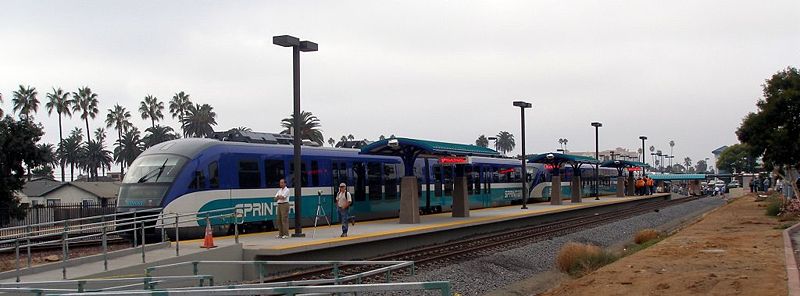
Sprinter train at a station stop…
Sprinter route map…
Then our friends north of the border in Toronto have started the Union-Pearson Express running from downtown Toronto Union Station to Pearson Airport with DMUs very similar to the SMART DMUs…
But note that two of the three types you illustrated are high-platform-optimized, and the other is implicitly ‘mid-platform’.
Part of the ‘innovation’ here is the idea that at least some ADA compliance with the old “interurban” practice of stopping along the route for boardings and departures can be achieved with proper low-floor car design (there might only have to be one low-floor section in the train for this to work, so some of the ‘underfloor diesel’ designs might still be workable). There would still be fixed stations with platforms, but those would require very minimal construction to be ADA compliant, and should not pose much of a flooding or drainage problem as they would be slightly above ‘ballast prism height’ probably on vaults. Adding a new service stop might be comparatively simple, modular, and cheap.