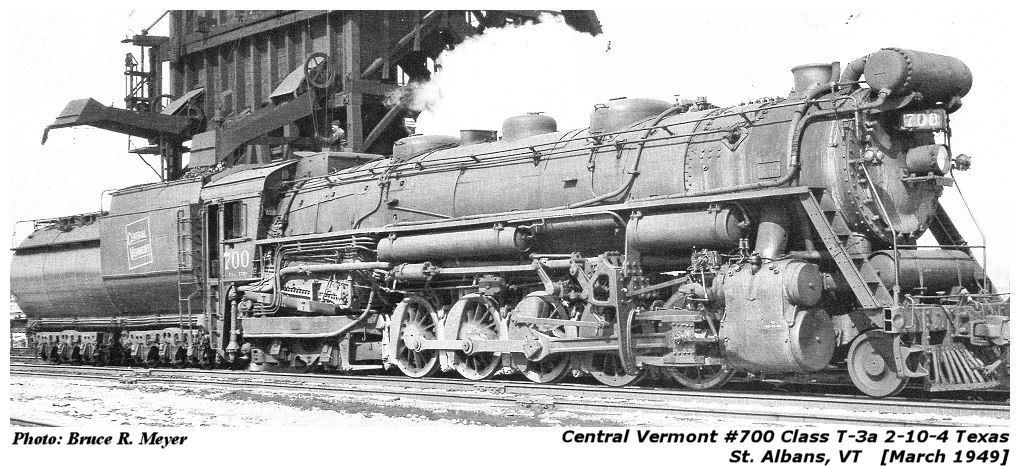
On many photos of steam locomotive cabs, usually under the locomotive number, I’ll see a number with a percentage sign- what does the percentage number mean?
Example:
2758
52%
Thanks,
Road Fan
On many photos of steam locomotive cabs, usually under the locomotive number, I’ll see a number with a percentage sign- what does the percentage number mean?
Example:
2758
52%
Thanks,
Road Fan
At this point, nobody knows. Gives us a few examples and we’ll see if we can guess.
In Classic Trains ‘Steam Glory 2’ in the steam color section (page 37; no.s 6405 thru 6409) is a photo of a Grand Trunk Western 4-8-4. Under the engineers window it says:
U-4-b
52%
Road Fan
IIRC some railroads used the % sign to show tractive effort. 52%= 52,000lbs TE.
I might be wrong about this as 52,000lbs seems to not be very much for a 4-8-4.
At any rate thats a great photo of the GTW.
…
This link to trainweb page explains % is the “haulage rating.”
http://www.trainweb.org/j.dimech/roster/rosnotes.html
CV 601. Old book says its tractive effort was 44000 pounds.
http://imagescn.technomuses.ca/structures/index_view.cfm?photoid=77900020&id=37
http://imagescn.technomuses.ca/railways/index_view.cfm?photoid=-865848423&id=55
http://imagescn.technomuses.ca/people/index_view.cfm?photoid=775793097&id=26
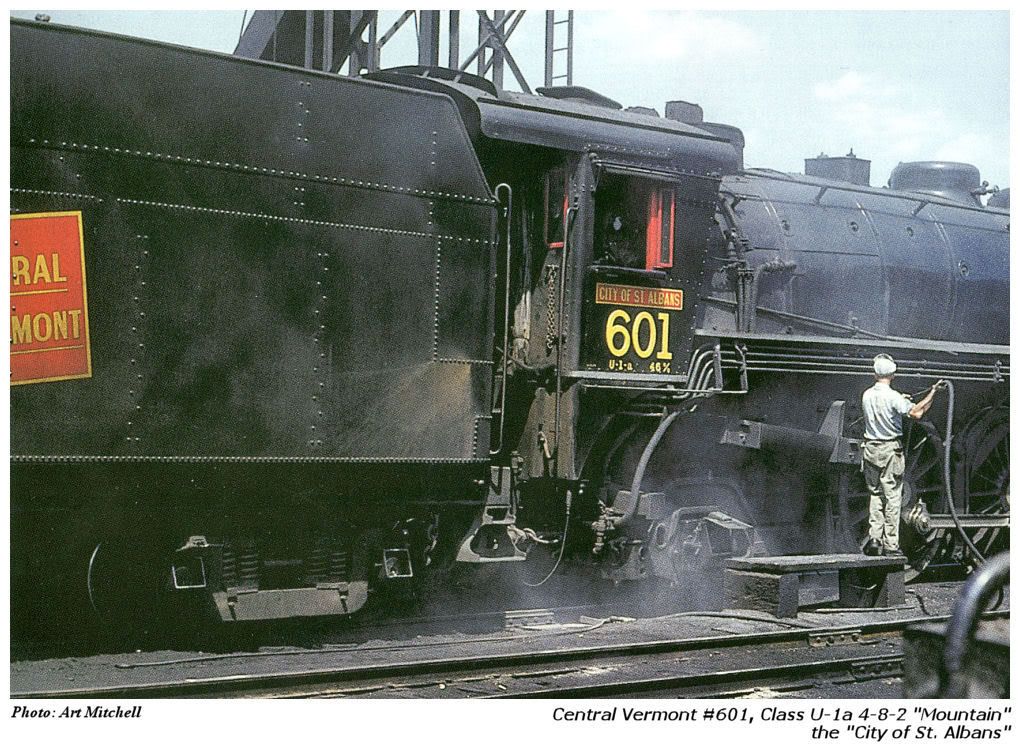
The 601 (with 600, 602, 603) is a favorite of mine because my grandfather drove it. American Locomotive with a Canadian-born engineer.
Happy New Year!
Thanks to all for solving this headscratcher of mine.
Happy New year,
Road Fan
[quote user=“wanswheel”]
This link to trainweb page explains % is the “haulage rating.”
http://www.trainweb.org/j.dimech/roster/rosnotes.html
CV 601. Old book says its tractive effort was 44000 pounds.
http://imagescn.technomuses.ca/structures/index_view.cfm?photoid=77900020&id=37
http://imagescn.technomuses.ca/railways/index_view.cfm?photoid=-865848423&id=55
http://imagescn.technomuses.ca/people/index_view.cfm?photoid=775793097&id=26
http://i43.photobucket.com/albums/e390/MikeMacDonald/CV601a.jpg
Of all God’s critters one always remembers CV belongs to the Grand Trunk.
http://216.94.16.48/_images/common/photos/original/CN005344.jpg
Mike
Just When you think you seen it all.
Someone shows up with another strange engine.
CN 7700.
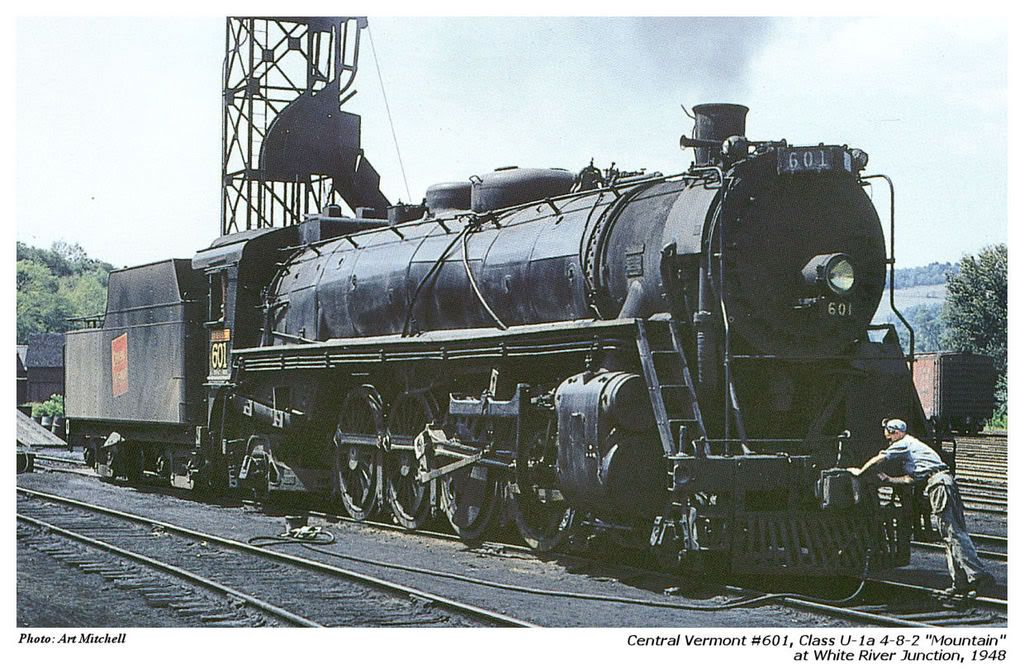
Just a couple more inches and it will be under the coaling tower.
St. Albans coaling tower
http://imagescn.technomuses.ca/railways/index_view.cfm?photoid=-1700731494&id=56
http://i43.photobucket.com/albums/e390/MikeMacDonald/CV_700-1.jpg
I note a lot of emphasis on tractive effort but I think that there may be a different answer. Steam engines were designed to operate at various valve cutoff settings. 52% might mean that this particular engine operated at a maximum of 52% cutoff, meaning that at its optimum intended speed the engineer should adjust his valve setting with the reverse lever to no more than 52% cutoff. That means he was allowing only 48% of the steam delivered by the boiler to actually enter the cylinders.
This link was referrenced earlier in the thread and fully explains CN’s definition of this “Haulage Rating” notation:
Hi All,
I wanted to add something to my explanation of Haulage Rating on my website. As some of you may have noticed, some Early CN Diesels also had a Haulage Rating written on the side of the cab.
I have a document in my possecsion which lists the wherabouts, and various other stats for all Motive Power owned by CN in December 1947. Among other things, this record lists the Tractive Effort. Here is where it gets scary. This record lists the Tractive Effort for an ALCo S2 (for example) as 60,000 lbs or (60%), which is more then my Northern (57%). However some sleuthing revealed that this quantity is in fact the STARTING Tractive Effort, whereas the CONTINUOUS Tractive Effort is only 34,000 lbs (34%).
Eventually CN realised no one was interested in STARTING Tractive Effort, and eventually reclassified all of its Motive Power by its CONTINUOUS Tractive Effort. This seems to have happened by 1949.
In 1954, CN completely re-did the paint scheme for everything except steam (which stayed black for the most part) and around that time introduced a new Classification system for Diesels (which it still uses to this day) which lists the Locomotive;s HORSEPOWER instead of Tractive Effort.
Hope this helps some of you get some sleep.
Cheers,
Joe
http://www.trainweb.org/j.dimech/
P.S. I’ve added this to my website http://www.trainweb.org/j.dimech/roster/rosnotes.html
I don’t know about the % on the cab side but I was a back shop machinist and for a short time a oilburner fireman so I have a comment on the cutoff. My experience was making parts and installing them. Most other subjects are way above me!
Valve gear and timing are very detailed subjects…Max cutoff or running in the front corner for starting a train means you have about 80% cutoff OR 80% of the bullring “piston” stroke is pushed by steam from the boiler, the remaining 20% which is the end of the stroke is “cutoff” from the steam supply. But steam admission starts at the begining of the next stroke, this is called “lead”. This 20% is when the valve wether slide or spool is switching “lap”. However the combination lever on the Walscheart valve gear ensures that “lap movement” happens quickly. This is another subject if anone is interested.
IN VALVE GEAR EACH SETTING OF THE REVERSE LEVER DOES MORE THAN CHANGE CUTOFF AND DRIVER DIRECTION. Thats another subject.
When on the road under normal load with no speed or grade changes the cutoff is about 25% with the throttle mostly open. This means that the first 10% of the bullring stroke has no admission or exhaust but it has “compression” the next 25% of the stroke is moved by boiler steam but the remaining 65% is pushed by expanding steam. This is where super heaters are useful and you are getting your economy.
“Compression” cushions the recipricating parts and also prepressurizes the space between the bullring and cylinder head, this reduces further the amount of steam needed to operate. If you now have a head ach don’t be supprized!
Slide valves are external admission and spool valves are internal admission. These are basic design changes that came about through locomotive evelution. Russell.
The PRR 2-10-0 and 2-8+8-0 originally had about 50% maximum cutoff; AFAIK they were the only engines in North America with that low a maximum. The engine in question probably had a maximum cutoff of 80% or more.
Just to avoid confusion, the percent listed on the side of a CNR, GTW, CV, etc. locomotive and has absolutely NOTHING to do with Cut-Off.
It is a short-hand reference to the amount of Tractive Effort that a given locomotive (either Steam or Diesel) produces. 1% = 1,000 lbs of Tractive Effort so 57% = 57,000 lbs.
(If you don’t believe me, check CN’s mechanical Department Diagrams and look at the Tractive Effort and the Haulage Rating.
http://www.trainweb.org/j.dimech/roster/diagrams.html )
http://www.imagescn.technomuses.ca/railways/index_view.cfm?photoid=2767360&id=55
Joe
I had not thought about that way of listing tractive effort, it would be handy data where many engines are used or where a high number of new emploees are working.