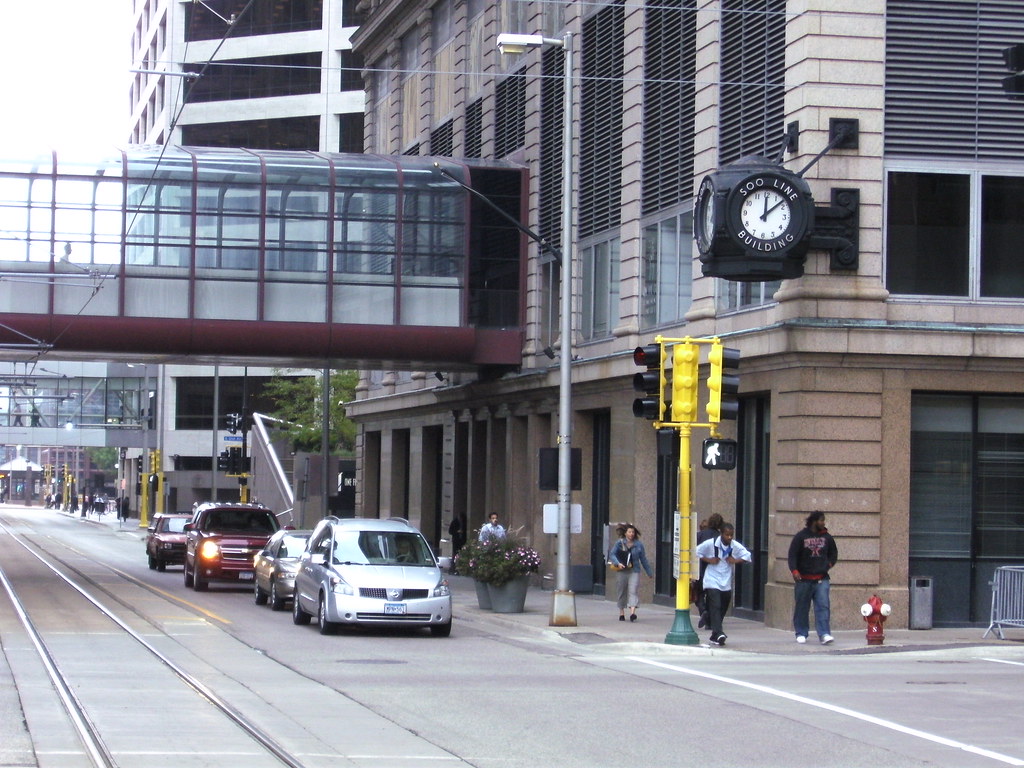
Last week there was an item in the TrainsNews Wire for Weds., Oct. 5, 2011 about “Canadian Pacific to leave Soo Line building, relocate U.S. offices” nearby over the next year:
Yep. We’re going to be moving about a block or so away at One Financial Plaza; basically a hop, skip, and a jump away from the Soo Line Building. While CP/SOO-MILW has a long history with the building, CPRS needed a larger, more modern facility for its US headquarters.
Love the previous version of “light rail vehicles” in the photo at the 1st link !
The article in the 3rd link says the Building will be converted into apartments - it now has 226,000 sq. ft. of “Class B” office space. Since it’s right next to a new light rail station stop, and 1 block away from the Nicollett Mall, and 2 stops away from the football stadium, it should have a good chance of drawing tenants for a downtown lifestyle.
Why would they be moving because they need more space? Unless they got some other tenants in recent years, the vast majority of the building was empty.
The Trains News Wire link that I posted above says only that the new building is more “modern” (albeit twice). Likewise, the “Class B” office space in the Soo Line Building is likely not as ‘nice’ as the space in the One Financial Plaza building, what with the customary modern amenities, handicapped access, modern telecom infrastructure, etc.
But the likely real reason is that CP was made “an offer they couldn’t refuse”. According to the article at the 3rd link by wanswheel above (the “Village Green” link): the owner of the Soo Line Building - Hempel Properties - bought the One Financial Plaza building mainly so Hempel could next move CP out of the Soo Line Building into One Financial Plaza, and then sell the Soo Line Building to Village Green for conversion to apartments, etc.
Whats funny about the building, is that according to some SOO Line guys, the Soo Line Building was sold in order to gain capital to purchase the Milwaukee Road! It had been leased ever since.
When I came to the Soo in 1980, Engineering and Mechanical were on the 15th floor.
Then Engineering moved to 3 and then to 6. (My office was in the corner over the clock on the 6th floor for my last 10 years there) and now Engineering is back on 15. Between the time on 3 and 6, I spent 7 years in Chicago.
Per a previous comment, Soo sold the building and leased space and gradually reduced its space in the building.
The building is reasonably nice for a cube holder, but certainly nothing fancy and with the newer security needs over the last many years it is more awkward than other newer buildings. You come out of the elevators into what is basically a hallway where you have to enter the office spaces.
“When Blackmun began his first day of law practice on January 2. 1934, the Dorsey firm occupied the thirteenth floor of the First National Soo Line Building, home of Minneapolis’s First National Bank, which had been the firm’s first major client.and the Minneapolis, St. Paul and Sault Sainte Marie, or Soo Railway.”
I wondered how the bank and the railroad got together on the skyscraper. Perhaps it was arranged by Clive T. Jaffray (1865-1956), vice-president of the bank and a director of the railroad. Later, he was president of the bank 1917-1924 and president of the railroad 1924-1937. He was chairman of the board of both companies until 1944.
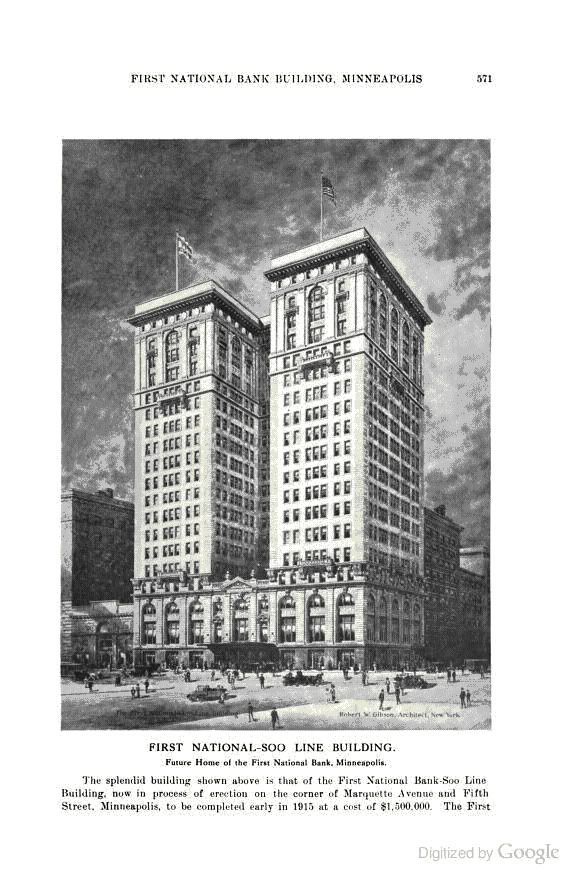
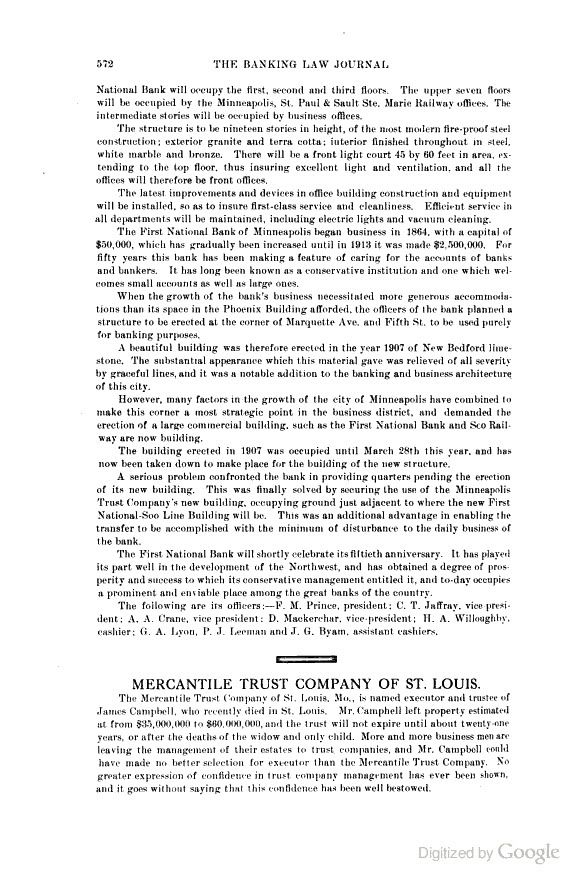
The splendid building shown above is that of the First National Bank-Soo Line Building, now in process of erection on the corner of Marquette Avenue and Fifth Street, Minneapolis, to be completed early in 1915 at a cost of §1,500,000. The First National Bank will occupy the first, second and third floors. The upper seven floors will be occupied by the Minneapolis, St. Paul & Sault Ste. Marie Railway offices. The intermediate stories will be occupied by business offices.
The structure is to be nineteen stories in height, of the most modern fire-proof steel construction; exterior granite and terra cotta; interior finished throughout in steel, white marble and bronze. There will be a front light court 45 by 60 feet in area, extending to the top floor, thus insuring excellent light and ventilation, and all the offices will therefore be front offices.
The latest improvements and devices in office building construction and equipment will be installed, so as to insure first-class service and cleanliness. Efficient service in all departments will be maintained, including electric lights and vacuum cleaning.
The First National Bank of Minneapolis began business in 1864. with a capital of $50,000, which has gradually been increased until in 1913 it was made 52,500,000. For fifty years this bank has been making a feature of caring for the accounts of banks and bankers. It has long been known as a conservative institution a