I grew up in the New York area near the Grand Central. 
3 Likes
OK, we forgive you. 
Rich
1 Like
Rich, As I have mentioned before, this map has signs of being a Sanborn Fire Map. You gave credit to some Chiago institution. If anyone is interested in THEIR small town, search out a Sanborn map and they include RR trackage. These maps are detailed and once consided as accurate as a survey by a surveyor. endmrw0122251345
I must confess that I never heard of a Sanborn Fire Map until you recently mentioned it. I have to familiarize myself with these maps.
Rich
Thank you for your answer, I guess you must be right, this loop was mainly used in the early days at the lower level by commuter coach trains without real cab car, and pulled by the old electric locos not really designed for a full push-pull service. I am still wondering if the loop was also playing a role in putting the observation cars at the rear end of the Limited Trains (the 21th Century Limited). Today, this loop seems to have no usage anymore (observation cars gone, commuter using EMU or dual mode push-pull locos) and maybe, it has already been destroyed.
Philippe
1 Like
My understanding is that the Limited trains were serviced at Mott Haven and pulled back and forth by switchers. One of the few things left at Mott Haven Junction is the wye, but not sure that was used to turn things like the obs car. The 20th Century kept most of the bed rooms facing the Hudson River, so I don’t think they would have turned whole trains. Another thread in this forum shows a 1950s video of the 20th Century leaving GCT. It shows the switcher which presumably dragged the train into the stub end platform track, leaving after the 20th Century moves out.
2 Likes
Getting back to Chicago station layouts, only IC’s Central Station was set up in such a way that the road engines could escape. At Union, trains carrying mail and express were often unloaded on the mail platforms that had ramps to the tunnel under the tracks. The incoming road engines couldn’t move until the mail and express cars were unloaded.
1 Like
I had not realized that. Was that true at other downtown Chicago stations? Trapped road engines, that is? I am particularly interested in Dearborn Station but also Grand Central Station.
Rich
Wherever you have stub end tracks - if the train heads into the track, the engines are trapped until the train exits the track either with its own power shoving it out or until a yard engine couples to the rear of the train and pulls it out.
The B&O at Washington DC backed their trains into the station using the Main Tracks between QN Tower and F Tower as the hypotenuse of the wye for the purpose as there are direct legs from both QN and F straight into the Terminal.
PRR Washington trains all headed into the station and had to be pulled back to the yard to be serviced. Through trains to the South, accessed the tunnel to the South and changed power at Washington. Amtrak still changes power on through trains at Washington - Electrics North of Washington, Diesels South of Washington.
At Washington all carriers (B&O, C&O, PRR, SOU, RF&P) had their power and destination trains serviced at Ivy City’s coach yard/engine service facility.
1 Like
This is all very interesting to me. I model Dearborn Station on my layout. I know from research that passenger trains pulled into the station with the road engines leading the way. After passengers were unloaded, a switcher would pull the passenger cars to a coach yard for servicing. Once the track was clear, the road engines would back up all the way to their respective engine servicing facilities. Switchers would back the serviced passenger cars into the station once again and then the road engines would back into the station and get coupled with the passenger car consist. When I do operations on my layout, I have been backing the baggage cars and mail cars onto their unloading tracks so that the switcher can escape. Maybe I need to rethink that procedure.
Rich
1 Like
I went back and looked at that map and, indeed, it is a Sanborn Fire Insurance map published on chicagology.com with credit to Sanborn.
Rich
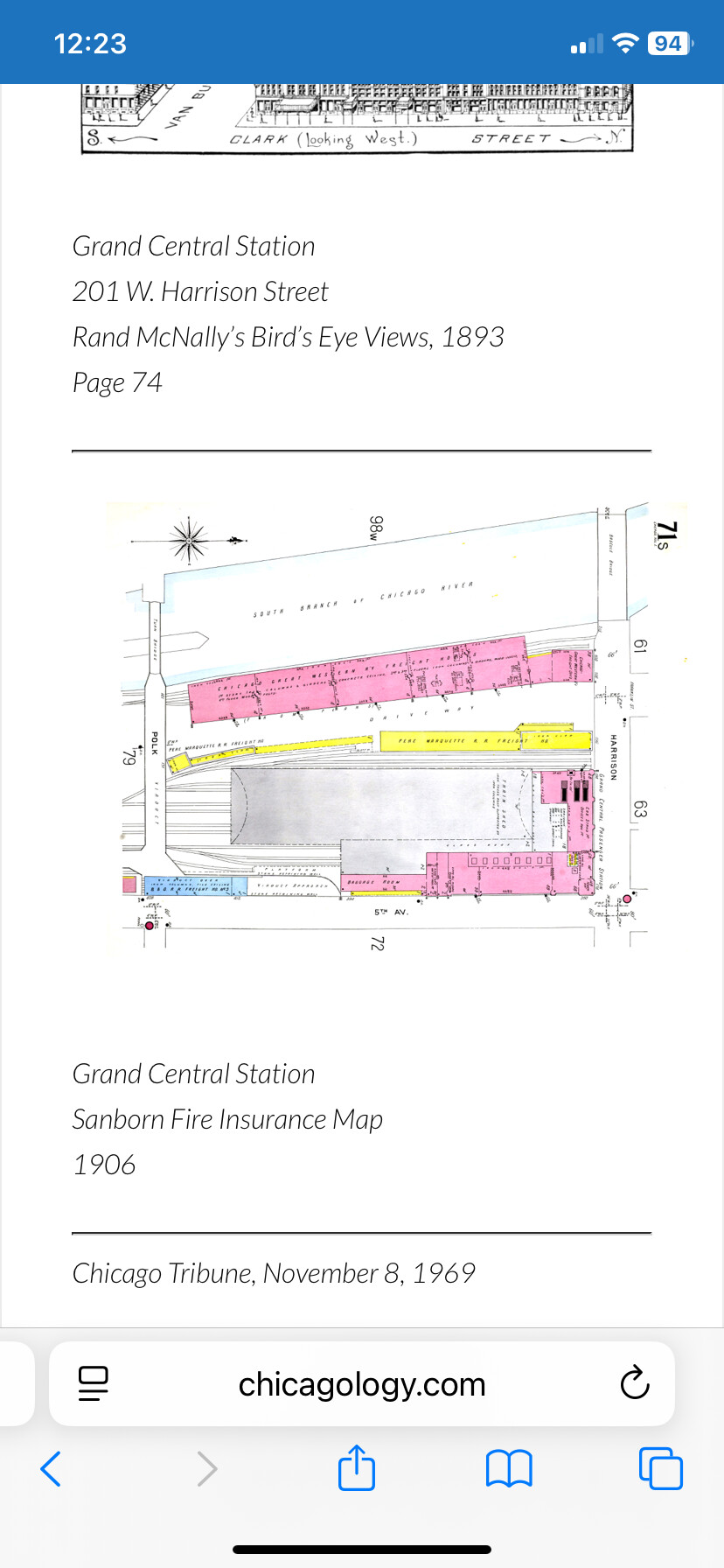
MP104 has mentioned Sanborn Fire Insurance maps which I had never heard of until he mentioned them.
For those of you who are unfamiliar with these maps, I encourage you to check them out. They are highly detailed and exactly replicate individual railroad tracks. A real good resource for this purpose.
Rich
I use the Library of Congress to access many Sanborn maps. Here’s a search for Illinois alone, over 6,000 maps:
The loop track at GCT was on the lower level only. Long distance trains arrived and departed on the upper level. When time permitted, trains with observation cars would be pulled in and the (usually an S-class ‘motor’) locomotive would run around the train and push the last few thousand feet so the observation car was the first thing passengers would see. This wasn’t done for all long distance trains. So when you see photos of the Century or Commodore Vanderbilt at GCT and the observation car is right against the bumping post you know that the switcher has already been cut off.
Cheers, Ed
1 Like
In my comment, I stated that the maps are highly detailed and exactly replicate individual railroad tracks. That is true, at least from what I observe. In my review of the track work at both Grand Central Station and Dearborn Station, the number of the tracks and the position of the tracks match original documents from other sources.
Rich
John Armstrong’s classic “Track Planning for Realistic Operation” had some diagrams of terminal layouts with engine escape tracks, but I can’t find a single one in current practice. Non-bidirectional trains just get a monkey tail and a restricted speed backup move.
1 Like
Hi Rich,BaltACD,
Sorry to come back again with my previous questions related to the correct positioning of the observation cars at the rear end of the various Limited, it is also true for Dearborn Station (Santa Fe, C&EI, Erie, Wabash), but you do not mention anything about it. In any case, these observation cars required some additional operations because they had to be turned somewhere. So where was the location of a close wye shared by all companies? If not, where the wyes of the different users were located?
Philippe
1 Like
Santa Fe had a balloon loop at their Archer Avenue coach yard at Archer and Cermak. All of the other railroads’ trains were serviced at Chicago & Western Indiana’s service area at 51st St about 4 blocks west of State. There is a wye at about 39th St where trains could be turned.
All of the railroads at Dearborn except Santa Fe were part owners of the C&WI, which owned Dearborn.
Considering that Santa Fe didn’t have its own terminal, but was always a tenant at Dearborn Station, it had some of the best service facilities.
1 Like
While rcdrye was replying, I found the following thread that he started some years back with a whole lot of information on this issue.
https://cs.trains.com/ctr/f/3/t/239913.aspx
Rich
Here is a thread on the subject that I started some years back.
https://cs.trains.com/mrr/f/13/t/195135.aspx
Rich
It sure did, and its servicing facilities were the closest to Dearborn Station.
Rich