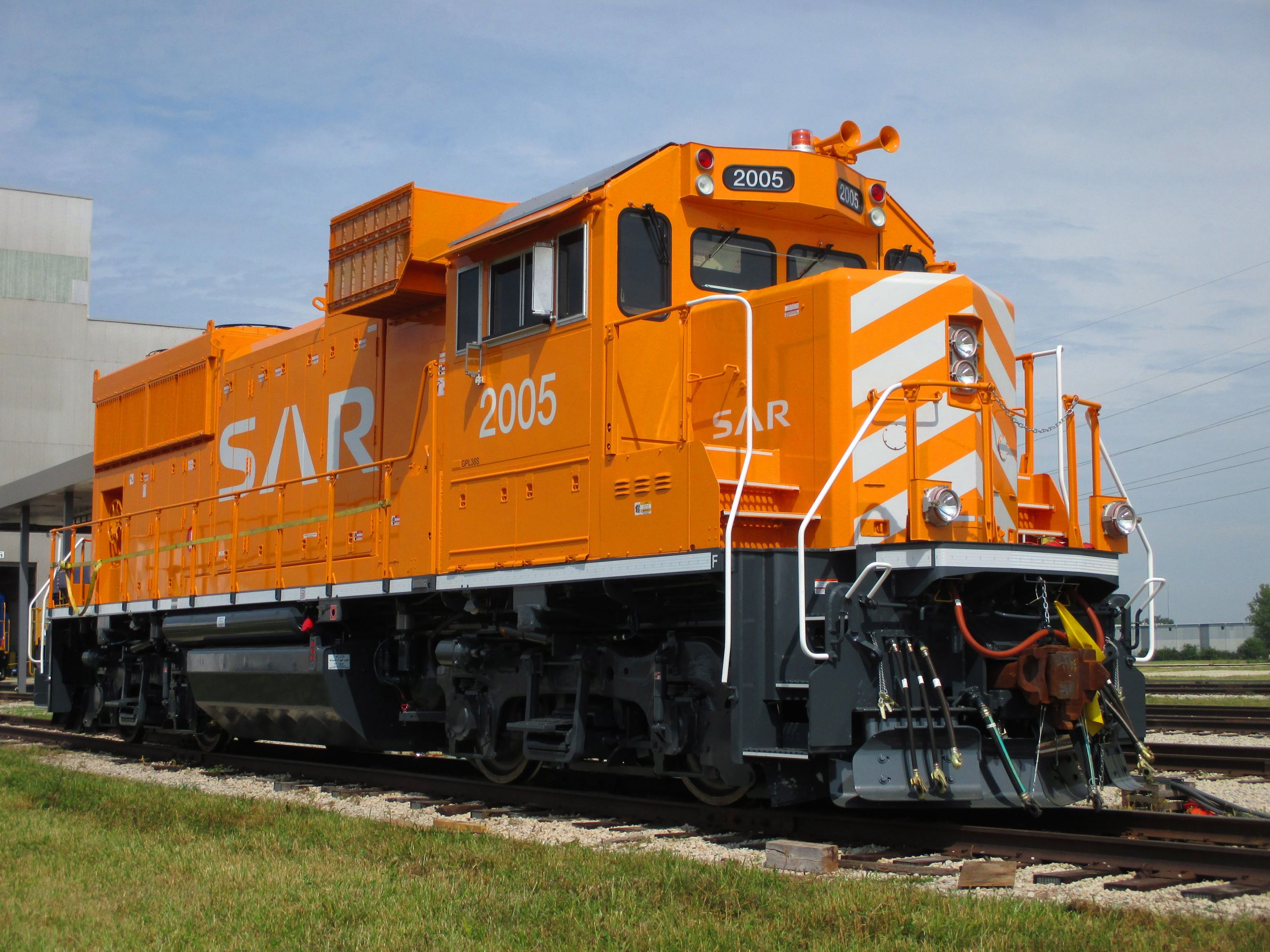
While not (yet?) adapted for North American service. Here’s is the newest iteration of the GP38 designated GPL38S for Saudi Arabian Railways. Here’s a full spec rundown
DC traction mtors in sand ? no thanks.
I agree. The Saudis shouldc have insisted on, and been willing to pay the extra charge for, AC-traction.
Looks alot like Canadian Pacific’s GP20C-ECO locomotives with enhanced intake air filtration.
Well, at least this answers any questions about whether EMD thinks they have worked any concerns out of the 8-cylinder engine configuration.
I have little doubt this design is to give parts and service commonality with other Saudi power, and I spoze the DC power fits in with that. Of course if I were Progress, I’d be actively trying to sell them on DC-to-AC conversion projects…
Wow! Tier 1 compatibility! (Well, it’s better than Tier 0…) somehow, though, if I were going to tout this as a technological tour-de-force I’d have made it a “cleaner” design, especially as we ‘as a nation’ are about to take a much greener turn. On the other hand it should be easy to get to higher tiers if the money and will are there; it would be interesting to see if the augmented filtration has been designed to accommodate the non-SCR Tier 4 equipment that so narrowly missed certification here.
I would be very interested to see the detail design of the traction-motor blower circulation – including the outlets.
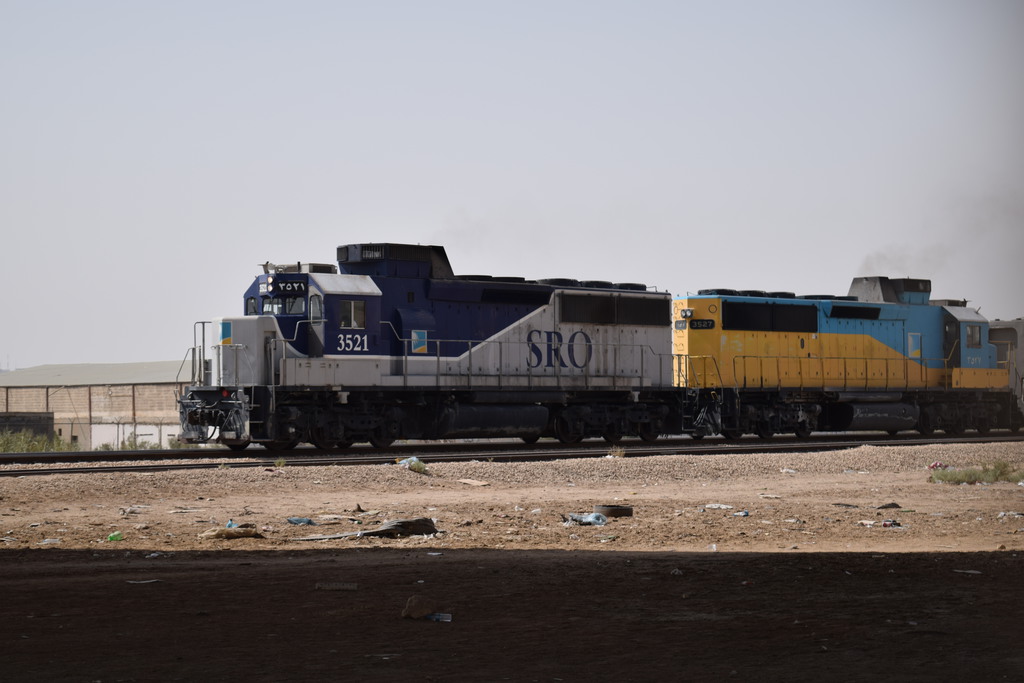
Saudishave been mixing the two since the Fifties - successfully as far as I know
Exactly. Not to mention all the SDL50’s SAR has bought and operated.


The concept of the air filters goes back to the Baldwin exports built for the French Supply Council for service in Algeria and Morocco. Some were equipped with Rotoclone air filters and were assigned to routes that skirted the Sahara.
DC motors and sand don’t sound great, but at least these have movable plows to get most of it off the rails (Little sand never hurt traction!) The GPL38S is probably the best new, modernized road switcher we’ll get for awhile. The GP20C-ECOs have already gotten most of these features, and this engine is EMD’s next step at making a completely new one. They’re using the SD60M and later style cab windows, EM2000 controllers, 710 prime mover, and other modern equipment. I’m liking this new trend and I think EMD has found their sweet spot in how they’ll (re)build locomotives from now on. Though, little, if any, of these new engines will show up in NA until ~20 years from now when the Geeps start getting retired from rosters. I wonder if any other foreign roads might order something?
So, I’m confused, there were plenty of 8-710s in service in GP20-ECOs and similar. Why is there a concern with this prime mover? I would assume, and maybe I’m wrong, That since it’s not an ECO rebuild, that the Engine is the same, but they can’t meet Tier 2 or 3 within the other Desert operations requirements on that platform.
Peter Clark and Don Oltmann, among others, remember a couple of early issues with the 8-cylinder EMDs, as I recall related to the balance masses involved (cracked webs?). This was a different issue from the documented issues with 8-cylinder 251s, and I think sometimes the two get confused. If I recall there was a firing-order change (C/CR, probably depending on rotation) on at least some of the engines that either solved or ameliorated the issues. As noted I’d expect there would be few if any difficulties with sourcing "8-710s’ in place of blower 12-cylinder engines, and you would be one of the authorities I’d look to in assessing if there were any remaining concerns in the proposed environment. {“creepycrank” would be another.)
The problems as recall with the 8 cylinder EMD 710 engines were the camshaft counterweights required to balance it. Some reinforcement of the top deck to overspeed trip housing were made to fix it. I think there were and may still be prohibitions by EMD for 950 rpm operation, at least that’s what I remember.
Dave
Dave this begs me to ask… Santa Fe before their merger with BN purchased SD75M’s. From what I recall a few in the group had their 710’s boosted to 1000 RPM generating 4500THP. Sometime after issues developed and they were dropped back to 950 RPM, producing 4300THP like the rest of the group. Is this the same issue you speak of with the cams?
I do remember that order and problems causing those units to be downrated not long after delivery but I don’t remember the specifics. Running that rpm puts a lot of strain on many of the systems including oil and water pumps and electric cooling fans and blowers that all see the proportional speed increase.
Looking at the Progress Rail list of freight locomotives, it appears that the “38” refers to the export engine designation, 8 for the number of cylinders plus 30 to indicate a 710G engine. (645E plus 10, 645F plus 20, and so on). I note that a GT18MC is still on offer at 1500HP, illustrated by the Malaysian locomotive.
But as well as the GPL 38S, there is an SDL 38, equally deserving of an “S” suffix.
However Progress Rail’s PR machine have mistakenly included a photo of the a generally similar SDL50 (3534), the real SDL38 being illustrated by 4321.
This appears to be an adaptation of the Milwaukee Road SDL39, and will be recognised by the fans of that type…
Peter
Well, if we’re talking a modern twist on the GP38:
https://www.facebook.com/WesternRailInc/photos/a.407127182676398/3571659229556495/?type=3&theater
You’ll excuse me if I wait for the conclusive report on the success of the rebuilt CECX 1919 before I give this GP38cc much attention.
And I say that as an unvarnished fan of Cummins Engine.
CECX 1919 was test bed that completed it purpose as was sold to KLW. That said the QSK95 and QSK50 are different engines. The QSK50 has been used on the repower of MNCR’s BL20 fleet and so far no negative press.
I’m well aware. What I’ve been waiting for is some description of the tests, problems with the tests, even reasons why Cummins did not persist with marketing of the QSK95 in freight service (or redesign it in certain ways to optimize efficiency under mandatory DEF-based SCR). Even a couple of sources would do!
Not by much. It was my understanding there was relatively little difference other than the obvious changes inherent in number of cylinders, such as crank design or number and placement of turbochargers. [EDIT: that is just plain dumb wrong - they are different engine families.] If that’s wrong, please indicate the differences. [EDIT: he does.]
But there is little if any negative press on the (by now, many) QSK95s running in passenger service. There is nothing I can see that would indicate issues with freight service. The engine has obviously been run in service. Where were the issues?
In any case – I find it interesting that the Progress design uses an 8-710 rather than either a 1010 or a C175-based engine. That has some interesting implications if that GP38cc is intended as competition.
From what I understand High Speed Diesels require overhauls around 650K Miles. A Medium Speed Diesel can go about double that. It would also appear power assemblies take less of a beating in a medium speed diesel. A few Santa Fe SD40-2’s were able to get well over a million miles out of their 645 power assemblies.